Inside Brazil's UFO Files: What Declassified Military Documents Reveal About the Varginha Incident
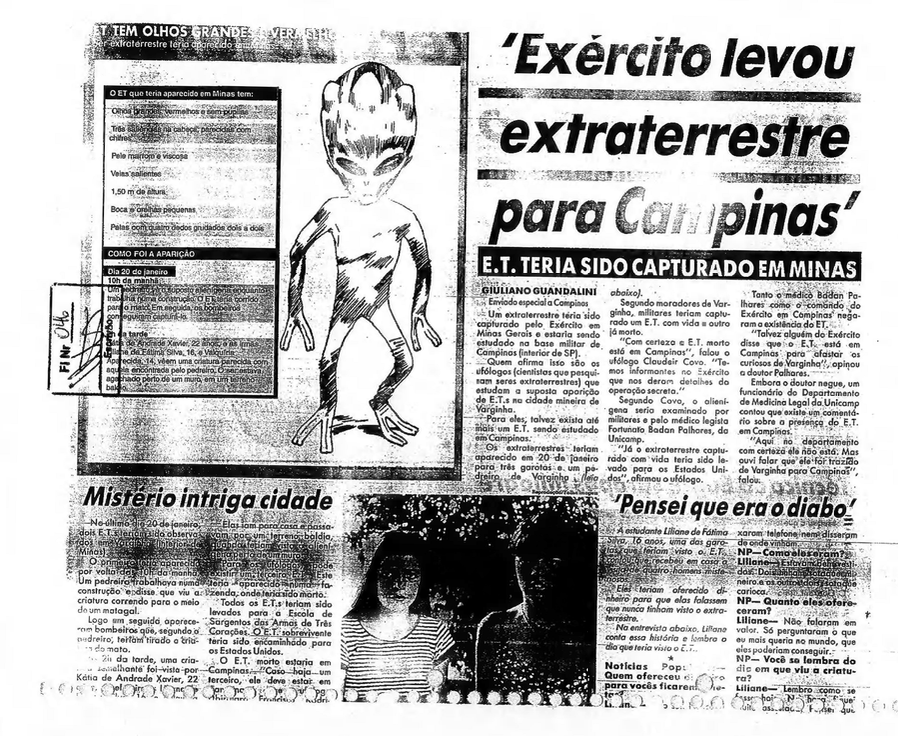
On January 20, 1996, three young women (Liliane, Valquíria, and Kátia) claimed to have encountered a strange creature on a vacant lot in Jardim Andere, a neighbourhood in the small Brazilian city of Varginha, Minas Gerais. What followed became one of the most controversial UFO cases in history: allegations of military capture operations, hospital cover-ups, a soldier's mysterious death, and a formal military inquiry that generated thousands of pages of documentation.
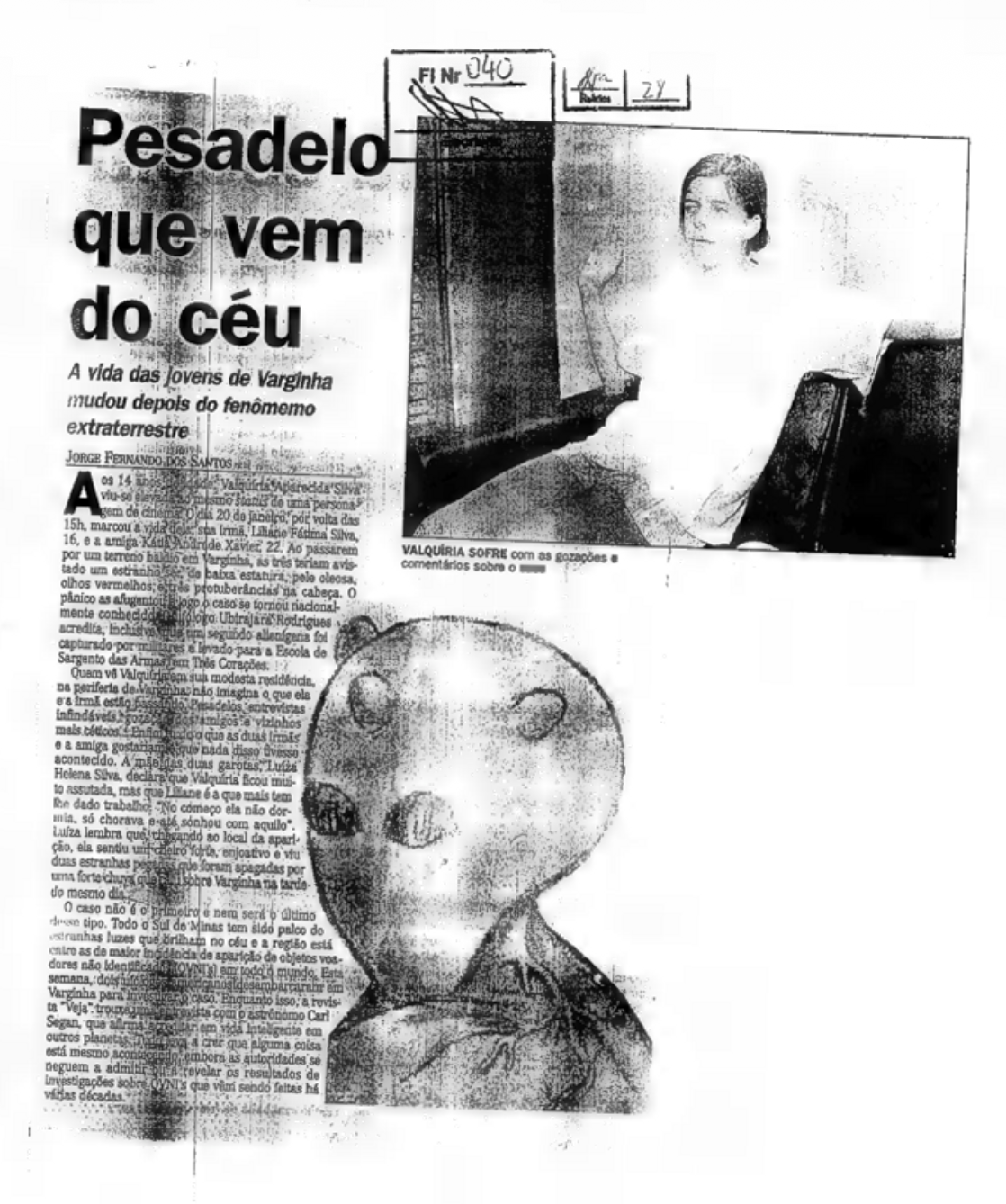
I recently obtained and translated 13 declassified Brazilian military documents, totaling over a million characters of Portuguese text, that were released to Brazil's National Archives. These include the complete Military Police Inquiry (IPM No. 18/97), the Brazilian government's formal response to Congress about UFO documentation, Air Force sighting questionnaires, and a 1971 military intelligence report that places UFO activity over Varginha a full 25 years before the famous incident.
Here's what they contain.
The Documents
The files fall into several categories:
- IPM 01 -The first investigation (sindicância, May 1996), witness testimonies, vehicle logs, expenditure documents
- IPM 02 -Formal depositions from named military personnel with detailed alibis
- IPM 03 -Newspaper clippings, ufologists' website printout, authentication stamps
- IPM 04 -The full ufonline.com website entered as evidence, including chronologies and first-person investigation accounts
- IPM 05 -Pacaccini's book “Incident in Varginha” (first portion)
- IPM 06 -Pacaccini's book (continuation), including bribery, threats, and additional witness accounts
- IPM 07 -Lt. Col. Vanderlei's defense, the Geraldo Bichara 1962 account, medical records
- IPM 08 -Prosecutor's recommendation and judge's ruling
- IPM 09 -Judicial/archival records, final routing to Superior Military Tribunal
- BRANBSBARX003_007 -A 180-page collection of standardized Air Force UFO sighting questionnaires, magazine articles, academic analyses, and civilian correspondence with military commands
- Resposta ao RIC 4470/2009 -The Ministry of Defense's formal response to a Congressional information request about UFO documentation
- CENDOC Envelope 02 (1971) -Military intelligence reports from the 1960s-70s documenting UFO activity
- Listagem 4o Recolhimento -An inventory of the Air Force's 1990s-era “Hotel Traffic” files transferred to the National Archives
All original documents are available as PDFs on this archive. The English translations quoted below were produced from the text of these scans. In February 2025, the source PDFs were reprocessed, recovering substantial content from six of the nine IPM volumes that had been unreadable in the initial text extraction, including complete witness testimonies, investigation reports, and newspaper interviews.
“Hotel Traffic”: Brazil's Code Name for UFOs
One of the first things that jumps out from the documents is that the Brazilian military had an extensive, formalized system for tracking UFO reports. They called it “Tráfego Hotel”: Hotel Traffic.
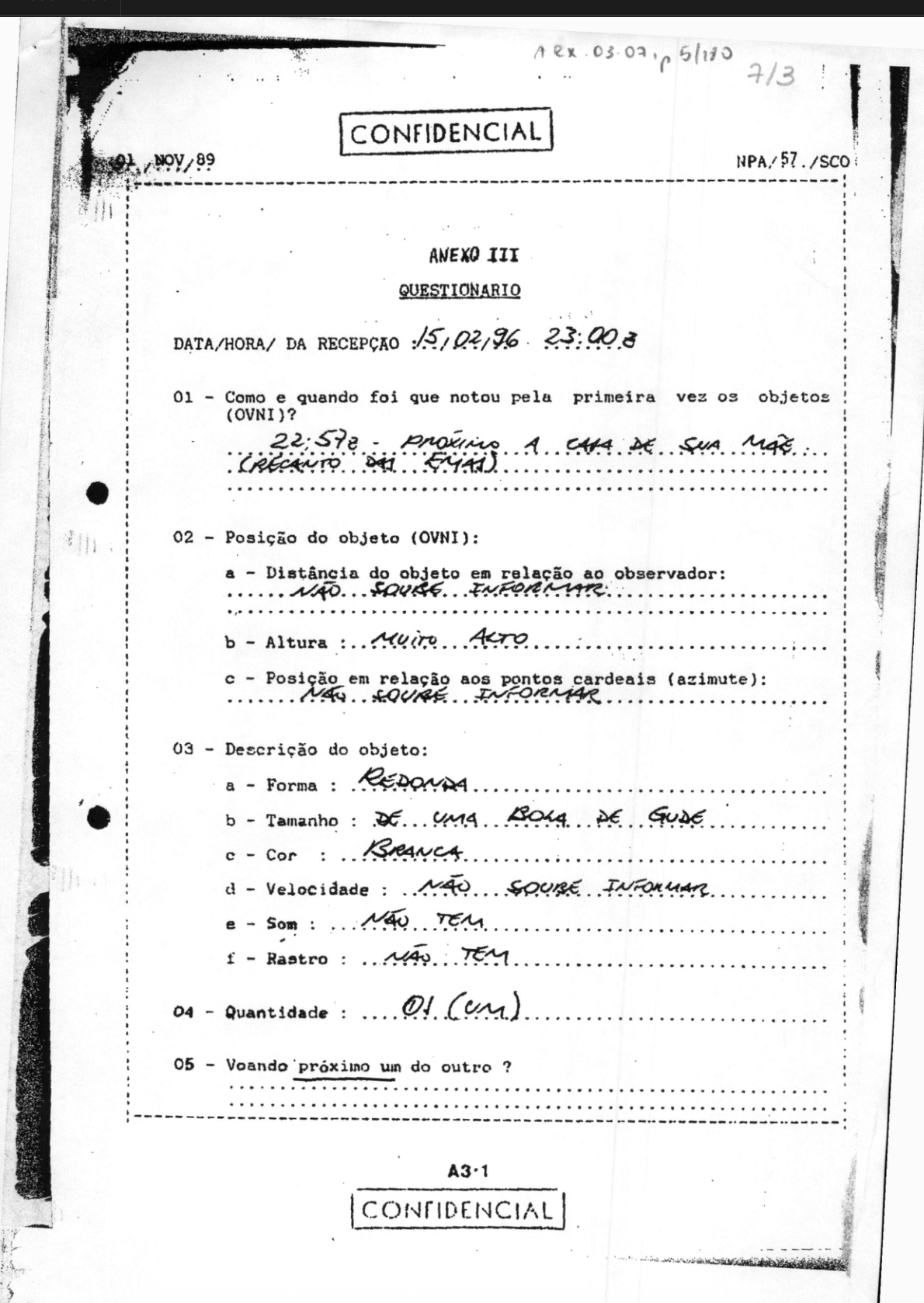
The inventory document (Listagem 4o Recolhimento) catalogs ten groups of envelopes covering 1990-1999, each containing standardized questionnaires, classified correspondence, and analyses. The Air Force used forms designated AD.9-52 and AD.9-53, all stamped CONFIDENTIAL, with a consistent 14-question structure covering the date, time, position, shape, color, speed, sound, trajectory, duration, witnesses, physical evidence, and observer credentials for each sighting.
The inventory alone runs to 68 pages listing hundreds of individual sighting reports, each filed with the names of the observers and the military personnel who received their statements. Typical entries read like this:
“Questionnaire on occurrence of unidentified flying object, of 06 March 1990. Confidential. Currently the document is unclassified. Questionnaire answered by Mr. Araujo Silva Terceiro. Information received by Third Sergeant Doca.”
Report after report, year after year, decade after decade. This was an institutional operation.
As the government's 2010 response to Congress explains, the system dates back decades:
“As early as 1978, in an internal document, the Minister of the Air Force directed the Air Force General Staff to organize a 'UFO Registry' in which observed phenomena would be chronologically archived. He also directed the creation of an 'Evaluation Commission,' which was to assign a degree of reliability to the data presented. Finally, he directed that this Commission be composed of Officers free from preconceived ideas or personal opinions.”
In 1989, responsibility was transferred to what became COMDABRA (the Brazilian Aerospace Defense Command). The documents show a steady stream of formal correspondence between regional air commands (CINDACTA I, II, III), civilian ufology groups, foreign researchers, and even the Brazilian Navy and Presidency.
1971: UFOs Over Varginha, 25 Years Before the Famous Incident
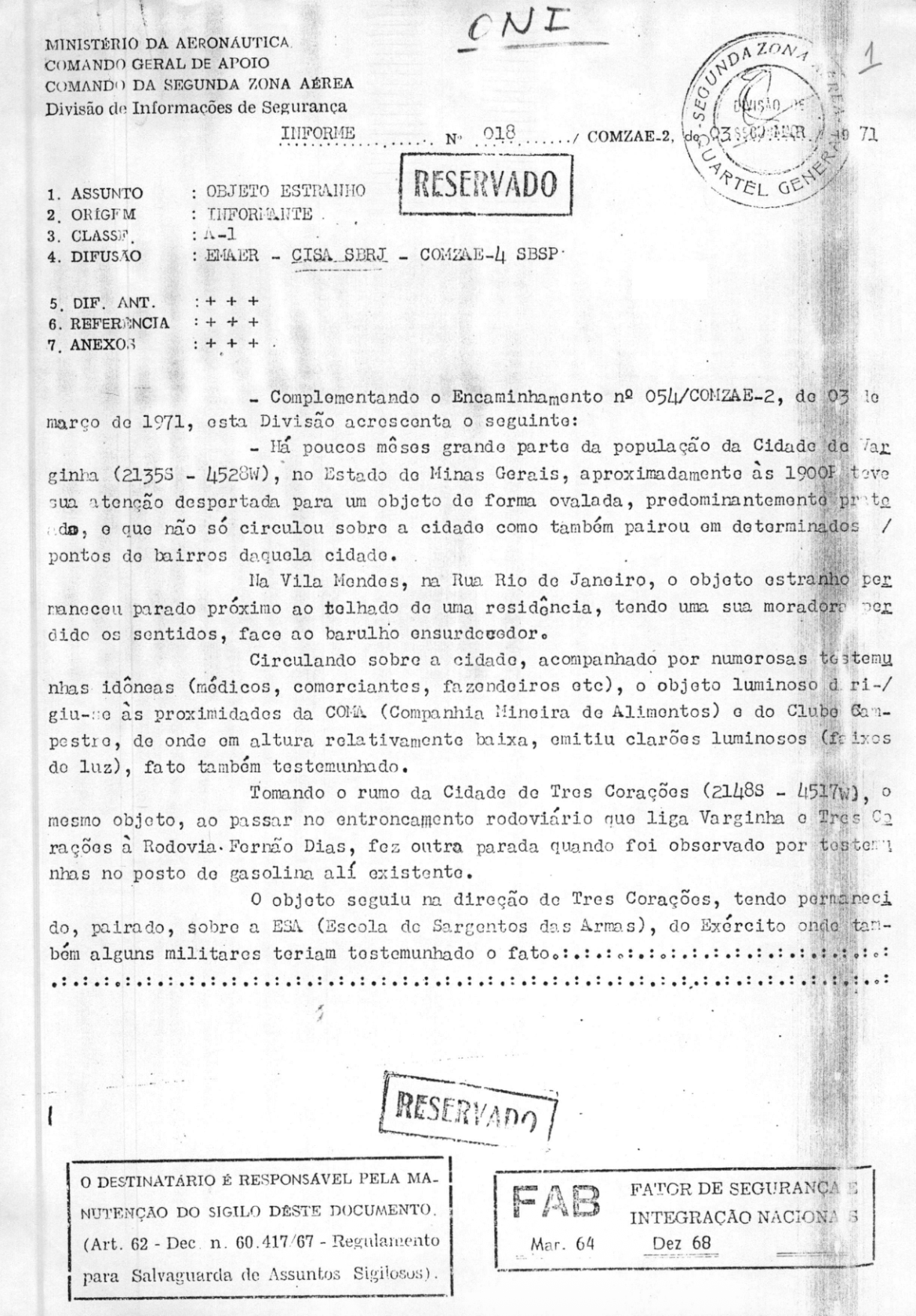
Perhaps the most surprising document is a 1971 military intelligence report from the Ministry of Aeronautics' Security Information Division. Classified CONFIDENTIAL, it describes UFO activity over the exact same locations that would become central to the 1996 case:
“A few months ago, a large part of the population of the City of Varginha (21°35'S – 45°20'W), in the State of Minas Gerais, at approximately 1900 hours, turned their attention to an object of [unclear] shape, dark color, over the neighborhoods of that city.”
“In Vila Mendes, on Rua Rio de Janeiro, the strange object remained stationary near the roof of a residence, one of its occupants having lost consciousness, due to the deafening noise.”
“Circling over the city, accompanied by numerous trustworthy witnesses (doctors, merchants, farmers, etc.), the luminous object headed toward the vicinity of COMA and the Country Club, from where, at a relatively low altitude, it emitted luminous flashes.”
And then the critical detail:
“Taking the direction of the City of Três Corações... the same object... hovering over the ESA (Escola de Sargentos das Armas), of the Army, where some military personnel also reportedly witnessed the event.”
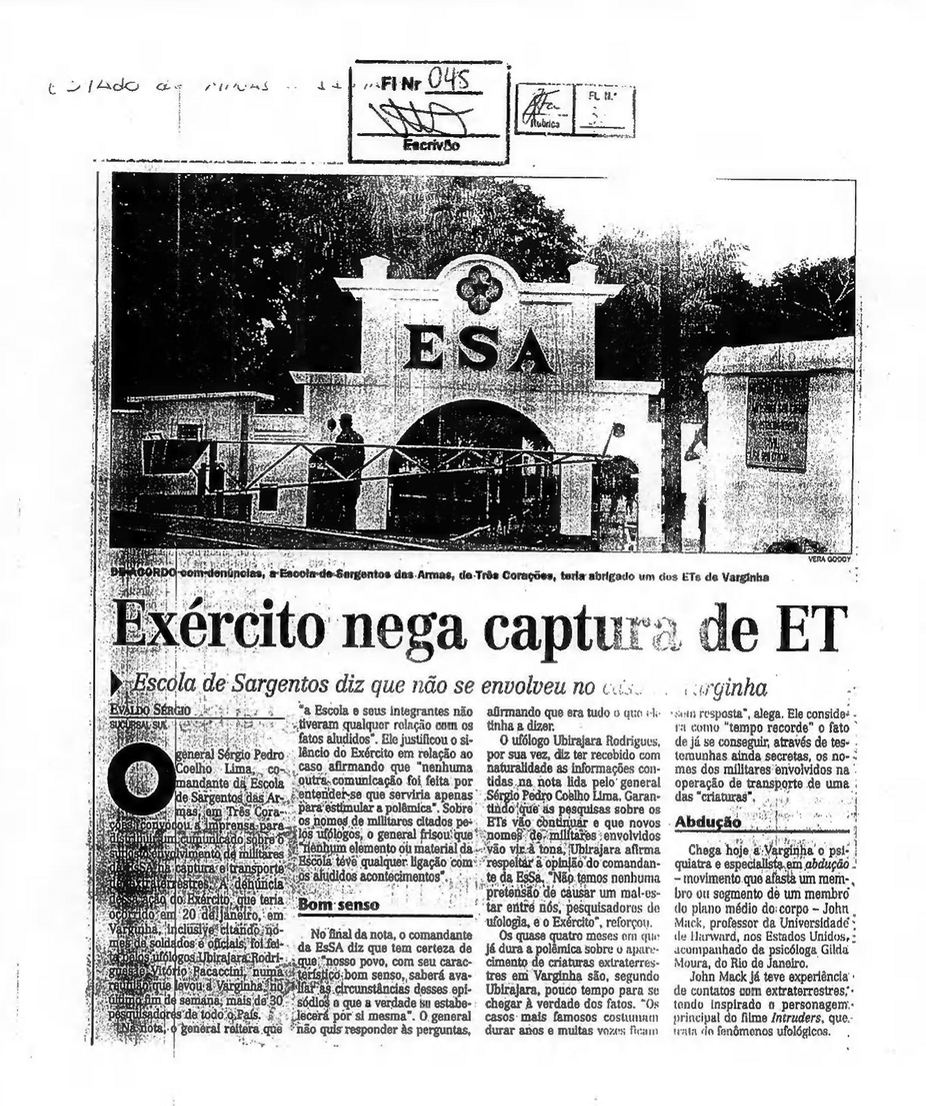
The ESA (the Army Sergeants School in Três Corações) is the same military installation at the center of the 1996 Varginha controversy. The same base whose trucks were allegedly used to transport captured creatures. The same base that launched the Military Police Inquiry.
The same CENDOC envelope also contains a witness testimony from a man named Wilson describing encounters on a farm near the region, including an account of beings arriving in a “large craft” and standing in the farmyard. His housekeeper Dona Geralda told him: “Mr. Wilson — the friends from [unclear] were here waiting. It was a large craft and it illuminated. 'They' — the three of them — opened a door and stood watching.”
The document also references a detailed sighting near Guaratinguetá, where a witness described “a large flying saucer coming from space, beyond the clouds,” about 14 meters in diameter with “a large dome, surrounded by round windows, from which emanated a tinted light.” A pharmacist in Barra de Itapemirim, Espírito Santo, described an object that crashed, initially thought to be a flying disc, it was seized by police. A pharmacist described it as “a large plastic object with light bulbs and tubes, resembling a transmitter of energy.” It was ultimately presumed to be a meteorological balloon from the Navy.
This connection between 1971 Varginha and the 1996 events has received almost no attention in English-language coverage.
1962: The Geraldo Bichara Account at ESA
The 1971 report isn't the only pre-1996 incident at the Army Sergeants School. IPM Volume 07 contains an account from Geraldo Bichara, who describes an encounter in 1962 while serving as a soldier at the ESA:
“He wanted to fire a warning shot, but felt himself completely immobilized. He could only see and hear what was happening. He attempted to shout to call his companion Mauro, the day-duty medic at the veterinary unit, but the shout remained stuck in his throat.”
“He observed the beam of light until then directed upon him move slowly and in silence toward the pharmacy side, causing strong vibration in the fourteen metallic doors of the Engineering sector and on the metallic canoes stored in the boatyard.”
“All the riding horses enclosed in their stalls and even the sick animals needing daily care whinnied in a sudden reaction, kicking, with some enraged ones going so far as to break the chains of the stall at the chest.”
Whether one believes these accounts or not, they establish a pattern: the ESA in Três Corações appears repeatedly across decades of Brazilian UFO reports. The 1996 incident didn't emerge from nowhere.
The Military Police Inquiry: Two Investigations, One Conclusion
The bulk of the documents, IPM Volumes 01 through 09, comprise the formal investigation into the Varginha case. But there were actually two investigations.
The First Investigation (May 1996)
Even before the IPM was opened, the ESA Commander ordered an internal investigation (sindicância) in May 1996, conducted by Colonel René Jairo Fagundes. This investigation, documented in IPM 01, heard testimony from all the named military personnel and produced a clear verdict:
“From the analysis of evidence gathered during this investigation, it is concluded that those cited by the press did not participate in any operation for the transport of [unclear]. It is the opinion of this investigation that the media are mistaken, giving publicity to unfounded claims.”
The investigation was methodical: government expenditure documents for Mercedes-Benz vehicle maintenance totaling R$432.00, commercial invoices from AUTOMACO, and vehicle departure/arrival logs from the Guard Corps were all entered as evidence. The conclusion: the trucks went to Varginha for routine maintenance, nothing more.
The IPM (January-May 1997)
The formal Military Police Inquiry was ordered by Brigadier General Sérgio Pedro Coelho Lima, Commander of the ESA, and conducted by Lieutenant Colonel Lúcio Carlos Finholdt Pereira beginning in January 1997. The trigger was the publication of Pacaccini's book, which the military treated as a potential crime against the Armed Forces.
The Central Question
The book named seven specific military personnel as participants in the alleged capture operation: Lt. Col. Olímpio Wanderlei dos Santos, Maj. Edson Henrique Ramires, Lt. Márcio Luiz Passos Tibério, Sgt. Valdir Cabral Pedrosa, Cpl. Renato Vassalo Fernandes, Pvt. Cirilo Martins, and Pvt. Ricardo Silvério de Melo. The military's task was to determine whether the book's claims constituted a crime against the Armed Forces.
Minute-by-Minute Alibis
The depositions in IPM 02 read like a carefully coordinated timeline exercise. Each witness was asked to account for the movements of the named personnel on January 22-25, 1996, with extraordinary specificity.
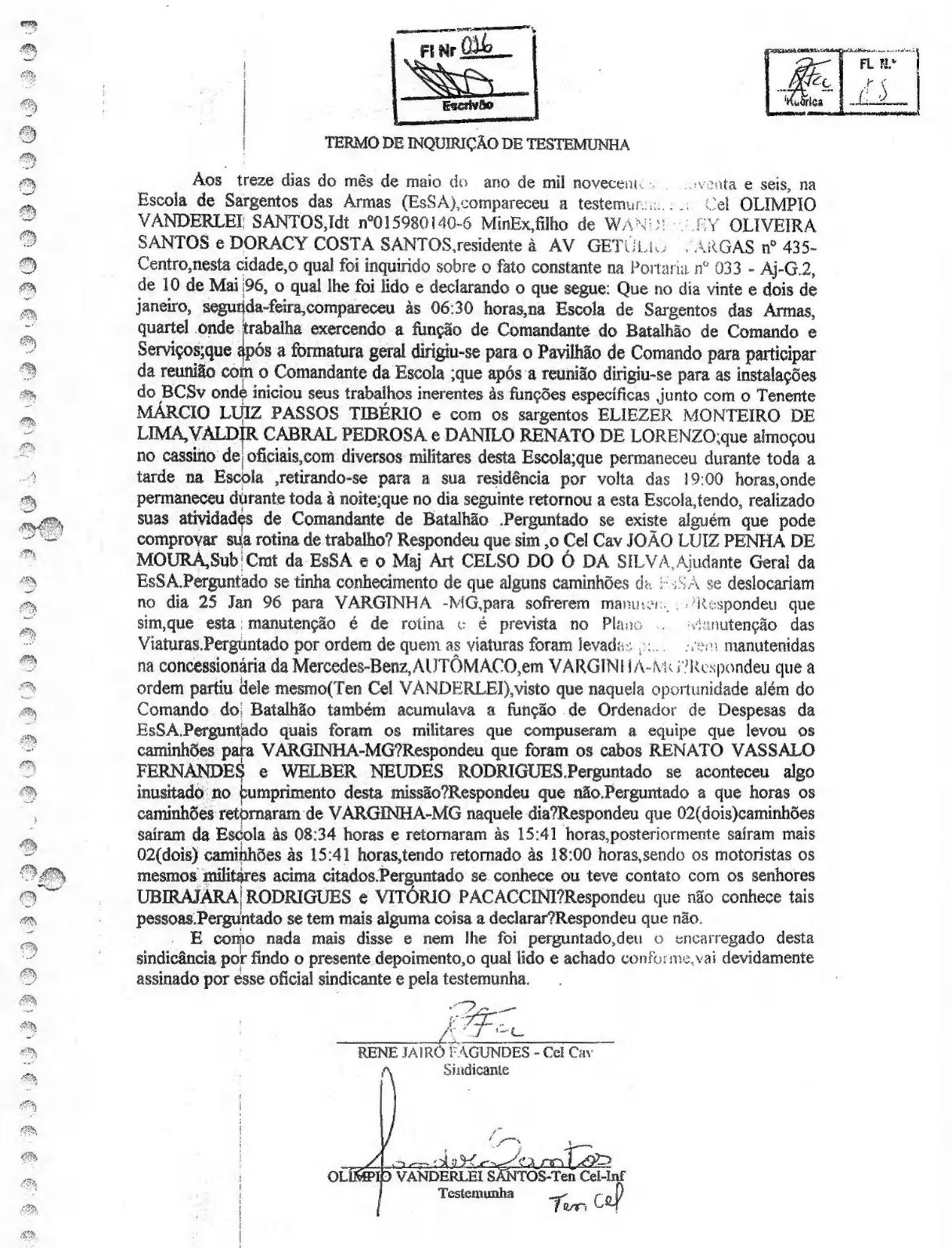
Lt. Col. Olímpio Vanderlei Santos accounted for his entire day:
“After the general formation he went to the Command Pavilion to participate in the meeting with the Commander of the School; that after the meeting he went to the BCSv facilities where he began his work related to his specific duties... that he had lunch at the officers' mess, with several military personnel of this School; that he remained the entire afternoon at the School, leaving for his residence at approximately 19:00 hours.”
Maj. Ramires gave an even more granular account, including a detour to the Chief of the Education Division's office to handle a fuel reimbursement, followed by study sessions for the Army Command and General Staff School entrance examination in his study “between 20:00 and 23:00 hours.”
Lt. Tibério's evening movements were verified through civilian witnesses: he visited the home of Mr. Enio Cupolillo from 19:30 to 22:00, and the next evening visited Mr. Ildovan Augusto from 20:30 to 22:00.
Every named officer has a similarly detailed schedule established by multiple witnesses.
The Truck Maintenance Alibi
The military's consistent narrative was that Army trucks seen in Varginha were on routine maintenance runs, not involved in any extraordinary operation. The specific details are almost suspiciously thorough: the Mercedes-Benz dealership was named (AUTOMACO), invoice numbers were cited (No. 003788), the maintenance was described as mandatory and contractual, and even the breakdown of the alignment machine was documented. (AUTOMACO Comercial e Importadora Ltda. is a real company that can be verified in Brazilian commercial registries — the maintenance alibi, at least, is built on a real business.)
Corporal Vassalo testified about the runs:
“This morning he joined a convoy of 2 trucks together with Cpl WELBER to travel to the city of VARGINHA-MG, where periodic maintenance, balancing, and front wheel alignment were performed at the firm AUTOMACO.”
Private Ricardo confirmed one trip was even cut short: “upon arriving, the vehicles did not undergo maintenance because the machine that would perform the alignment was broken, and they returned immediately.”
Notably, the military insists the trucks went to Varginha only on January 25-26, not on January 22-24, the dates when the alleged creature sightings occurred. However, as the ufologists later documented, a Parmalat employee named Eduardo Bertoldo had a different story.
The Repeated Question
Every single witness, without exception, was asked the same question: “Do you know or have you had contact with Messrs. Ubirajara Rodrigues and Vitório Pacaccini?” Every single one denied it, with variations of “he does not know such persons.”
Except one.
Corporal Kleber's Admission
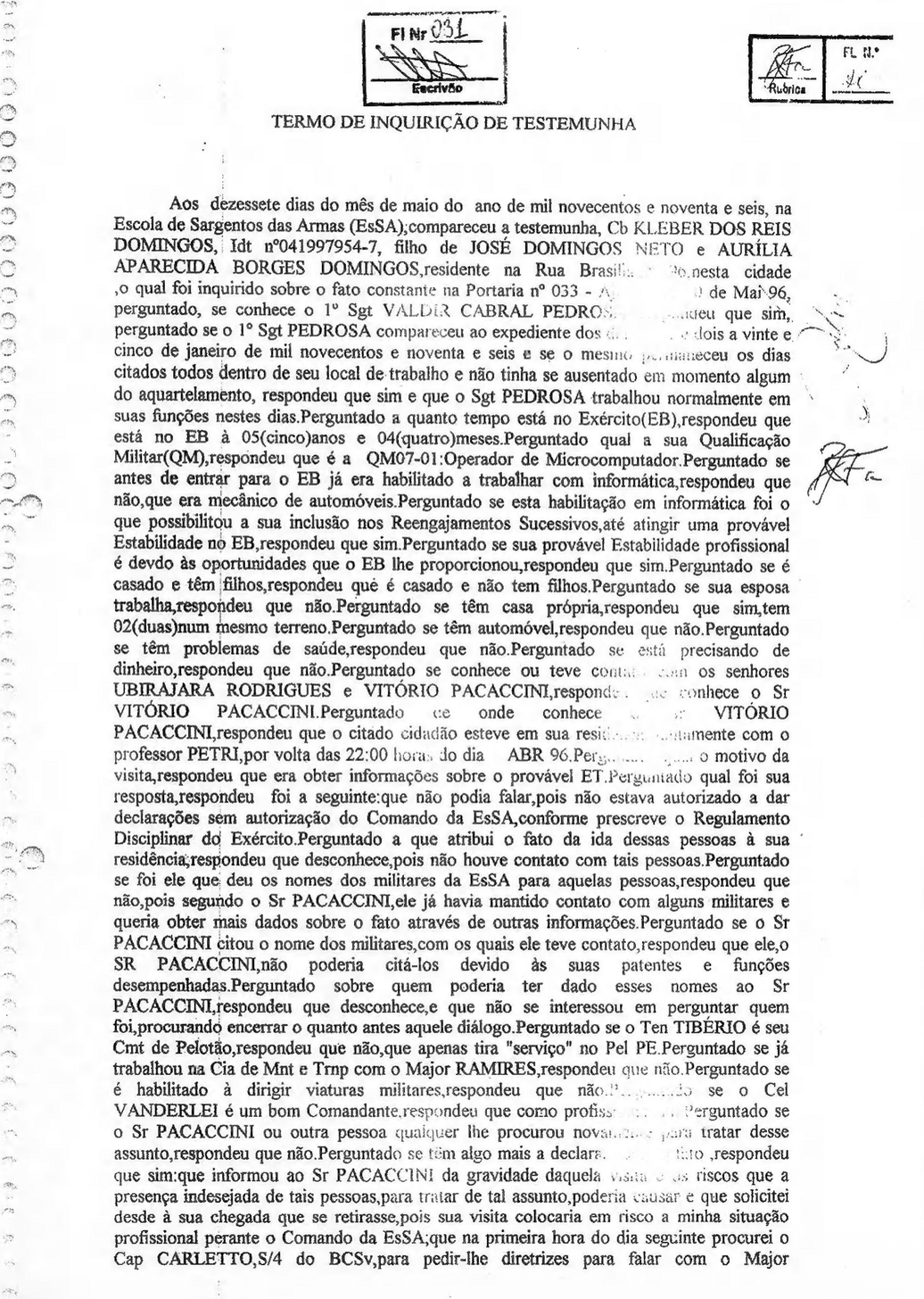
Corporal Kleber dos Reis Domingos gave the most revealing testimony in the entire inquiry. After the standard questions about alibis, he admitted:
“Asked whether he knows or has had contact with Messrs. UBIRAJARA RODRIGUES and VITÓRIO PACACCINI, he answered that he knows Mr. VITÓRIO PACACCINI. Asked from where he knows Mr. VITÓRIO PACACCINI, he answered that said citizen came to his residence together with Professor PETRI, at approximately 22:00 hours on [a day in] April 96. Asked about the reason for the visit, he answered that it was to obtain information about the alleged ET.”
Kleber says he immediately reported the contact up the chain of command:
“He informed Mr. PACACCINI of the seriousness of that situation and the risks that the unwanted presence of such persons, to discuss such a matter, could cause; that he requested from the moment of their arrival that they withdraw, as their visit would put at risk his professional situation before the EsSA Command.”
The inquiry then subjected Kleber to an unusual set of personal questions: his military qualifications, his marriage, whether his wife works, whether he owns a house, whether he owns a car, whether he has health problems, whether he needs money. Questions asked of no other witness. The implication seems clear: they were probing whether he might have been motivated to sell information.
Lt. Col. Vanderlei's Defense: “Disgruntled Subordinates”
The most dramatic testimony comes from Lt. Col. Olímpio Vanderlei Santos, the officer most prominently named by the ufologists as the commander of the capture operation. His deposition in IPM 07 is defensive and pointed:
“Such information being entirely untruthful, even demonstrating total irresponsibility and lack of character on the part of those responsible for this publication.”
His explanation for why he was named is striking: he suggests it was revenge by disgruntled soldiers he'd disciplined:
“Due to having commanded the Command and Services Battalion of the School for three years, probably in the fulfillment of his duties in command, he was obliged to make decisions that may have displeased some military personnel, and he believes that, unfortunately, this story was created by some professional from the ESA with the intent of taking revenge.”
He compared the ufologists' claims to Hollywood:
“The comment is fanciful and quite similar to a scene from the film 'E.T.' by Steven Spielberg, in which the doctors used a tunnel made of plastic material to travel to where the 'being' had been placed.”
He also confirmed that the publicity caused real personal consequences:
“On a personal level the repercussions caused by the matter caused a series of difficulties in his family life, resulting even in health problems, mainly for his wife, who remains in treatment to the present date.”
The “Mudinho” Explanation
In IPM 02, Lt. Col. Maurício Antônio Santos of the 24th Military Police Battalion offered what became one of the official alternative explanations: the girls may have seen a local mentally disabled man nicknamed “Mudinho” (roughly “the little mute one”), who was sometimes seen in the area.
The man has since been identified as Luiz Antônio de Paula, a 23-year-old Varginha resident with severe intellectual disabilities and physical deformities who was nonverbal and known to wander the neighborhood and squat to examine small objects on the ground. The IPM concluded he was the “creature” the girls encountered: “The more probable hypothesis is that this citizen, probably dirty due to the rains and crouching next to a wall, was mistaken by three terrified girls for a 'space creature.'”
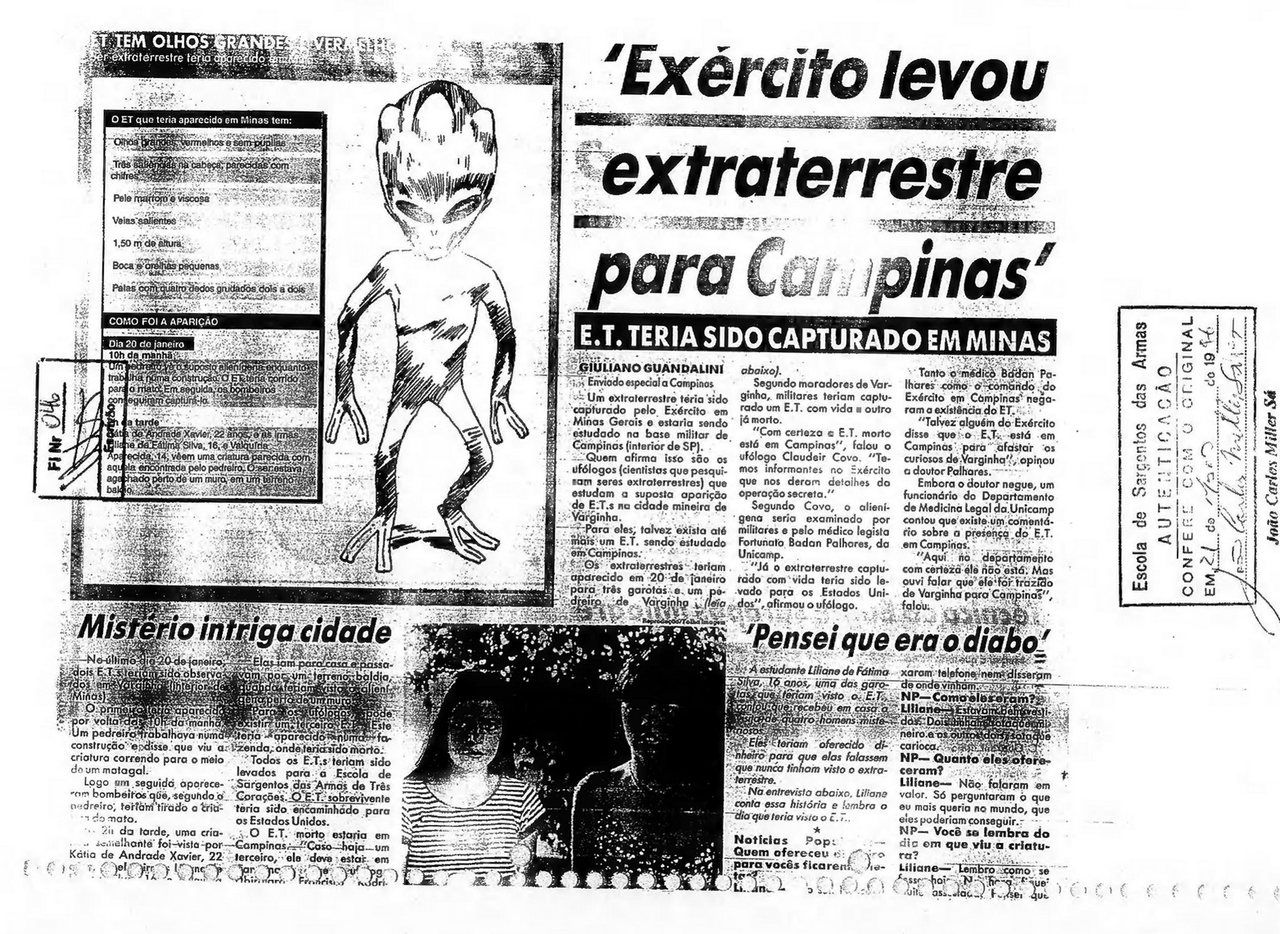
The three girls (Liliane, Valquíria, and Kátia) have consistently rejected this explanation for nearly 30 years. They reiterated their original account in filmmaker James Fox's 2022 documentary Moment of Contact and have never wavered publicly. However, one of their own investigators would later complicate this picture (see “Thirty Years Later” below).
The Ufologists' Investigation: Entered as Military Evidence
Perhaps the most extraordinary aspect of the IPM is that it entered the ufologists' entire investigation as evidence, including their book, their website, and detailed first-person accounts. This means that Pacaccini and Rodrigues' investigation, conducted at personal risk over months of clandestine meetings with military informants, is now preserved in official military archives.
The Website as Evidence
The military literally printed out the ufologists' website (ufonline.com, captured in January 1997) and entered it as evidence in IPM 04. The site was run by five organizations including the Brazilian Center for Flying Saucer Research (CBPDV) and CICOANI (Civil Investigation Center for Unidentified Aerial Objects). It opens with a remarkable warning:
“FOR SECURITY REASONS DO NOT SEND ANY VITAL INFORMATION BY E-MAIL. PROVIDE A TELEPHONE NUMBER SO THAT WE CAN CONTACT YOU.”
Rodrigues' Account: The Nurse, the Hospital Director, and the Cover-Up
The website contains Ubirajara Rodrigues' first-person account of the early investigation. After the girls' sighting, he tracked down a nurse at the Regional Hospital:
“She was very reluctant to receive me and speak with me until, finally, she accepted an interview and revealed that, on Sunday, January 21, a strange commotion had occurred at the Regional Hospital. The event involved doctors from outside Varginha, Military Police, and Army vehicles.”
The nurse described being called to a meeting where the hospital director issued explicit instructions:
“According to this witness, the meeting culminated with the following statement from the director: 'Here in Varginha there are some people who really like to get involved with cool things, you know, supernatural, strange things... It is likely that these people will look for you, especially that lawyer, Ubirajara. To these people, you must deny everything. Deny it completely.'”
When Rodrigues investigated at the Humanitas Hospital, a nurse there gave an even more chilling response to two young women who came asking about the creature:
”'You cannot enter here to see that, and even if you could, I would advise against it... you would not want to see it.'”
The Fire Department Denial
Rodrigues' account of confronting the fire department is telling. Captain Alvarenga, when visited, immediately and defensively grabbed the occurrence report to show there was no call about a strange animal. While Rodrigues went to get water, he overheard firefighters loudly mocking the claims:
”'Yeah, it must be a giant toad,' said one. 'No, it must be a devil, hahaha,' added the other.”
Both the Fire Department and the Regional Hospital then sent unsolicited faxes to local television denying involvement, an unprompted response that the ufologists found more suspicious than reassuring.
A later investigation found that fire department logs from January 1996 contained gaps, with missing entries for the relevant dates. Whether this reflects routine record-keeping or something more deliberate remains unclear, but it adds another layer to the department's insistence that no calls were received.
IPM 07 also contains the full IPM testimony of the Fire Department Commander himself. Major José Francisco Maciel Dias Ferreira, 37, Commander of the 13th Special Fire Company based in Varginha, was the specific individual the ufologists named as leading the morning capture operation on January 20. Under oath on March 14, 1997, he mounted a systematic defense.
He stated he was off-duty at his residence on January 20, though in an on-call status. In his absence, command would have fallen to Captain Alvarenga, who resided in the barracks. He argued that as company commander he would have been “one of the last to be activated, after all standard procedures had already been taken.”
He then dismantled the capture narrative point by point: by regulations, all emergency responses require prior confirmation of the call, meaning “the claim that an anonymous phone call would have triggered a Fire Department operation is completely unfounded.” Fire department vehicles are prohibited from transporting “any animal or things that are not part of the normal use of the vehicle.” If such a creature existed, the response would have involved “a series of precautions and procedures” classified as “highly complex,” not the ad hoc capture described in the book.
His most interesting argument was about what was missing from the ufologists' account:
“Another relevant factor for believing the authors' claims to be false was the absence of description of the crowds of onlookers that normally form around Fire Department vehicles, a fact that is common during the course of any typical fire department occurrence... The authors, therefore, if they wanted to truly report the truth, would necessarily have to mention the crowd that would have formed around the location.”
He also noted that press organizations are always quickly notified during operations and that a two-hour capture would inevitably attract media coverage. He cited the fire company's daily occurrence log, which has “a numerical sequence impossible to alter,” as proof that no animal capture was recorded.
On a personal note, he described the lasting damage: constant approaches from “people, press organizations, curious individuals, scholars, and pests,” and conversations that always ended with people saying “tell the truth” — “leading him to understand that these people believe he is lying.”
Pacaccini's Clandestine Meetings
In IPM 05, Pacaccini describes meeting military informants in conditions that read like a spy novel. His first key witness came through a coded message: “The jaguar is going to drink water,” meaning an important witness was about to talk. Another military informant arrived at his home at 3 AM with his wife.
His informant described the ESA's intelligence service, and the description aligns with how S-2 (intelligence) sections actually function in Brazilian Army units:
“These S-2, as they are called, blend into the crowd, wear mustaches, long hair, drive old cars, and behave like civilians... Inside, there is a shed where the S-2 work, surrounded by enormous security, and even the barracks officers do not have access to the location.”
The capture was strategically timed, according to this source, because it happened on a weekend when the ESA was “practically empty, with only guards,” and the intelligence operatives “could enter and exit at any time, without answering to anyone.”
The Parmalat Employee
Eduardo Bertoldo, an employee at a Parmalat factory located on the road between Três Corações and Varginha, provided testimony in IPM 05 that contradicted the military's version of truck movements:
“He told us that, in the month of January, together with another work colleague, they had seen on several occasions an unusual transit of ESA trucks in a constant coming and going in and out of Varginha... during practically an entire week!”
What drew Bertoldo's attention was “the reasonably accelerated pace with which the trucks traveled, having, notably, soldiers armed with rifles in their covered flatbeds, quite typical for troop transport.” He noted that routine truck traffic to Varginha was occasional and slow, not convoys with armed soldiers running all week.
The May 4th Meeting and the Secret Recording
IPM 06 contains Pacaccini's account of the dramatic ufologists' meeting on May 4, 1996, where the military personnel's names were first made public. The scene is vivid.
The auditorium was packed: CNT TV from Paraná, SBT and Globo affiliates, reporters from Estado de Minas and Hoje em Dia, the Correio do Sul, Radio Vanguarda, FM stations from across southern Minas Gerais, and a crowd of ufologists. Pacaccini and Rodrigues began narrating their findings in slow detail.
In the middle of the presentation, Pacaccini's assistant Angélica appeared in the auditorium signaling that someone was on the phone. It was the military informant he had been trying to get on the record for weeks, a soldier who knew about the removal of the creature from Hospital Humanitas. The soldier was at the Três Corações junction and had decided to record his testimony.
Pacaccini slipped out of the auditorium, asking Marco Antonio Petit to help him. He couldn't take Rodrigues (who had the floor) or Claudeir Covo (who was reviewing a manifesto for the meeting's close). Luis Petry noticed them leaving and asked what was happening. Pacaccini lied, “minimizing his curiosity,” because the military man “did not want anyone from the press, trusting only me.”
They picked up the soldier at the Varginha bus station and drove to the empty house where Rodrigues' father lived. In the backyard, next to a wall, they set up a tripod and camera:
“I sat beside the military man, stated my name, his, the time and day. From there, and for thirty minutes, live and in color, we witnessed one of the most incredible narratives known in Brazilian Ufology.”
When the recording was finished, they returned the soldier to the bus station. He mentioned another colleague at the ESA who was also willing to talk but “would just muster courage.” Pacaccini returned to the meeting and resumed his presentation as if nothing had happened.
Then came the moment. He named the military personnel involved in the capture operations: Major Maciel of the Fire Department for the morning capture; Lieutenant-Colonel Olímpio Vanderlei for the Humanitas removal; Captain Ramirez, Lieutenant Tibério, Sergeant Pedrosa in support; Corporal Vassalo, soldiers De Mello and Cirilo as convoy drivers. The auditorium fell silent:
“I confess, that silence in the auditorium was unforgettable, observing that many of those present were surprised at my courage in citing the names of the military and, at the same time, tense and fearful in the expectation that at any moment the Army would come to invade the venue.”
The Soldier Who Tried to Sell Photographs
Sixteen days after the captures, visual evidence almost surfaced. IPM 05 contains an account of a young soldier, approximately 20 years old, who contacted the local SBT television editor by telephone on March 5, 1996, announcing he possessed six photographs and a recorded film of the creature. He wanted R$30,000.
The reporter requested three hours to get authorization from a company director. When the soldier called back, he had already dropped his price to R$10,000. They arranged to meet that night in a square away from the city center.
The soldier arrived “very nervous,” explaining he was a relative of the original contact. Both worked in areas of the ESA where they had the opportunity to film and photograph the creature. But his relative's mother had discovered the plan and was “extremely nervous and afraid, not only of the repercussions but much more because of what would result from that attitude, since her husband was also a soldier.”
He described the creature in detail to the reporter: oily skin, large veins, wide-open eyes, two nostrils without a nose, a very thin mouth. It was inside an enclosed space and “tied to what appeared to be a table, but he wasn't certain because it was covered with a cloth.” The impression was so powerful that he “could not sleep for three nights.”
A second meeting was scheduled for the following day at noon. The soldier was “more agitated than before,” looking over his shoulder constantly, “betraying a fear of being followed stamped in his eyes.” He delivered the bad news: on the night of the first meeting, ESA soldiers had gone to his relative's house, “forcing him to hand over the material.” The relative was then taken detained to the school. His own father, also a soldier, had informed the ESA command.
The photographs and film were confiscated. The soldier vanished. Pacaccini's frustration with the SBT reporter who let the opportunity slip was withering:
“Having had two meetings with the young soldier, [he] demonstrated to all of us that he did not have the slightest intuition for, at a moment like this, and with the unique possibility of negotiation to get his hands on a document of worldwide repercussion... he let himself remain like a puppet of doubt, in the 'loves-me, loves-me-not,' peeling away his own mediocrity.”
Whether the photographs actually existed is unknowable. But the account, if true, suggests visual documentation of the creature was produced inside the ESA and that the military moved swiftly to confiscate it when a soldier tried to sell it to the press.
The Stanton Friedman Connection
The international attention is documented in IPM 05. At the 14th Congress of Ufology in Curitiba, Pacaccini gave a private two-hour presentation in English to Stanton Friedman (the Canadian-American nuclear physicist), Graham Birdsall (editor of UFO Magazine UK), and John Carpenter (a UFO researcher). They “listened attentively and took notes on many details... they turned on their cameras fixed on tripods.”
The personal costs of cooperation with the ufologists were not abstract. IPM 04 preserves Pacaccini's description of a military informant's wife “who desperately implored that her husband give up the idea of giving us any details, because from that point on their lives would be ruined.”
Later, Dr. John Mack, the Harvard psychiatrist and Pulitzer Prize winner, traveled to Varginha with psychologist Dr. Gilda Moura to conduct interviews directly with witnesses. Pacaccini served as interpreter. Mack was already a controversial figure. Harvard Medical School had investigated whether his research into alien abduction experiences met accepted scientific standards, ultimately clearing him after a year of closed-door hearings (1994-1995). According to multiple accounts, he was so impressed by the Varginha witnesses that he reportedly stated he would “resign his academic achievements if these girls were ever proven to be lying.” His biography by Ralph Blumenthal includes a chapter titled “Aliens in Brazil.”
Friedman later characterized the Varginha case as a “cosmic Watergate”, a phrase he also applied to the broader UFO cover-up. Both men are now dead: Mack was struck and killed by a drunk driver in London in September 2004, at age 74, while attending a T.E. Lawrence Society conference. Friedman died of a heart attack at Toronto airport in May 2019, at age 84, returning from a speaking engagement.
The Doctor Who Refused: “This Is Not of This World”
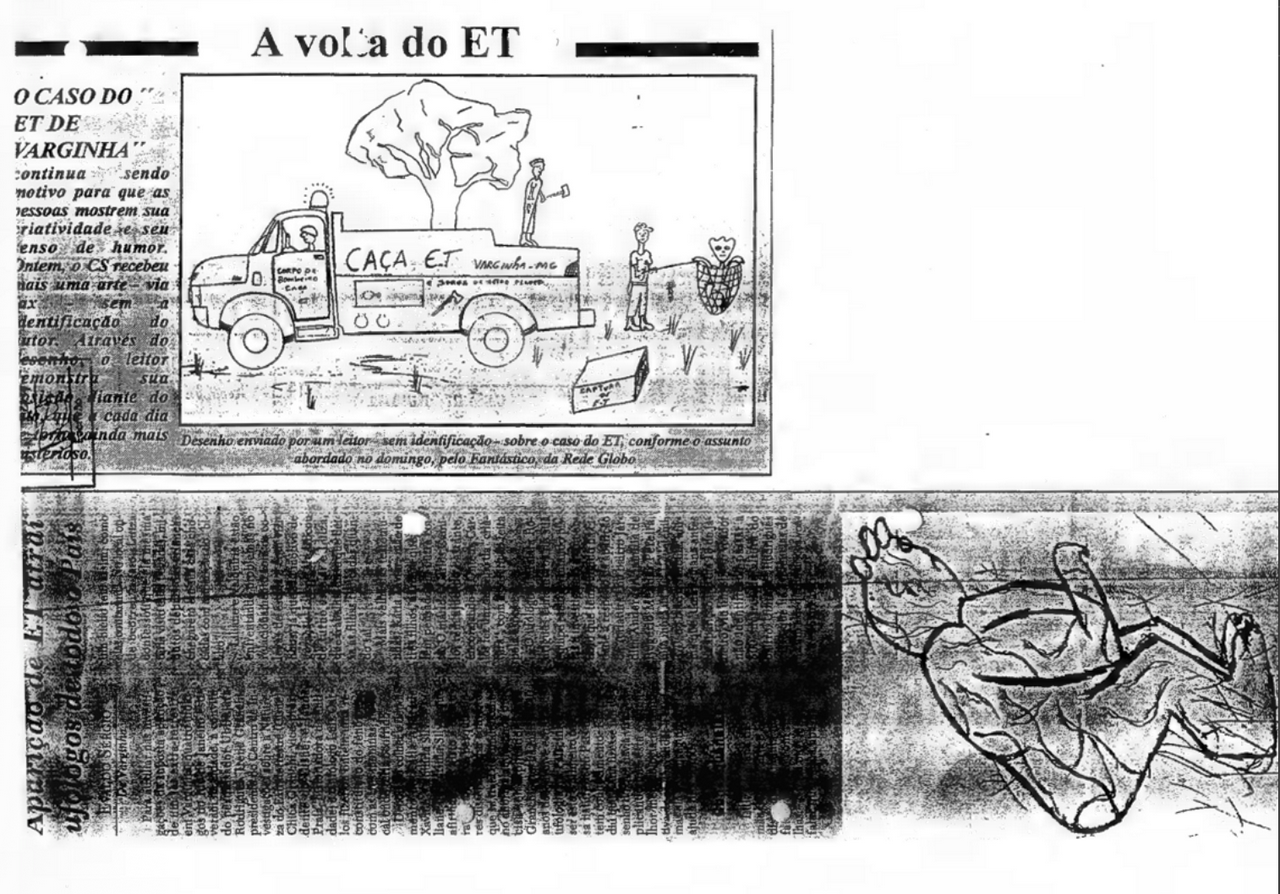
One of the most vivid accounts from IPM 06 describes what allegedly happened after the second creature was captured on the evening of January 20 by Military Police officers in civilian clothes:
”'Doctor, we have this thing in here and you could help us with what to do with it.' He looked at the creature and stepped back, annoyed to learn what it was about, alleging he did not want his name linked to 'that,' because he had a reputation to uphold.”
”'I don't know! I don't know and I don't want to know what to do with this thing. Take it to the Regional, that's the safest bet! I don't want to get involved with this thing, no way, because this is not of this world!'”
This account came through a judicial authority who told the researchers that a Military Police officer had disclosed the story at a barbecue among friends.
The Doctor Who Came Forward: 30 Years Later
The doctor who refused is unnamed in the documents. But in January 2026, nearly thirty years after the incident, a different doctor broke his silence publicly.
Dr. Italo Venturelli, a neurosurgeon who served as Director of Finance for the Department of Neurology and Neurosurgery at the Regional Hospital, Hospital Bom Pastor, and Hospital Humanitas, testified on camera and at the National Press Club in Washington that he was called to a bedside at the Regional Hospital on the evening of January 20, 1996. He claims he observed a non-human being whose cranium had been sutured by his colleague Dr. Marcos Vinico Neves.
He described a being resembling a seven-year-old child with a teardrop-shaped cranium, large lilac eyes, white skin, three fingers with an opposing thumb, no nipples, and a small mouth. He said he experienced a feeling of “peace” emanating from the being and described what he interpreted as telepathic communication.
Venturelli says a near-fatal heart attack prompted his decision to come forward, not wanting to take his account to the grave. His testimony is notable because it is the first from a named, credentialed medical professional, not an anonymous nurse or secondhand account. Both hospitals he names (Regional and Humanitas) are the same ones described in the IPM documents and remain operational today.
His account has not been independently corroborated by other named medical staff.
The Hospital's Story Falls Apart
The Regional Hospital's denials were challenged on camera. In the second half of May 1996, São Paulo television producer Goulart de Andrade, host of Comando da Madrugada on TV Manchete, traveled to Varginha with his crew to film a documentary. At the Regional Hospital, he interviewed the administrator, Adilson Usier, who denied any involvement of doctors or staff with the creature. Usier then produced a document claiming that all the commotion on the night of January 20 was explained by a simple event: the Fire Department had brought in the body of a prisoner who had committed suicide at the Varginha jail.
IPM 06 records what happened next. Pacaccini and Rodrigues had anticipated this and obtained a copy of the forensic report through a lawyer friend. When Usier finished his explanation, Goulart reached into his pocket:
”'Look, Adilson, I'm very sorry, but either you were completely mistaken or there is another reason, because I have here in my hands the forensic report and that person died on January 30th!'”
The prisoner had died ten days after the date Usier claimed. And the contradiction didn't stop there: Captain Alvarenga of the Fire Department had already stated on the record that the Fire Department had not brought any deceased person to the Regional Hospital on that date. Usier's alibi collapsed from two directions simultaneously, on camera.
The documentary aired on Saturday, June 1, 1996, running two hours and fifteen minutes, time Pacaccini described as “never before used on television dedicated to a single subject of ufological nature.” It was rebroadcast the following week.
Goulart also visited Unicamp, where Dr. Badan Palhares denied any involvement but offered the TV crew a tour of the refrigerated body drawers at the Amarais cemetery morgue. Pacaccini noted the obvious: the creatures had allegedly arrived at Unicamp in January. The documentary was filming in late May. “No creature would still be there, in the refrigerator, waiting for the Comando da Madrugada program to arrive and find it stretched out on the table.” The real question, as the ufologists saw it, was what had happened in the underground laboratories in the days immediately following the creatures' arrival, not what was in a refrigerator five months later.
The Soldier's Death
One of the most controversial aspects of the Varginha case is the death of a young military serviceman who allegedly had contact with one of the captured creatures. IPM 07 contains both Pacaccini's account and actual medical records.
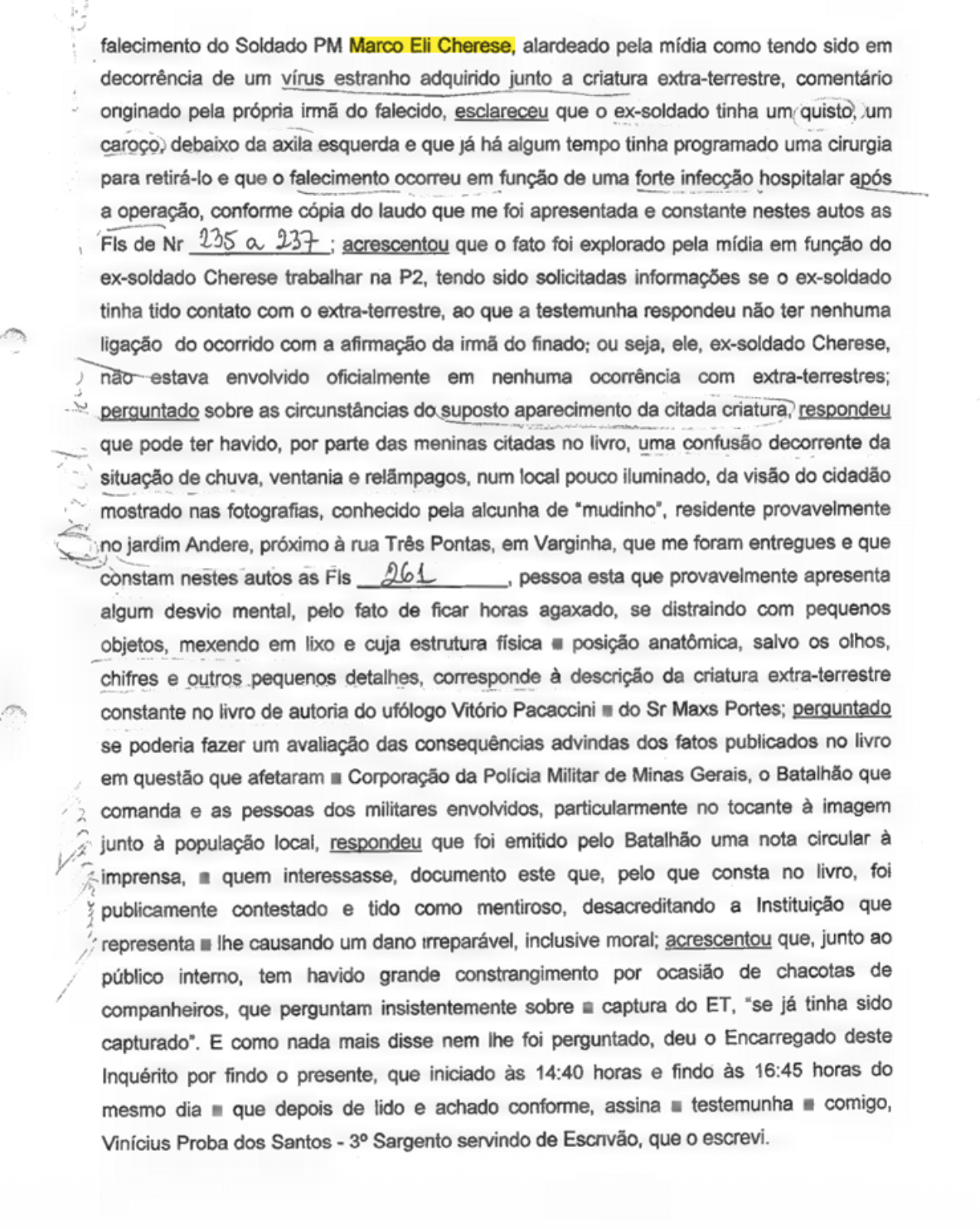
Public records establish the basic facts: Marco Eli Chereze (born October 10, 1972) was a soldier with the 24th Military Police Battalion in Minas Gerais (not the ESA, but the regional MP unit). He was reportedly a P2 (intelligence) officer. He was hospitalized on February 12, 1996 -23 days after the alleged January 20 events, with abdominal pain, and died on February 15, 1996, at age 23. The autopsy was performed by medical examiner Dr. José de Frota Vasconcelos on February 16, with the report issued February 29. The official cause was sepsis from a post-operative hospital infection following removal of a pre-existing cyst under his left armpit.
The family requested a police investigation into possible medical negligence. The police chief, João Pedro da Silva Filho, confirmed this and stated the autopsy report was “of the utmost importance to determine the cause of death.” The family was also reportedly denied an exhumation request.
The Family's Testimony
Pacaccini describes going to the family's home on the outskirts of Varginha. The mother, referred to as “Dona Geralda,” told him:
“On January 20, her son, a P2 [intelligence agent] of the Military Police, had been on a mission. And that on the night of the great rainstorm he had come home to change clothes because he was dirty and very wet. A white car, official, without the markings that characterize it — for it was used only by the P2 — had brought him and waited at the door.”
The father, “Francisco,” revealed an earlier exchange:
“He had spoken with his son precisely about what he thought of the subject of extraterrestrials in the city. He received as a response virtually an order from his son not to discuss it with anyone, because he was certain that it was only the beginning of a great confusion! 'It's going to be a big mess, Dad. You can just wait and see!'”
The grandmother, “Dona Benedita,” recalled:
“When the newscast covered the subject, immediately the grandson got up from the sofa and turned off the set, saying: 'Don't watch this, it's just nonsense.' Thus, in a sudden manner, demonstrating enormous annoyance as if the news affected him directly.”
Days after January 20, the young man fell ill with a strong fever. He lost movement in his legs and arms, was placed in the ICU of the Regional Hospital, and died without any doctor clarifying the cause. The family described “a funeral with a sealed coffin, rushed, and arranging the burial a few hours later.”
The Sister's Account
Cherese's sister, Marta Antonia Tavares, provided the most detailed account of the medical timeline. Her testimony, published in the Jornal dos Lagos in January 1997 and preserved in IPM 07, paints a picture of medical negligence followed by institutional stonewalling.
According to Marta, Cherese began showing symptoms of pain under his right arm on February 6. On February 7, at the barracks, the PM's medical lieutenant, Robson Ferreira de Melo, performed an incision to remove a cyst from his right armpit. Marta's description of the procedure was damning: the doctor opened the area “without performing antisepsis and without removing the hair.”
Three days later, Cherese began experiencing back pain. He went to the emergency room, was given Voltaren. His condition deteriorated rapidly. By Wednesday he was in severe pain. The doctor told Marta her brother had an infection but “didn't yet know where the source was. Everything indicated it was from the surgery he had.” Cherese was admitted to the Regional Hospital of Southern Minas for round-the-clock intravenous treatment.
When Marta next saw him, “he was only moaning with pain, he was completely stained purple and the doctor did not allow the family to get close.” In the brief interval when Marta stepped out and another family member went to buy the antibiotic Vancocin that the doctor had requested, Marco Eli died. The doctor recommended burial on the same day, February 15.
The official autopsy, performed on February 16 by Dr. José de Frota Vasconcelos, gave the formal cause of death as septic pulmonary thromboembolism, incipient myocarditis, and acute hepatic congestion. But the autopsy report itself was not issued until May 29, 1996, more than three months later, despite having been requested on an urgent basis.
A supplementary examination had been recommended by Dr. Janine, requiring R$653. Marta went to the barracks to request funding: “They gave me the runaround, told me to wait because the government hadn't released the money.” The supplementary exam was never performed. The autopsy report was never provided to the family. And Marta's assessment of the report's reliability: “My opinion is that this report is no longer of use, because it may have been altered.”
The Medical Records
The IPM includes laboratory results for Marco Eli Cherese (Exam No. 0120407), performed by Dr. José da Frota Vasconcelos at the Institute of Legal Medicine in Varginha. The full lab findings show an HIV test (non-reactive), a direct bacterioscopy from the autopsy (inconclusive), and a culture from a serous effusion at the axillary lesion site. The culture identified Staphylococcus schleiferi, a species primarily associated with infections in dogs and cats. It is rarely found in human clinical samples. In the medical literature, S. schleiferi is classified as a coagulase-variable organism that can cause aggressive wound infections in immunocompromised patients, but its presence in a fatal human infection of a previously healthy 23-year-old is unusual enough to merit attention.
Pacaccini raised pointed questions:
“Was his brutal and unexplained cause of death due to contamination from the creature? Was this the reason they rushed the burial? ...In one of the laboratory reports, yes, there is mention of a 'small toxic quantity' in the body of the military serviceman.”
Chereze's former companion, Eric Lopes, appeared in the 2022 documentary Moment of Contact, credited as “Chereze's Companion,” suggesting that at least one person close to the soldier was willing to speak publicly, decades later.
At the January 2026 National Press Club event in Washington, a pathologist presented findings about an unusual bacterium of “extremely high aggressiveness and lethality” found in Chereze's tissue samples, a detail that aligns with the “small toxic quantity” described in the IPM. Whether this represents a genuinely anomalous pathogen or a mischaracterization of the Staphylococcus infection documented in the IPM remains a matter of interpretation.
The tension at the heart of the Chereze case: the official record says he died of a routine post-operative infection from a pre-existing condition. His family's testimony in the documents tells a completely different story. A man who came home wet and dirty from a mission on January 20, who warned his father it was “going to be a big mess,” and whose death was followed by a sealed coffin and rushed burial.
Pacaccini drew a connection to animal deaths at the local zoo, a connection that began with another sighting.
The Creature at the Zoo
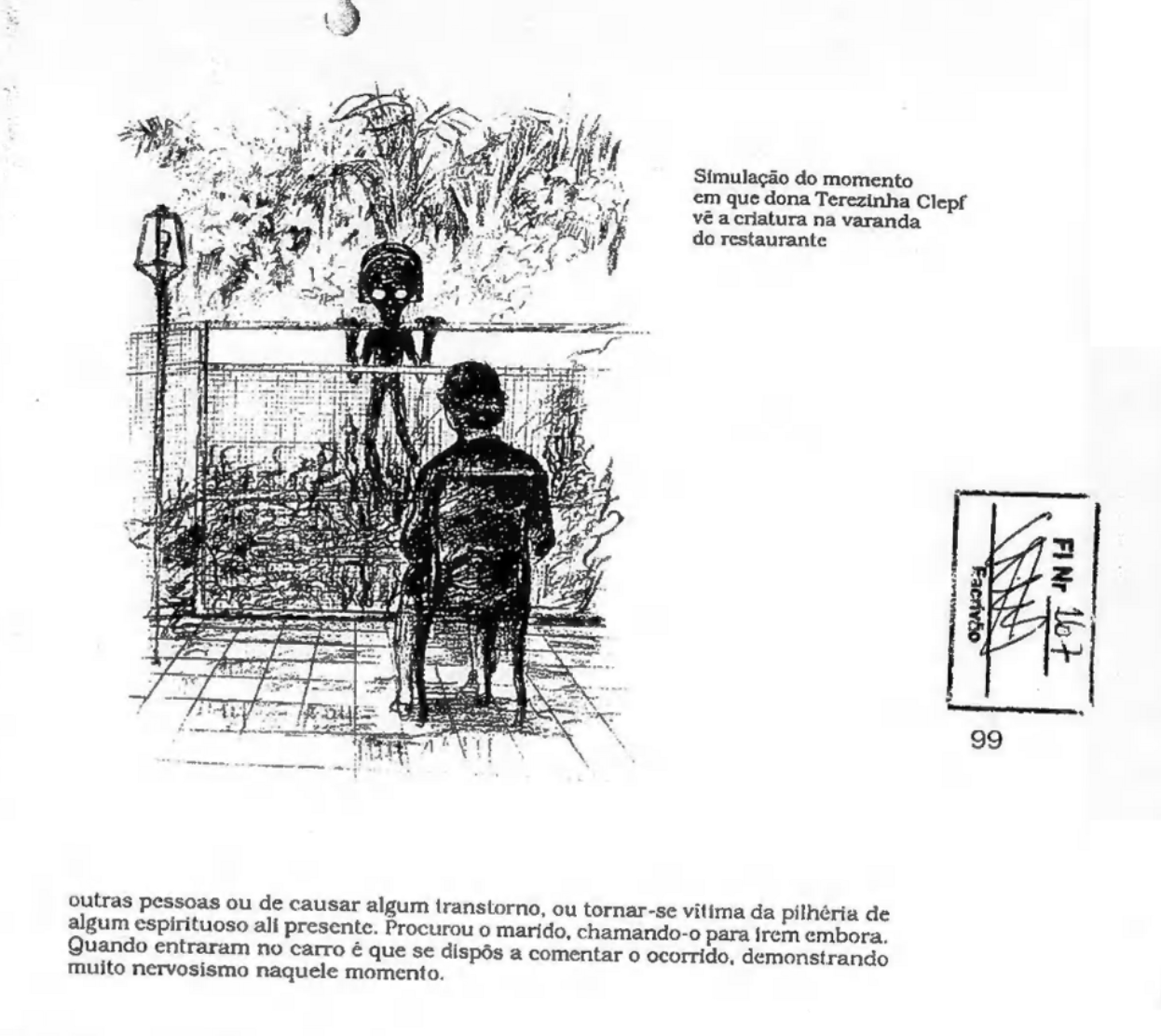
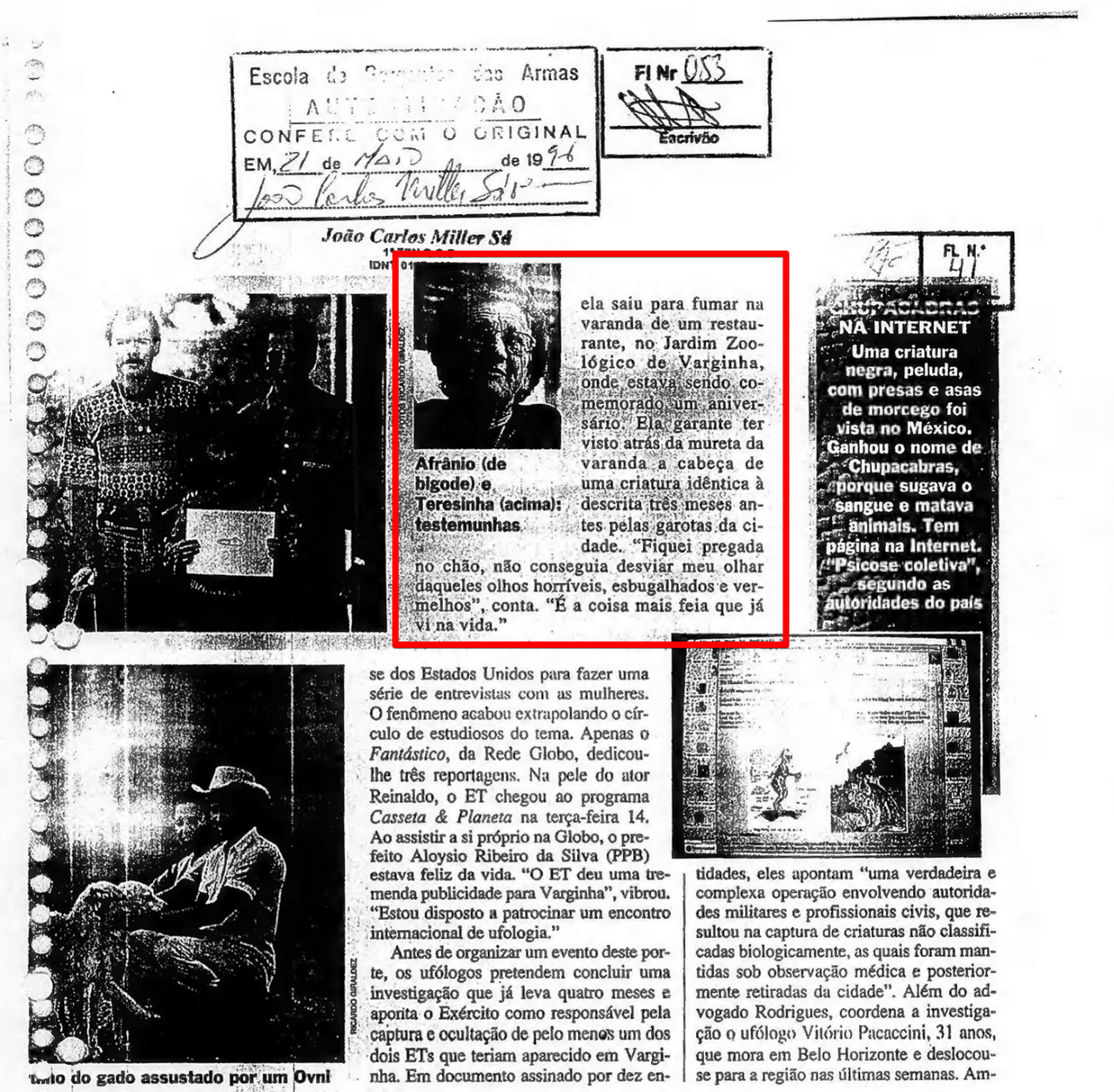
On the evening of April 21, 1996, roughly three months after the main events, 67-year-old Terezinha Gallo Clepf was attending a birthday party at a restaurant called Paiquere, located inside the grounds of the Varginha Zoo. Her husband, Marcos Clepf, was a former city councilman and well-known figure in Varginha. According to the chronology in IPM 04:
“Dona Terezinha Gallo Clepf, 67, wife of Mr. Marcos Clepf, former city councilman, went out to the veranda to smoke a cigarette. The place was totally dark. When she looked to the left side, at 4 meters distance, she saw a being exactly like the one described by the young women and by the military, except this one had on its head a kind of yellow helmet. Dona Terezinha said she had the impression that the enormous red eyes of the being emitted a type of luminescence, which allowed her to see its face very well.”
IPM 06 contains Pacaccini's full account of the encounter, based on his interview with Dona Terezinha at her home. She had gone to the veranda to smoke because her husband and the other men at the table were non-smokers and she didn't want to bother them. The veranda was darker than usual: the external floodlights were malfunctioning, and large trees blocked much of the ambient light from the restaurant.
She sat in a chair, lit her cigarette, and found standing before her, at a distance of five meters, a creature leaning against the outside of the veranda's metallic fence railing. She described momentary terror, initially thinking it was a loose animal, though she had “never seen anything similar.” Its two large, red, wide-open eyes were without pupils and luminescent, staring fixedly at her. The nose was “almost nonexistent.” The mouth resembled “a small horizontal slit.” The skin was dark brown and oily. On its head there was what appeared to be a golden helmet or cap.
“Dona Terezinha says the eyes resembled 'rear car brake lights.'”
For approximately seven minutes, the two stared at each other in silence. The creature did not move, though it opened and closed its eyes intermittently while continuing to watch her. Finally, overcome with fear, she rose slowly from the chair and backed toward the restaurant door. At the threshold, she turned and looked once more: the creature was still there, inert, in the same position, still staring fixedly at her.
A newspaper clipping preserved in IPM 03 captured her own words:
“I was frozen to the ground, I couldn't look away from those horrible, bulging, red eyes. It is the ugliest thing I have ever seen in my life.”
Frightened, she went inside and joined the others, but said nothing for fear of causing panic or becoming “the victim of a joke from some witty person there present.” She sought her husband and insisted they leave immediately. Only in the car, showing visible nervousness, did she tell him what she had seen. That night she could not sleep. “The image of that creature tormented her, persisting in her memory.”
According to IPM 04: “Even today, Dona Terezinha becomes distressed when she thinks about what she saw.”
The family deliberated for a week before going public. As Pacaccini recounts in IPM 06, Marcos Clepf called them on April 26 to say they had decided “by mutual agreement among family members” to share what happened, despite being “fearful that he and his family would be ridiculed.”
The Zoo Animal Deaths
The Clepf sighting was not the first sign that something was wrong at the zoo. IPM 06 reveals that the animal deaths actually occurred in the week before Dona Terezinha's April 21 encounter, not after it. Dr. Leila Cabral, the zoo director, contacted the ufologists after the Clepf testimony was publicized, reporting that “one week before the 21st, that is, in the week before Dona Terezinha had the sighting, five previously healthy animals came to die in an inexplicable and mysterious manner.” The chronology in BRANBSBARX003_007 names them specifically:
“Two deer, one tapir, one blue macaw, and one ocelot. The biologist and director of the local zoo, Dr. Leila Cabral, had never seen anything like it. Dr. Marcos, the veterinarian, sent the viscera to Belo Horizonte for examination. Only in one of the deer was a type of caustic intoxication found. In the other animals nothing was found. It is not known what they died of.”
The zoo's own staff were divided. The veterinarian, Dr. Marcos A. Carvalho Mina, considered the deaths a coincidence. But the zoo director, Dr. Leila Cabral, believed they were connected to the presence of the creature.
IPM 06 contains the individual autopsy findings. The tapir, which Dr. Leila had affectionately nicknamed “Banzeco” for being healthy and playful, died from an “unidentified toxic substance.” The deer died from “caustic intoxication without apparent cause.” The remaining three animals (the blue macaw, the jaguarundi, and one additional animal) showed “nothing that would justify the death.” All died abruptly and unexpectedly. The zoo's water was treated, the food was carefully selected, and as Pacaccini noted: “Had there been a toxic product, it would have been detected in the examinations of the animals' viscera. However, when 'unknown toxic substance' appeared and in the other animals 'no definition,' something inexplicable had really happened.”
Pacaccini, drawing the link to Marco Eli Cherese's death, wrote in IPM 07:
“Also five healthy animals from the Zoo had sudden deaths, with the autopsy performed by veterinarian Dr. Marcos Mirna revealing that in one of the animals there was an 'unknown toxic substance' and, in the other four, 'no definition.' Strange! Very strange!”
There is also a revealing anecdote about Dr. Leila. Back in January 1996, when rumors of a creature capture were circulating through the city, she had encountered a firefighter and joked with him: “You captured the ET and I'm going to take care of it.” According to the account in BRANBSBARX003_007, the firefighter, rather than laughing it off, “alarmed, told her to be quiet and not to discuss this with anyone.”
The animal deaths themselves have been independently confirmed by the zoo's own staff — both Dr. Cabral and Dr. Mina have spoken to journalists outside the ufological community. Necropsies revealed blackening of the stomach and intestinal mucous membrane in the affected animals. The tissue samples sent to the laboratory in Belo Horizonte, however, have never been fully released to the public. The caustic intoxication found in one deer was never explained, and no cause of death was ever determined for the other four animals. The military inquiry does not address these claims.
Bribery, Threats, and Witness Intimidation
The Men in Suits
On the evening of April 29, 1996, four men, two young and two older, “dressed in black suits and ties,” appeared at the home of Liliane and Valquíria's mother. Pacaccini's account in IPM 06 is detailed:
“In a major bribery attempt, they offered them enough money to fulfill their dreams, in exchange for a recording of a video where Liliane and Valquíria would say that they had not seen any strange creature and that everything was just a prank.”
The mother, Dona Luísa, described the escalation:
”'They showed a paper with lots of money inside. Not just coins, but bills of many types.' ...They said that if she was afraid to take all that money, she should give them a document so they could open a savings account for her.”
The men never identified themselves and said they would return for her answer.
The Casseta & Planeta Affair
The Brazilian comedy show Casseta & Planeta tried to get the girls to appear on-air. The ufologists advised against it and hid the girls at a farmhouse. The TV crew offered money too. Signs went up around the city: “The Prefecture welcomes the Casseta & Planeta team to this cosmic city” and “The ET of Varginha opens its arms for tourism.”
Death Threats
The researchers also received anonymous death threats:
“Someone called us with a male voice, threatening us with death, alleging we were going too far and that the time to stop everything had come. If we continued, we would bear the consequences.”
Surveillance and Wiretapping
A Nossa Folha newspaper interview preserved in IPM 04 reveals that Pacaccini that he had been “forced to change telephones three times, because they were constantly 'tapped.'” He added that at the ESA, “still today, whoever ventures to mention our names gets even prison time.”
More significantly, IPM 04 reveals that the military was actively monitoring the ufologists' public appearances. A classified military communication (Official Letter No. 002/TG, marked “CLASSIFIED”) from the Tiro de Guerra (War Training Unit) in São Lourenço, MG, reported to the ESA's intelligence section (2nd Section) that ufologists Ubirajara Rodrigues and Vitório Pacaccini had given a lecture at the Hotel Primus, where they stated that creatures were captured and taken by ESA personnel to a military unit in Campinas. The letter was forwarded to the IPM file. The significance: local military intelligence units across Minas Gerais were functioning as a surveillance network, monitoring civilian lectures and filing reports back to the ESA command about what the ufologists were saying publicly.
Armed Researchers
The threats were taken seriously enough that Pacaccini and Rodrigues began carrying weapons during nighttime investigations. On one vigil near the ESA, they brought “a .38 revolver that Ubirajara had inherited from his father and my semi-automatic 9mm Beretta” and spent from 8:30 PM until 3:00 AM on a hilltop overlooking the area where a hairy creature had reportedly been seen.
The Creatures in the Tank
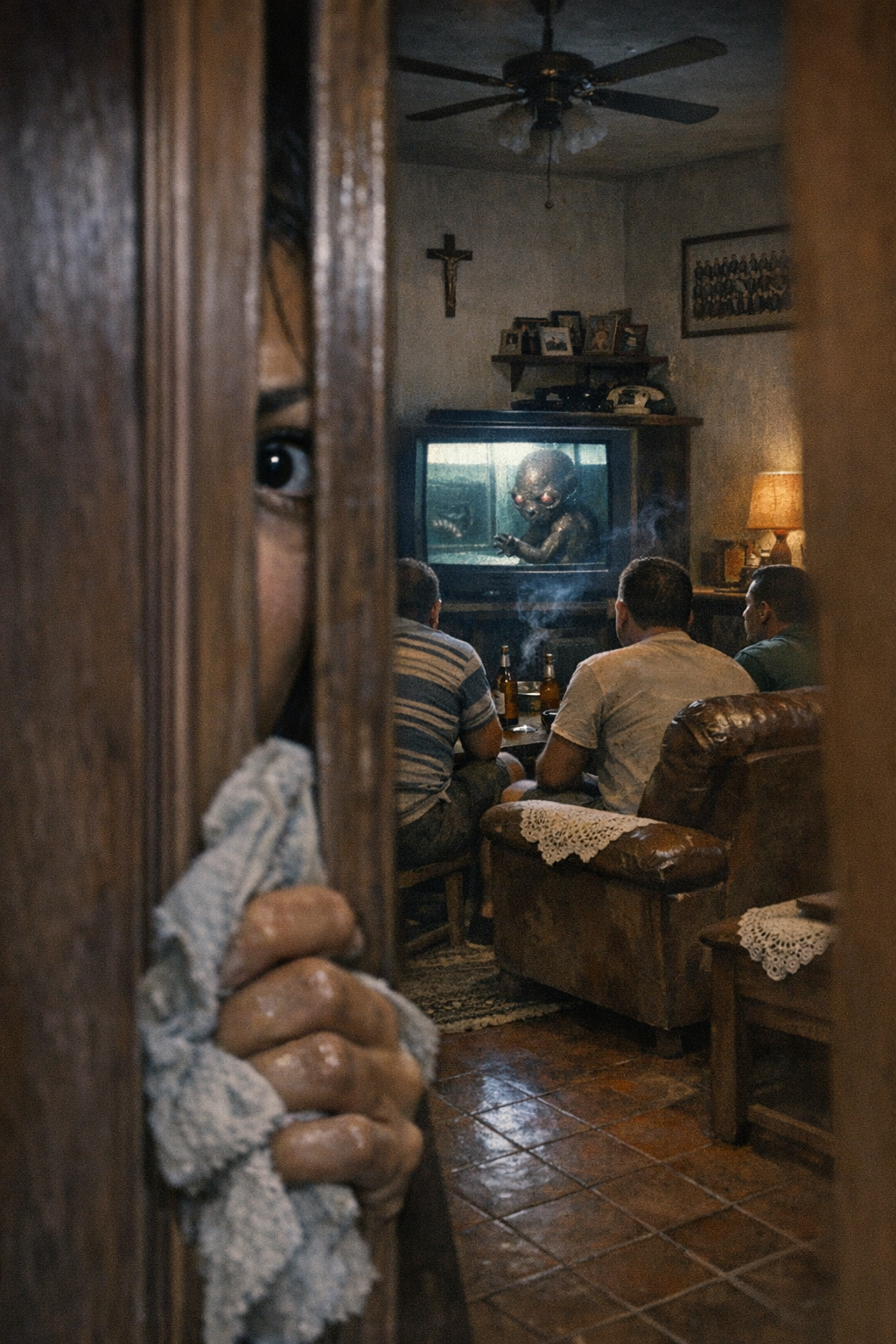
One of the most extraordinary claims from IPM 06 comes secondhand through a domestic worker. A young woman employed by a military family in Três Corações accidentally saw something while cleaning:
“While doing her normal cleaning work, she saw the military employer meeting in the living room with two or three other military friends. While doing the work in the rooms, out of curiosity she peeked through a crack in the door at what they were watching on television. It was a video showing [unclear]... one creature was eating a fruit. The other, lying in another tank with water, appeared dead because it was not moving.”
Her mother advised her: “She ran the risk of being dismissed for snooping into the lives of others.”
The Signed Denials
According to Pacaccini's informants in IPM 06, military personnel who participated in or witnessed the operation were required to sign documents:
“All those named had to sign their respective pages, together with a fabricated witness, with the sole purpose that when and if — some or all — should they leave the military for any reason and decide to tell what they knew, the Army would have a way to prove their statements were lies by bringing to the public the signed document.”
This is described as a deliberate counter-intelligence measure: preemptive written denials to discredit any future whistle-blower.
The Hairy Creature on the Road
In IPM 06, Biology student Ildo Lúcio Gardino (21 years old) reported a separate sighting to the director of the Varginha Zoo. While driving a van from Três Corações to Varginha at night:
”'A few kilometers from arrival, where the road has a sharp curve and then a long straight uphill stretch, there, right after this curve I saw a creature trying to cross the road heading toward the woods on the other side. This creature was standing, slightly hunched over... dark brown thing, with hair all over its body, reddish and large eyes reflected by the car's light, and in an intelligent and protective gesture, it raised its hands to its face and crouched down.'”
When Pacaccini asked if it could have been a calf: “A two-legged calf? And hairy? With big bulging red eyes? What are you talking about?” When the researchers traced a straight line from the sighting location, it pointed directly to the house of Eurico and Oralina, the couple who had seen the UFO on the morning of January 20.
The Wave Continues: April-May 1996
IPM 06 documents sightings in the weeks following the main events that paint a picture of sustained anomalous activity across southern Minas Gerais.
The Standard Factory Mass Sighting
In late April 1996, at 11:00 AM on a clear blue autumn day without a single cloud, an incident occurred at the Standard factory, a multinational recently established in Varginha. More than forty people, including factory workers, administrative staff, and executives, left their workstations and went to the courtyard to watch:
“A disc-shaped object, silvery, at approximately two hundred meters in altitude, coming from the horizon, hovered above the factory. At the same time, another identical object came from another direction, hovering below the first. They slowly rotated and, as if in a coupling, departed at high speed vanishing from sight.”
Forty witnesses spanning multiple organizational levels, in broad daylight, at close range. The ufologists documented this but it received little media attention compared to the creature sightings.
The Dentist on the Dark Road
A dentist from Três Corações, requesting anonymity “for fear of being the target of jokes,” reported a disturbing encounter on a rural road. Pacaccini says he had known the man since childhood and vouched for his character. The dentist was driving home around 8:00 PM on a shortcut through an eight-kilometer rural road when his new car began to malfunction:
“Suddenly he spotted on his left side part of an enormous object with some curvatures, flying just above him with the other part covering the road with frightening proximity, making him fear a contact that would certainly cause a disaster. There were some edges where various yellow and red lights blinked, projecting complete luminosity to the object.”
His hands froze on the steering wheel. The engine died. He pulled to the shoulder and sat motionless, eyes closed in terror, until the object moved away and the engine spontaneously restarted. He drove to his destination at the highest speed of his life.
The dentist later testified at the May 4 ufologists' meeting, but only on condition that his face and voice were electronically distorted.
The Zoo Veterinarian's Observation
IPM 06 also preserves a detail from the zoo veterinarian, Dr. Marcos Carvalho Mirna, that directly contradicts the military's timeline. While discussing the animal deaths at the zoo, Dr. Marcos recalled that he had seen Army trucks on the road on January 22 (a Monday), while driving to pick up his daughter at the Country Club of Varginha. The military's consistent position has been that trucks only traveled to Varginha on January 25-26 for routine maintenance at AUTOMACO. The veterinarian's observation places military convoys on the road three days earlier than the Army admits.
The Ruling: “Too Implausible to Be Criminal”
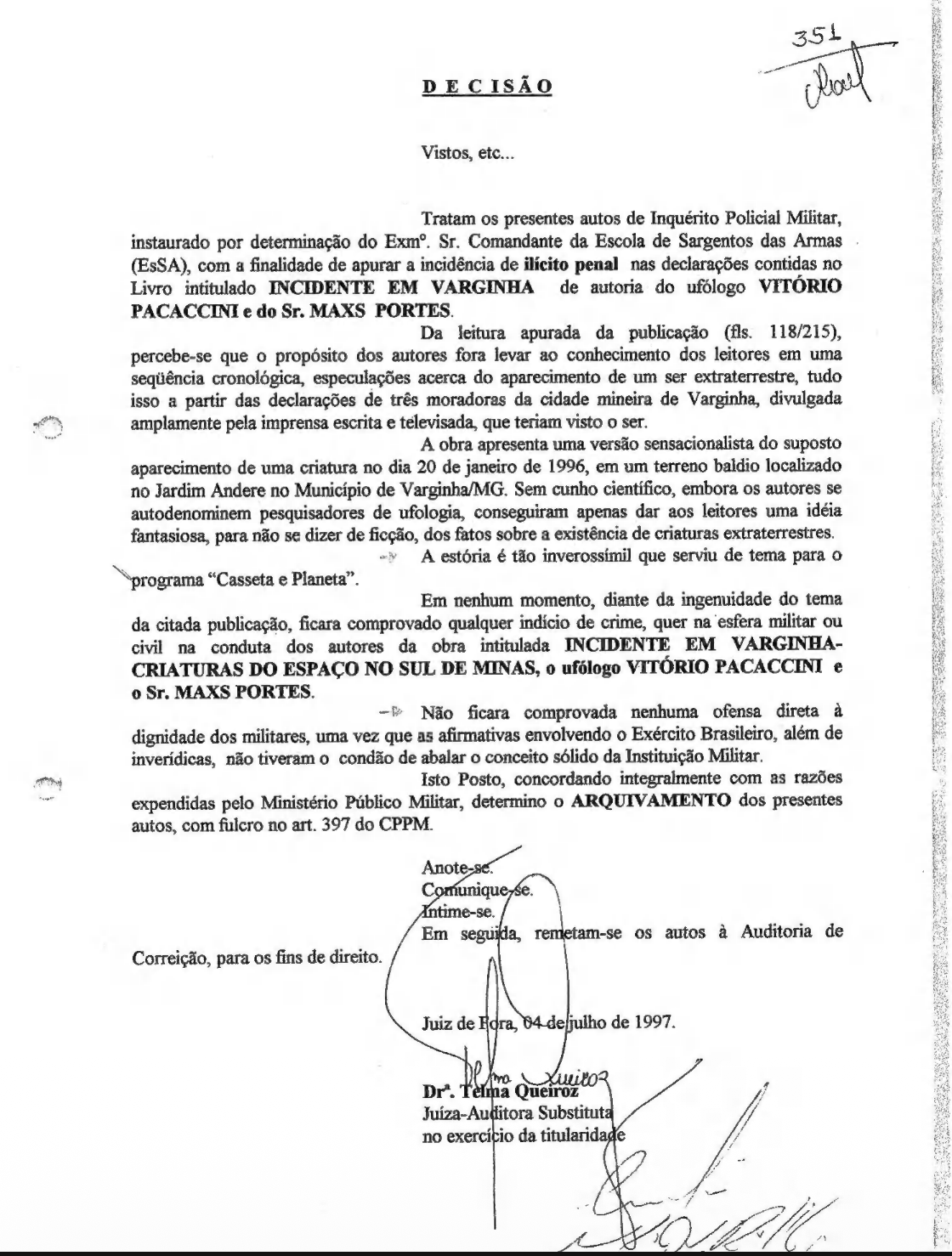
The Military Police Inquiry concluded in mid-1997 with a recommendation from the Military Public Ministry (IPM 08) (prosecutor's office) to archive the case, meaning no charges would be brought.
The prosecutor's reasoning is notable not for what it proves, but for how it characterizes the claims:
“Although in my opinion their behavior was reprehensible from a moral standpoint... I do not perceive, given the nature of the subject and the naivety of the statements, any intent to commit a crime against the reputation of the Armed Forces.”
“The assertions were always conjectural and generic, not being capable of inspiring public credibility and much less of undermining the solid reputation of the Military Institutions.”
The judge agreed, with a memorable flourish:
“The story is so implausible that it served as a theme for the program 'Casseta e Planeta.'”
The decision became final on July 15, 1997 (IPM 09), when no appeal was filed within the legal deadline. The case files were routed through the Court of the 4th Military Judicial District in Juiz de Fora, to the Inspector Court of Military Justice, and finally to the archive of the Superior Military Tribunal in Brasília. The substitute Judge-Auditor who handled the case was Dr. Telma Queiroz; the final archiving was ordered by Dr. Zilah Maria Callado Fadul Petersen, serving as substitute Inspector of Military Justice.
What the Army Told Congress
In 2010, Federal Deputy Chico Alencar (PSOL-RJ) submitted an information request to the Ministry of Defense (Resposta ao RIC 4470/2009) asking nine specific questions about UFO-related documentation. The responses from each branch of the Armed Forces are revealing.
The Air Force confirmed it had transferred all UFO-related materials from the 1950s through 1980s to the National Archives, with 1990s material still being processed. It also acknowledged COMDABRA's role and the existence of specific directives for handling sighting reports.
The Navy issued a terse certificate:
“I CERTIFY that, in the records of the Brazilian Navy, there is nothing on file related to what was requested.”
The Army confirmed it had produced exactly two documents about the Varginha case:
“An investigation opened on May 10, 1996, by the Commander of the Army Sergeants School (EsSA) to ascertain facts regarding news reports published in the press about the participation of military personnel from that School in the apprehension of the 'Varginha ET'; and a Military Police Inquiry (IPM) opened on January 29, 1997.”
Two documents. For what became one of the most publicized UFO cases in Brazilian history, involving allegations of military capture operations, hospital transfers, autopsies, and a soldier's death. The Army says it produced two documents.
Military Pilots and Their Sightings
The BRANBSB collection includes multiple sighting reports from military pilots, not easily dismissed as unreliable observers. One stands out:
Commander Beni and Commander Pavel reported a pulsating light varying between red and white, traveling at approximately 200 knots, observed for 15-20 minutes under CAVOK conditions (clear skies, visibility over 10 kilometers). Beni noted this was the most significant sighting of his career.
Another report from CINDACTA III documented multiple fireballs in formation: “One large and two small... with the larger one in front and the small ones right behind,” accompanied by “a tail of fire,” observed by a Military Police Major and corroborated by a commercial flight (TBA397 en route from Brasília to Recife) that reported seeing something similar.
A questionnaire from a pilot reported disc-shaped objects “2 times larger than the aircraft” at approximately 31,000 feet with “monstrous acceleration.” Another observer described an oval object that “alternates colors” between silver, red, and blue, moving in a “zigzag” trajectory.
Regional air commands (CINDACTA I, II, III) consistently noted in their forwarding correspondence that no radar tracks correlated with the reported objects, though at least one incident contradicted this, as described below.
The Academic Response: UFO Over the Prison
A detailed 1991-92 case study from the University of Brasília's Ufological Studies Group (GEU-NEFP/CEAM/UnB), preserved in the BRANBSB collection, analyzes a sighting near the Papuda maximum-security prison where approximately 25 police officers, led by Lt. Damasceno, observed a color-changing oval object for over 3.5 hours on April 11, 1991.
The prison setting is described precisely: 15 km southeast of Brasília, housing over 1,100 prisoners across multiple facilities, with a guard force of more than 60 men. “It is a location isolated from the urban environment. Most of its area has no lighting.”
The study documents four telephone contacts between Lt. Damasceno and CINDACTA I's Sergeant Petronio. CINDACTA confirmed radar registration of the object at approximately 2,000 feet. Yet after several contacts, they concluded with “the easiest route”: “'Look, Lieutenant, that was a balloon.'”
The researchers then systematically deconstructed this explanation:
- Sunset for Brasília was at 6:06 PM. The last observation occurred at 10:40 PM, 4 hours 34 minutes after sunset. Solar reflection on any object was physically impossible.
- The weather balloon was launched at 9:00 PM, but the object had been observed since 7:10 PM, nearly two hours before the balloon existed.
- CINDACTA's own Sergeant Petronio admitted during the third phone contact that “the balloon sent by the CMA had already reached its maximum altitude and burst.”
- The object disappeared and reappeared three times in different positions. Weather balloons do not do this.
- 72 hours later, the object reappeared with the same characteristics. At that point, nothing was reported to CINDACTA “due to the previous indifference.”
The study also revealed a contradiction between Air Force agencies: CECOMSAER (social communications) confirmed radar registration while NUCOMDABRA (aerospace defense) denied it. The researchers estimated the object's actual diameter at approximately 20.5 meters.
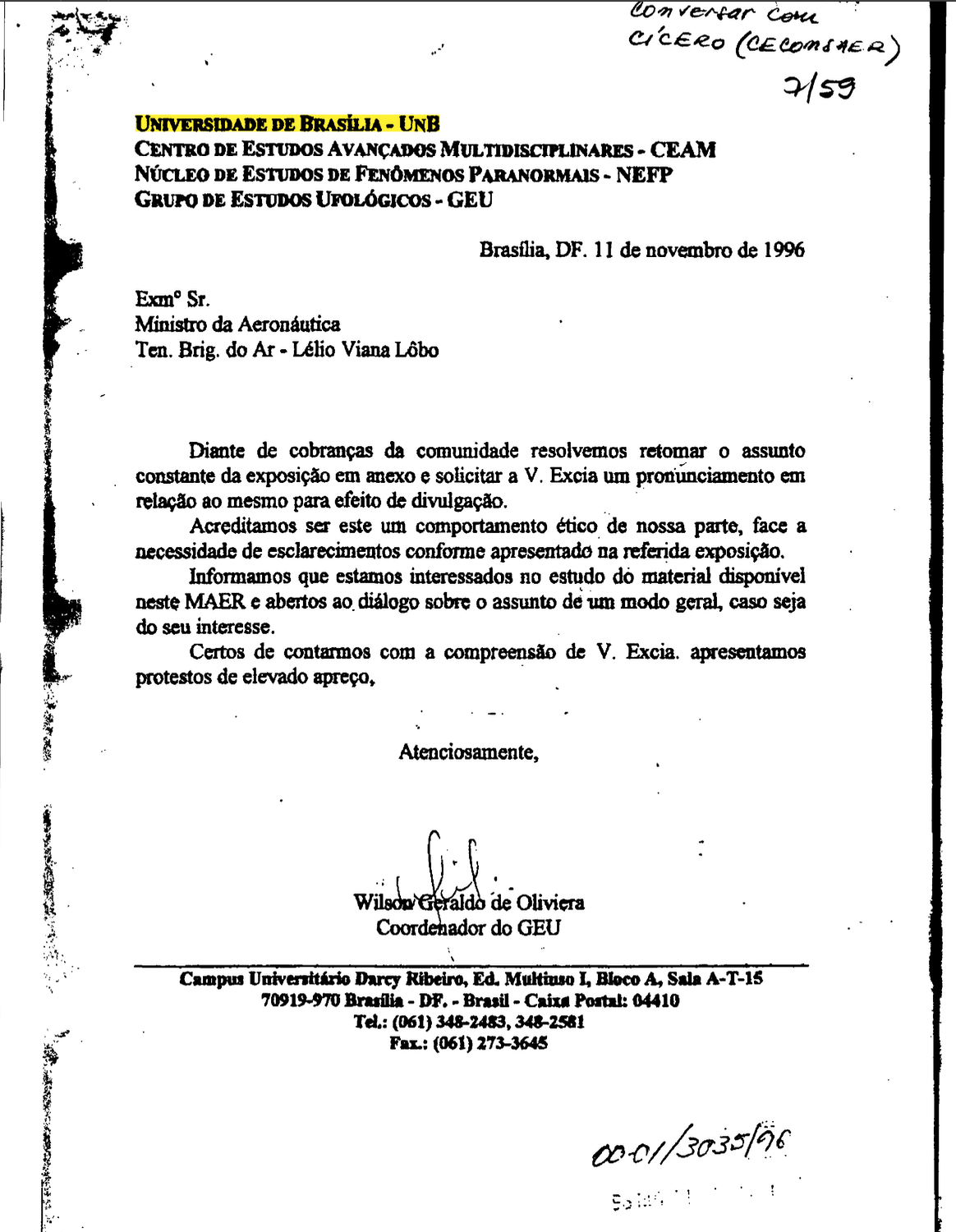
In 1996, the GEU wrote directly to COMDABRA demanding answers about the Varginha case and the May 1986 incident.
The May 1986 Incident
While not directly related to Varginha, the documents contain extensive material about the famous May 19, 1986 Brazilian UFO incident, one of the best-documented military UFO encounters in history.
A detailed article by Claudeir Covo in the BRANBSB collection compiles official testimony from Brigadier Otávio Júlio Moreira Lima (Minister of the Air Force), Colonel Ozires Silva (president of Petrobrás and a pilot who personally chased the objects), F-5E and Mirage fighter pilots, and radar operators documenting 20+ objects detected on radar at speeds of 250-1,500 km/h.
Brigadier Cherubim Rosa Filho, minister of the Superior Military Tribunal, is quoted in an ISTOE magazine article entered as evidence in IPM 03: “There exist today unexplained cases by the Aeronautics regarding UFOs.”
The Chronology According to the Ufologists
Claudeir Covo's timeline, published in Planeta magazine and entered as evidence in IPM 04, gives the fullest picture of what the ufologists believe happened:
| Date & Time | Event |
|---|---|
| Jan 20, 1:30 AM | A UFO flies over a farm 10 km from Varginha at 5 meters from the ground. Eurico and Oralina are awakened by frightened cattle. |
| Jan 20, 8:30 AM | Firefighters receive anonymous calls and dispatch four men. Major Maciel arrives at 10:30 AM. The creature is captured with a net and placed in a box on an Army truck. |
| Jan 20, 2:00 PM | Seven Army soldiers in camouflage with FAL rifles conduct a sweep along the train tracks. Three shots are heard. Soldiers emerge with two Army bags, one containing something moving, the other something motionless. |
| Jan 20, 3:30 PM | Katia, Liliane, and Valquíria see the creature on the vacant lot. |
| Jan 20, 5:00 PM | The worst hailstorm in 25 years hits Varginha. |
| Jan 20, 8:00 PM | Military Police in civilian clothes capture another creature. |
| Jan 21, 1:30 AM | Creature transferred from Regional Hospital to Humanitas Hospital. |
| Jan 22, 4:00 PM | ESA trucks begin removal from Humanitas. |
| Jan 23, 4:00 AM | Special convoy departs ESA for Campinas. Creatures allegedly taken to Unicamp and handed to Dr. Fortunato Badan Palhares. |
| Jan 23 | A Buffalo aircraft from Canoas Air Base delivers portable radar equipment to southern Minas. |
| Jan 26 | NASA-affiliated military personnel arrive at Unicamp. |
| Apr 21 | Dona Terezinha Clepf sees a creature at the zoo restaurant. |
| Apr 29 | Four men in suits attempt to bribe Liliane and Valquíria. |
| May 8 | Brigadier General Lima reads a denial statement to the press. |
| May 29 | In unprecedented secrecy, the Army Minister meets with 29 generals in Campinas. |
This timeline remains unverified. The military denies all of it.
The Storm
One entry in the chronology deserves its own discussion: the hailstorm.
At approximately 5:00 PM on January 20, roughly ninety minutes after the girls' sighting, a hailstorm hit Varginha with a severity the city hadn't seen in a quarter century. January is the peak of the rainy season in southern Minas Gerais, but this was something else entirely. Pacaccini described it in IPM 05:
“A torrential storm with hailstones the size of ping-pong balls destroying houses, knocking down trees, roofs, flooding streets and, with such violence, that had not been seen in the city for a long time.”
The ufologists' chronology in IPM 04 is more precise: “In the last 25 years, Varginha had not seen such rain.” A military witness in IPM 02 confirmed it was “a strong storm that darkened the entire city.”
The storm matters to the case for three separate reasons.
First, the military cited it to explain the girls' sighting. Lt. Col. Vanderlei's defense in IPM 07 attributed the encounter to “a confusion resulting from the situation of rain, windstorm and lightning, in a poorly illuminated location.” The prosecutor in IPM 08 described it as a sighting “on a stormy night.” But the girls saw the creature at 3:30 PM, in full southern-hemisphere summer daylight, on a vacant lot in their own neighborhood. The storm didn't arrive for another ninety minutes. By the time it hit, the girls were already home, already terrified, already telling their mother what they'd seen. The timeline is in the military's own documents.
Second, the storm gave the military a reason to be everywhere. The chronology in BRANBSBARX003_007 is explicit about this: “After the rain, the Fire Department, the Military Police, and the Army had good excuses to search the entire region. For the public, they would be helping the population regarding the damage caused by the storm. In reality, the military knew that there were more beings in the region.” When the fire department's Captain Alvarenga was confronted by Rodrigues, he showed an incident report listing responses to storm damage at various points around the city, around 5:30 PM. The storm was the alibi for every official vehicle seen in the streets that evening. Yet only nine occurrences were logged for a day that produced the worst storm in twenty-five years, with houses unroofed and walls knocked down. Nine.
Third, the ufologists believed the storm injured the creatures. IPM 04 speculates that beings still hiding in the small forest of Jardim Andere “were certainly hit by the hailstones and, in a way, were injured.” The creature captured by Military Police at 8:00 PM that evening was described as “apparently dazed, sick, or injured.” Whether the hail caused this, or whether the creature was already weakened from other causes, or whether the entire account is fabricated, the documents don't say. But the ufologists saw a direct line: a healthy creature seen at 3:30 PM, a catastrophic hailstorm at 5:00, and a weakened creature captured at 8:00.
Major Siqueira of the Military Police, asked about January 20, said only that “on that day the PM's work was normal, he only remembers a storm and some disruptions caused by heavy rain.” The worst storm in twenty-five years, and he remembers it as disruptions.
The Damaged Craft
The very first event in the chronology takes place twelve hours before the girls' sighting. At 1:30 AM on January 20, on a farm 10 kilometers from the center of Varginha, something woke the cattle. IPM 04 describes what happened next:
“The couple Eurico Rodrigues de Freitas, 40, and Oralina Augusta de Freitas, 37, are awakened by the noise of frightened cattle running back and forth. Upon opening the window, they saw a small craft, the size of a minibus, in the shape of a submarine, that slowly flew over the region for 40 minutes at 5 meters from the ground. The craft was dark and had at one of its ends a structure that appeared damaged, releasing a lot of smoke.”
The craft continued slowly in the direction of Jardim Andere, the neighborhood where the creatures would later be seen. The ufologists concluded that an explosion had damaged the craft, scattering debris across the area, and that the vessel eventually came down near Jardim Andere, “probably injuring part of the crew, which took refuge in the small forest of said neighborhood.”
This interpretation gained support from a civilian witness. IPM 07 contains the full account of Carlos de Souza, an ultralight pilot who was heading to Varginha along the Fernão Dias highway for a flight competition. He heard a loud noise “like a tractor motor or a washing machine with a dull sound” coming from the direction of Varginha. He pulled over and entered a side road just past the Varginha access point, where he found an Opala sedan, an ambulance, and three civilian cars already at the scene.
The ground was covered with fragments:
“They were scattered all over the field as if they were made of paper.”
He picked up a piece. It was light and metallic, and when he crushed it, it returned to its original shape. Immediately, according to his account, a tall man in dark gray pants and a light brown shirt with a cap took the object from his hands and threatened him: “Give me that. Get out of here. You didn't see anything.”
In the bed of one of the trucks, Souza saw a large piece of metal. The ufologists noted some of his claims matched their other intelligence, but remained cautious: Claudeir Covo acknowledged that “some points match other information we have, but others are totally divergent.”
According to a military informant, one of the three trucks in the January 23 convoy to Campinas carried “thousands of small unknown metallic fragments” of unknown origin. The fragments were reportedly sent to the Aeronautics Technology Center (CTA) in São José dos Campos, where they were said to be “analyzed by Brazilian and North American military personnel inside another secret underground laboratory.” The ufologists' conclusion: three trucks left the ESA that morning. One carried a dead creature. The second carried another dead creature. The third carried the fragments of the craft that Eurico and Oralina had seen limping over their farm.
(NORAD later confirmed a satellite reentry over the region around January 20, 1996, a detail discussed below in “The NORAD Data,” which could account for what the couple saw in the sky. It would not explain the metallic fragments or what was found on the ground.)
The Sweep
Five hours before the girls' encounter and seven hours before the hailstorm, the military was already in the area. At 2:00 PM on January 20, a civilian witness with former military service observed a disturbing scene along the same train tracks where the firefighters had captured the first creature that morning. From IPM 04:
“A civilian witness, who was formerly in the military, observed at the location at least seven Army soldiers with typical camouflage-type uniforms, armed with FAL rifles. They were coming on foot along the train tracks and surroundings, conducting a type of sweep in the region, when they entered the small forest where, in the morning, the first being had been captured by the firefighters.”
Then, three shots:
“At a certain moment, this witness heard three FAL rifle shots, which have a well-known metallic sound. A military person from Campinas said that a creature was assisting another one lying on the ground, apparently wounded. Perhaps this creature showed signs of reaction against the military and ended up being hit in the chest by the three shots.”
What happened next is the detail that stayed with the witness:
“Some minutes after the three shots, the military personnel emerged from the woods with two typical bags used by the Army. One of them contained 'something' that was moving a lot, while in the other there was 'something' motionless.”
The ufologists' count at this point in the day: the firefighters captured one creature in the morning. The army sweep produced two more in bags, one apparently alive, one dead. One of the creatures in the forest was described as “different from the others, with its entire body covered in black hair,” a detail that would resurface weeks later when biology student Ildo Lúcio Gardino reported seeing a hairy creature trying to cross a road outside Varginha.
“Cairo”: The Witness on the Hill
IPM 06 contains the full testimony of the sweep's civilian witness, referred to by the pseudonym “Cairo.” He was a resident of the Santana neighborhood, situated just below Jardim Andere, and had waited months before coming forward, wanting to verify “the seriousness with which we worked” and confirm that neither researcher had ever leaked a source's identity to the press.
Cairo's account is specific. At approximately 1:00 PM on January 20, returning home for lunch, he parked his car and noticed from his front door an Army truck parked at the crest of the hill marking the upper edge of Jardim Andere. Curious, he walked toward it. By the time he arrived, the truck was gone, but he could see seven soldiers heading downhill toward the tree line near the railroad tracks:
“He spotted seven soldiers down below, heading toward the forest, whose total number caught his attention by the way they walked: somewhat spaced apart from each other but all aligned as if forming a sweep barrier walking toward the forest existing near the railroad tracks. They were wearing combat fatigues, the camouflaged ones, and carrying rifles.”
He positioned himself to watch, joined by other curious bystanders. The soldiers entered the forest. Then came the shots:
“Moments later, he heard three bangs. It was not long before two soldiers came out of the forest each carrying a campaign sack. By the volume of the sacks the contents were evident. One of the sacks gave the clear impression that something in there was trapped and moving. In the other sack, just an inert volume.”
IPM 06 also reveals the explanation for why one of the creatures was shot. Information gathered through Claudeir Covo, the Mondini brothers, and Edson Boaventura established that a creature was killed not because it attacked a soldier, but because the soldier panicked:
“One of the creatures had been shot not for having attacked the soldier, but due to his fright at being face to face with something horrifying by 'our standard of beauty' and from inexperience, nervousness and the worst, being uninformed by his superiors about the importance of what he was doing there, even more considering that a creature had been captured in the morning.”
The implication is damning: the ordinary soldiers conducting the sweep had not been told what they were actually looking for.
The chronology in the documents also records that at least one of the captured creatures was kept at the ESA for 24 hours before being “placed in a cage and, by helicopter, departed for Brasília. From there, it would have gone to the United States in a jet.” The documents note: “This account also remains unconfirmed.”
The Portable Radar and the Americans
Three days after the captures, the operation apparently escalated from local to national to international. On January 23, according to IPM 04:
“A Buffalo aircraft departs from the Canoas Air Base (RS). Inside it were three containers, a box, and several military personnel. In the first container there were generators, in the second the reception equipment and computers, and in the third a small portable workshop. In the box there was a disassembled antenna. In other words, a sophisticated portable radar.”
The aircraft headed for southern Minas Gerais. The radar was installed somewhere near Varginha. During this period, the documents claim, “there were many alien craft flying over the region.” ESA personnel reportedly told the ufologists that “one night they were worried about the possibility of retaliation by extraterrestrial beings.”
The ESA itself was transformed. “Several military personnel from the US Air Force and Army arrived at the ESA by helicopter. An area of the ESA was restricted. Intelligence Service (S2) agents from various parts of the country were sent to the ESA.” Local residents who had lived near the base for years “had never seen such activity at the Sergeants School.” And the soldiers who participated in the operation paid a lasting price: they “are still today being watched and followed by S2.”
Three days after that, on January 26: “Several military personnel who work within NASA arrive at Unicamp, claiming they were going to select Brazilian scientists to participate in future space missions with the North Americans.” The ufologists were skeptical of this cover story: “They are probably military personnel who deeply understand all the details about flying saucers and extraterrestrial beings.”
Tracking the Trail to Campinas
While the ufologists in Varginha gathered testimony, a separate team was tracing the alleged route to Campinas. IPM 06 contains a detailed investigation report from CEPEX (a São Paulo-based research group led by the Mondini brothers, Eduardo and Osvaldo), presented minute-by-minute in field-report format. It reads like an intelligence operation conducted by civilians with no authority and considerable nerve.
On May 20, 1996, Eduardo Mondini, Carlos, and Marco Antonio drove from CEPEX headquarters in Sumaré-SP to Campinas with a specific mission: photograph, film, and find any trace of the creatures' alleged passage through the military infrastructure. They drove directly into the 11th Armored Infantry Brigade compound via the Via Anhanguera entrance, passing through the 2nd Logistics Battalion, the 28th Armored Infantry Battalion, the 2nd Army Police Platoon, the Brigade Headquarters, and the 2nd Armored Communications Company, filming with a camera hidden in their moving car. “Throughout the entire barracks there are guard posts with armed soldiers guarding the entrance to each Company.”
At the Amarais Cemetery, they photographed the Medical Legal Institute from outside, posing as cemetery visitors. They noticed a single employee watching them suspiciously from a distance.
Then they drove to Viracopos International Airport to check for military aircraft. What they found instead was unusual:
“We noticed another ANTONOV parked at the Federal Express terminal and it did not have commercial airline paint, but bore, besides the Russian flag, the Russian government emblem on the tail, which means the aircraft belonged to the Russian government.”
An airport employee told them the aircraft had arrived on May 15 and was sitting empty, “awaiting cargo” for a flight to the United States. The investigators found it “very strange that an aircraft of that size would literally be parked awaiting cargo and wasting time and money.”
At the 2nd Combat Artillery Group in Jundiaí, they spoke with guard corporal “Everton,” who confirmed the arrival of vehicles from the Campinas barracks but said visits required scheduling through public relations. When pressed about the Campinas connection, the corporal said the barracks “had no link” to Campinas, which the investigators noted was contradicted by the existence of vehicle maintenance facilities at the 2nd Logistics Battalion in Campinas.
The most significant intelligence came through human sources. A contact called “Rubens” had entered the 2nd GAC barracks on a pretext of getting water. Through his mother's friend, married to a captain at the barracks, he learned that the captain had been “incommunicado for 15 days” at an undisclosed location in Bragança Paulista. “His wife tried to speak with him several times and was unsuccessful. When she asked him about the Varginha ET, he changed the subject.”
On June 21, the CEPEX team met a source called “Santiago” at the home of “Miriam” in Campinas. Santiago reported that a friend on Badan Palhares' team had told him the creature's body was at the Hospital das Clínicas at Unicamp. His claims were specific:
- The military chose Campinas because the trip from Três Corações was short enough that “the body would not be exposed to travel conditions for too long.”
- Unicamp had an underground laboratory built in the 1970s for military purposes, beneath the Hospital das Clínicas, accessible only by magnetic card and fingerprint.
- Badan Palhares was studying the creature's body with a German specialist at the university.
- The Araguaia bones (remains of political prisoners killed during the military dictatorship, which had been at the hospital since 1991) were used as a cover story to justify the presence of military vehicles at the HC and IML.
- One of the military men involved in the capture operation was “missing and it is believed he is dead.”
- All military personnel involved were being transferred to other units.
Through a separate source, a physician reported giving a ride to a soldier near the 11th Armored Infantry Brigade. When he asked the soldier about the ET, the soldier confirmed the story and said he had personally “seen on top of one of his officers' desks a document talking about the ET.”
None of these claims have been independently verified. But the CEPEX report is notable for its operational specificity: real locations, real unit designations, timestamp-by-timestamp movement records. It documents a group of civilians physically penetrating military installations and gathering intelligence from inside the apparatus that was allegedly concealing the creatures.
The timing of what followed struck the ufologists as more than coincidence. On March 1, U.S. Secretary of State Warren Christopher signed a “Cooperation for the Peaceful Use of Outer Space” agreement with Brazil's Foreign Minister. The very next day, NASA administrator Daniel Goldin visited the National Institute for Space Research (INPE) and signed space cooperation agreements. It was the first time a NASA director had personally visited the country to inspect the “national scientific apparatus.” As IPM 04 notes: “People who are following the Varginha Case, both civilians and military, believe that the presence of Daniel Goldin and Warren Christopher in Brazil involves agreements regarding the beings captured in Varginha.”
A Note on Badan Palhares
The chronology names Dr. Fortunato Badan Palhares as the forensic examiner who received the creatures at Unicamp. This is a significant claim, because Badan Palhares is one of the most famous forensic pathologists in Brazilian history: the man who identified Josef Mengele's skeletal remains in 1985, who coordinated identification of over 1,000 bodies from a mass grave linked to the military dictatorship, and who was involved in the controversial PC Farias death investigation in June 1996 (the same year as the Varginha events).
His Department of Legal Medicine at Unicamp unquestionably had the forensic capabilities described in the allegations. The distance from Três Corações to Campinas is approximately 350 km, roughly 4-5 hours by road, making the “4:00 AM convoy” timeline plausible. And his career demonstrates he was exactly the kind of specialist the Brazilian establishment turned to for sensitive forensic work.
However, between the allegations and the denials, there is a striking quote. A passage from the Nossa Folha newspaper of São Lourenço (January 16-23, 1997), preserved in IPM 04, describes what happened when Badan Palhares was asked about the Varginha case during a lecture to medical students in Rio de Janeiro:
“With an undisguisable transformation in his expression, he justified: 'If this question is put to me in about five years, perhaps I can say something...'“
Five years. Not “I have nothing to say” or “This is nonsense.” A specific timeframe, as if describing the expiration of a secrecy obligation.
The same interview contains an even more explosive claim from Pacaccini about why the creatures remained in Brazil:
”'What is happening is that the military did not give in to pressures from the American government for the removal of the bodies of the extraterrestrials from Brazilian soil, and they are doing a joint research effort, including studying the craft that was found at the site.'”
According to Pacaccini, this was why American personnel were at Unicamp: not because the US had taken custody of the bodies, but because Brazil had refused to hand them over and insisted on a joint operation.
When researcher Aurimas Svitojus finally contacted Badan Palhares directly in August 2012, the response was categorical: “I DID NOT AND NEVER WAS CALLED TO DO ABSOLUTELY ANYTHING WITH THIS MATTER.” He added: “I am a scientist and I do not need to hide such facts if they exist. I am not connected to any intelligence or defense agencies... Nothing would stop me to say something if I was really involved.”
Critically, no ufologist had ever actually contacted him before publishing claims about his involvement, a significant gap in the investigation. Whether his denial is the final word, or whether the “five years” has simply become thirty, each reader will have to judge for themselves.
The General's Denial
On May 8, 1996, nearly four months after the alleged captures, Brigadier General Sergio Pedro Coelho Lima, Commander of the ESA, finally addressed the press. IPM 06 contains Pacaccini's full account of the event.
The press conference had been announced formally to media across southern Minas Gerais. Radio Vanguarda from Varginha, Rede Globo, SBT, TV Educativa, reporters from the Estado de Minas and Hoje em Dia in Belo Horizonte, the Correio do Sul, and various FM stations all attended. But the General had made a critical decision before the cameras even rolled: he had instructed his subordinates to notify all attendees in advance that he would not answer questions.
He delivered his statement with what Pacaccini described as “superb language,” declaring that the ESA had always been open, that the rumors were “frivolous, driven by hidden intentions,” and that no element or material from the school had any relation to the subject. Then he thanked the audience and turned to leave, declaring the press conference over, “just like that, without further ado.”
What followed was more revealing than the statement itself. As the General moved toward an adjoining room, a reporter from EPTV (the Globo affiliate in Varginha) broke from the press corps:
“General! General! Where were the military men cited by Pacaccini? What were they doing on the day of the creature's capture? And why did the convoy go to Varginha?”
The General responded sternly:
“They were working on behalf of the Army and for the benefit of the Nation!” — and turned his back to leave.
The reporter insisted:
“And can you prove it, sir?”
The General turned around, tense:
“Prove to whom?”
“To the press! Isn't it the press that wants proof of the facts?”
“I don't have to prove anything. What had to be said was said in this statement.”
He walked into the adjoining room. A subordinate slammed the door shut behind him.
Pacaccini's observation: in the stunned silence that followed, the reporters became convinced that something had indeed happened in Varginha. Military contacts later told him the General had “burned his image and that of the ESA” and that if anyone in the region still had doubts about the creature, “those doubts were now settled once and for all. Everything had been substantiated in a 'no' in favor of 'yes.'”
The Ministers' Meeting
Three weeks after the General's denial, something unprecedented occurred.
“May 29. In near-total secrecy, for the first time in Brazilian history, a Minister of State meets with the High Command outside of a capital city.”
The Army Minister, Zenildo Zoroastro de Lucena, traveled to Campinas with 29 generals, including the Chief of the General Staff (General Delio de Assis Monteiro), the Military Commander of the Southeast (General Paulo Neves de Aquino), all chiefs of directorates and departments, and the eight regional military commanders. The official agenda: evaluate 16 computers at an infantry battalion, inspect construction for new German Leopard tanks, and visit an agricultural research center's geographic information system.
As IPM 04 dryly notes, this was “an agenda that could easily have been handled by lower-ranking military personnel.”
Campinas is also where, according to the ufologists' chronology, the creatures had been taken five months earlier. Where Badan Palhares' forensic laboratory was located. Where “NASA-affiliated military personnel” had reportedly been working at Unicamp since January 26. And where, on February 28, 1996, according to IPM 07, the hospitalized mayor of Campinas had his wife initially denied entry to the Hospital das Clínicas at Unicamp due to an ongoing “special operation” with military personnel, many in civilian clothes. She was admitted only after being identified.
In the days before the minister's arrival, “according to military personnel from various places in the State of São Paulo, including the coast, several meetings were held in Campinas, Pirassununga, Bragança Paulista, and probably also in other states, involving high-ranking military personnel.”
Twenty-nine generals and the Army Minister, traveling to a provincial city in near-total secrecy, to look at sixteen computers. The ufologists found the cover story unconvincing. The military has never provided an alternative explanation for why this meeting required such unprecedented secrecy or such a concentration of senior leadership.
Thirty Years Later
The declassified documents tell us what was on the record in 1996-1997. But the Varginha case didn't end when the IPM was archived. Three decades of subsequent developments have both strengthened and complicated the narrative.
The Investigator Who Changed His Mind
Perhaps the most significant development in the case's 30-year history came in December 2023, when Ubirajara Rodrigues, the lawyer who co-investigated the case from the very beginning, broke over a decade of self-imposed silence:
“I no longer believe in any of this. It's practically 30 years of reflection. I tried to relate my errors, my mistakes with suggestions on how to change and what to really seek.”
Rodrigues went further, explicitly criticizing the investigative methodology — including his own. He said that that direct influence of investigators on witnesses was a “gross error” capable of “molding and reconstructing memories over time.” This is particularly significant because witnesses recalled that Rodrigues himself told the three girls, shortly after their encounter: “You didn't see a demon or an ape, you saw an extraterrestrial.” He now acknowledges this as a form of witness contamination.
He appeared in the 2026 Globo docuseries (“O Mistério de Varginha”) to explain how his early involvement and beliefs influenced the construction of the narrative around the case.
The Investigator Who Doubled Down
Pacaccini has taken the opposite trajectory. He testified before Brazil's Chamber of Deputies in September 2025, defending that at least five creatures were secretly captured by the Armed Forces. In January 2026, he participated in a closed-door congressional session in Washington's Longworth House Office Building with three members of the U.S. Congress and Brazilian witnesses. He published an expanded English edition of his book, Incident in Varginha: Space Creatures in the South of Minas.
The two men who jointly investigated the case, who carried weapons together during nighttime vigils, who received death threats together, whose work is preserved side by side in the military archives, now hold irreconcilable positions about what they found.
New Witnesses at 30 Years
The January 2026 events in Washington brought new testimony:
- Dr. Italo Venturelli -the neurosurgeon who claims he treated a non-human being at the Regional Hospital (described above)
- Carlos de Souza -an ultralight pilot who reported witnessing the crash site and handling metallic fragments (see below)
- Retired U.S. Colonel Fred Clausen -who claimed a U.S. cargo plane landed at Campinas Airport and departed with “unusual cargo,” suggesting an American dimension to the case that the IPM documents only hint at through references to “NASA-affiliated military personnel” arriving at Unicamp
A Firefighter's Reversal
In 2019, a firefighter who had provided key testimony about the creature capture was located and completely denied his original story, stating his deposition was “manipulated” and that he was “instructed to record the false account.” This is significant because firefighter testimony was central to the capture timeline described in IPM 04.
The 2026 Globo docuseries raised further questions about whether Pacaccini may have paid or promised payment to military personnel for testimony. This allegation was not new. A sworn deposition from 1997 had already documented exactly this claim. Sergeant Caubi Francisco Valerio, 33, an audiovisual equipment operator at the ESA, testified under oath on March 14, 1997, that Pacaccini had visited his home through an intermediary named Alessandro, a military goods manufacturer who used their friendship as a pretext. Once inside, according to Valerio's testimony in IPM 07, Pacaccini steered the conversation toward the ESA and the creature, then made a direct financial proposition:
“He knew a person of high rank in television who would buy any video tape for forty thousand reais, or any reliable information for ten thousand reais, having insisted for a long time on such claims.”
Valerio said he immediately reported the visit to Major Vilela of the Second Section (intelligence) and Major Calza of the Fifth Section. His testimony also revealed that Pacaccini had used a cover story, claiming he was “setting up a television station in Mato Grosso do Sul,” to justify his curiosity about the creature — though Valerio found this implausible for someone who should already have known about the Fantástico broadcast. Pacaccini issued a formal statement of repudiation, denying he ever paid for reports or induced testimonies.
The NORAD Data
NORAD recorded a satellite reentry over the region around January 20, 1996. This could account for the aerial phenomena that preceded the ground-level encounters (the UFO that Eurico and Oralina reported over their farm at 1:30 AM) but does not explain the subsequent claims of creature sightings and military operations.
Varginha Today
The city has fully embraced the incident. A 20-meter-tall spaceship-shaped water tower glows purple over the town center. Bus stops are shaped like flying saucers. The City Hall has a spaceship-shaped elevator. In September 2025, a 4-meter alien statue was unveiled at the Praça do ET (ET Plaza). Grey alien dolls in football uniforms are sold at the original sighting location. A planned UFO museum received over 1 million reais in federal funding, though construction has stalled.
The three girls, now women approaching middle age, have maintained their story. They appeared in the 2022 documentary Moment of Contact and have not recanted. They stopped giving free interviews years ago.
The Bigger Picture
Reading through a million characters of Portuguese military bureaucracy, what emerges is not a clear-cut case for or against the Varginha claims. What emerges is something more nuanced:
The Brazilian military took UFOs seriously. They maintained a formal reporting system for decades, used standardized questionnaires, classified the documentation, and transferred it to the National Archives when pressured by Congress and civilian researchers. The inventory alone lists hundreds of individual reports spanning the 1990s.
The Varginha case provoked a disproportionate response. Two separate investigations — first the sindicância in May 1996, then a nine-volume Military Police Inquiry, with dozens of depositions, to investigate whether a book constituted a crime against the Armed Forces. The inquiry meticulously documented alibis, tracked the UFO researchers' movements, probed potential leakers, and entered the entire investigative work of the ufologists as evidence — all to conclude that the claims were too implausible to prosecute.
The historical pattern is unexplained. UFO activity documented by the military over Varginha and the ESA in Três Corações in 1971. An encounter account from the same base in 1962. Then the famous 1996 incident. Three separate events spanning 34 years, all centered on the same small city and the same military installation. The documents offer no explanation for this pattern.
The military collected skeptical voices alongside the ufologists' claims. The Army included in its inquiry file a lengthy article by Cláudio Tsuyoshi Suenaga, a master's student in History at UNESP and CNPq fellow, published in Assis, SP. Suenaga argued the Varginha incident was a product of social rumor dynamics influenced by the American Roswell narrative and the Ray Santilli “autopsy” film. He drew on French sociologist Jean-Noël Kapferer's work on rumor propagation and made a pointed social observation: the creature, as described, “represents a kind of modern Macunaíma,” found “leaning against the wall of a vacant lot, in a situation that evokes that of street children — and just like them, it ended up arrested, a victim of police and military violence.” The Army's decision to include this analysis suggests it was building a case from multiple angles, not simply denying the claims.
The ufologists' investigation was extensive, but flawed. Over 45 military contacts, video-recorded testimonies, collaboration with international researchers including Stanton Friedman and John Mack, death threats, bribery attempts against witnesses, and night vigils with firearms. But one of the two lead investigators now says the methodology was compromised by witness contamination. A key firefighter witness says his testimony was manipulated. A military sergeant's sworn deposition documented Pacaccini offering R$40,000 for video and R$10,000 for information — an allegation that resurfaced three decades later in the Globo docuseries. And the forensic pathologist at the center of the autopsy allegations was never contacted before his name was published. Whatever one thinks of their conclusions, both the investigation's scope and its problems deserve acknowledgment.
Internal contradictions persist. The hospital director explicitly instructing staff to “deny everything” to “that lawyer, Ubirajara.” The fire department denying any calls when its own logs have gaps for the relevant dates. Air Force agencies contradicting each other about radar registrations. Military personnel forced to sign preemptive denial documents. A soldier's death officially attributed to a routine infection, while his family describes a man who came home from a mission and warned his father about an impending cover-up.
New testimony keeps emerging. Thirty years later, a neurosurgeon claims he treated a non-human being at the same hospital whose director told staff to deny everything. A retired U.S. colonel claims American military involvement. Meanwhile, one of the original investigators has recanted entirely. The case refuses to resolve.
Key questions remain unanswered. The autopsy report for Marco Eli Chereze was never provided to his family, his sister believes it “may have been altered,” a R$653 supplementary examination was never funded, and the rare Staphylococcus schleiferi found in his tissue samples has never been explained. A soldier attempted to sell six photographs and film of the captured creature to a television station — material that the ESA allegedly confiscated, raising the question of whether visual documentation of the creature existed and was suppressed. The “unidentified toxic substance” that killed the tapir and the “caustic intoxication without apparent cause” that killed the deer were never identified, and the lab results from Belo Horizonte were never publicly released. The Army confirmed only two documents exist about the entire Varginha affair. The bribery allegations against witnesses were never investigated. Badan Palhares denies involvement, but his own cryptic statement about needing “five years” was never followed up on, and no ufologist contacted him for sixteen years. The Regional Hospital administrator's cover story collapsed on camera when confronted with a forensic report that contradicted his timeline by ten days. And the zoo veterinarian's observation of Army trucks on January 22 directly contradicts the military's insistence that trucks only traveled to Varginha on January 25-26.
The documents are now public. Read them and decide for yourself.
Read Part 1 Here
All documents referenced in this article are available as original PDF scans on Blue Book Files. English translations were produced from the original Portuguese military documents. This article was updated in February 2025 with additional material recovered from reprocessed source documents.
Check my other posts
Was Flight MH370 Teleported?
My detailed analysis of the plane and orb teleportation videos that some people have linked to the disappearance of MH370.
Why Is Skinny Bob Still Blinking at Us?
A look at the “Skinny Bob” alien footage, where I break down why it’s so strangely convincing, what’s likely fabricated, and why the videos still spark debates years later.
Did a 2024 Forgotten Languages Post Foreshadow The Nordic Drone Crisis?
A breakdown of a cryptic Forgotten Languages post about a supposed drone strike simulation off New Jersey, and how its details later echoed the real drone shutdowns across Denmark, Norway, and Germany. I compare the timeline, the political backdrop, and the odd overlap between fiction, leaks, and NATO airspace incidents.
The “Flyby” UFO Footage: And Why It Refuses to Fade Away
A deep dive into the 2008 “Flyby” UFO video, where a disc-shaped object appears to following an airliner (or jet?), and why this short, grainy clip still sits in that uncomfortable space between what is could be a clever hoax, or genuinely a real UFO.
Best UFO Photos of All Time
A collection of some of the best and most famous UFO photos ever taken. Looking at who took them, how they’ve been debunked or defended, and why a handful of images still sit in that annoying space between “obvious hoax” and “if this is real, everything changes.”
Follow me on X for more updates.