The Varginha UFO Incident: Brazil’s Roswell
In January 1996, something happened in Varginha, Brazil, that has never been adequately explained. Depending on whom you ask, the events of that month represent either the most significant extraterrestrial contact event since Roswell, or a spectacular case of mass misidentification fueled by media frenzy and UFO enthusiasm.
What is not in dispute is that dozens of unconnected witnesses across a small Brazilian coffee city reported seeing things they could not explain, that the military mobilized in ways that went far beyond routine, and that a young police officer who was allegedly involved in the events died under circumstances that remain deeply suspicious nearly thirty years later.
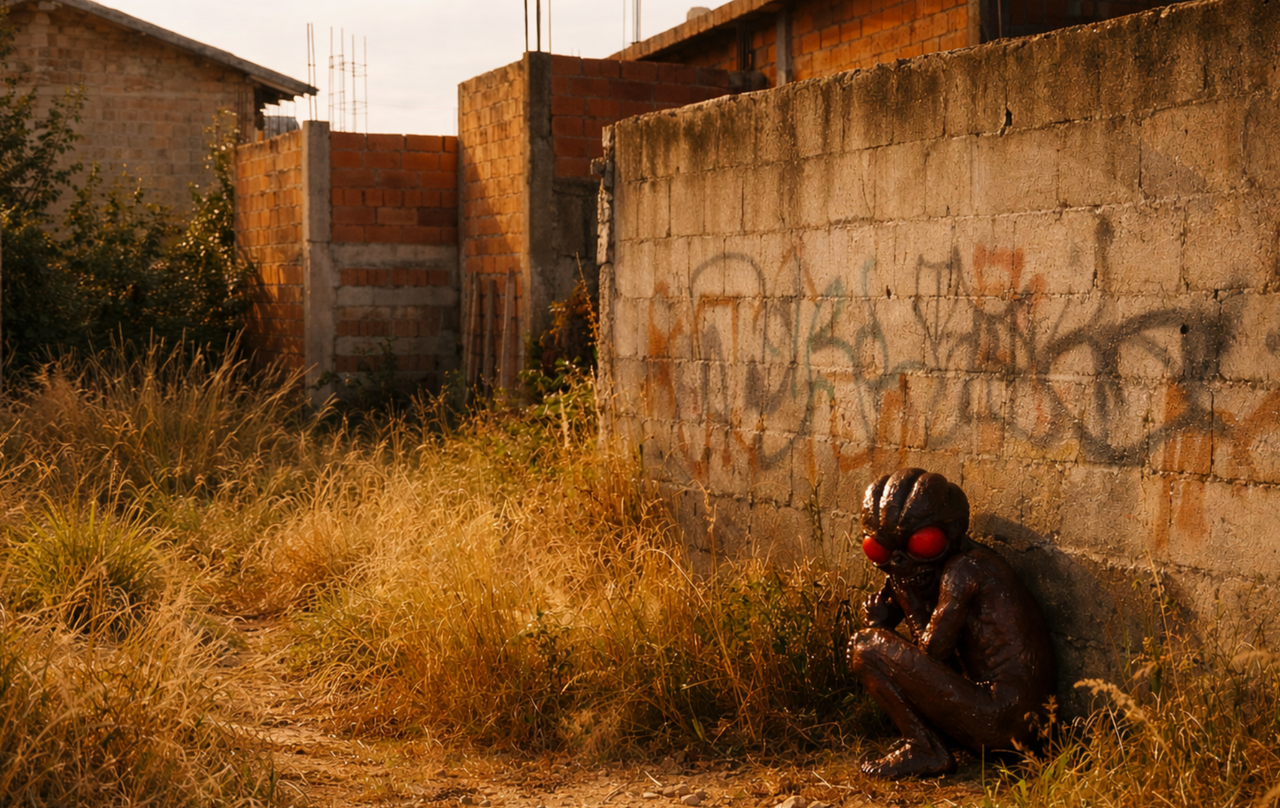
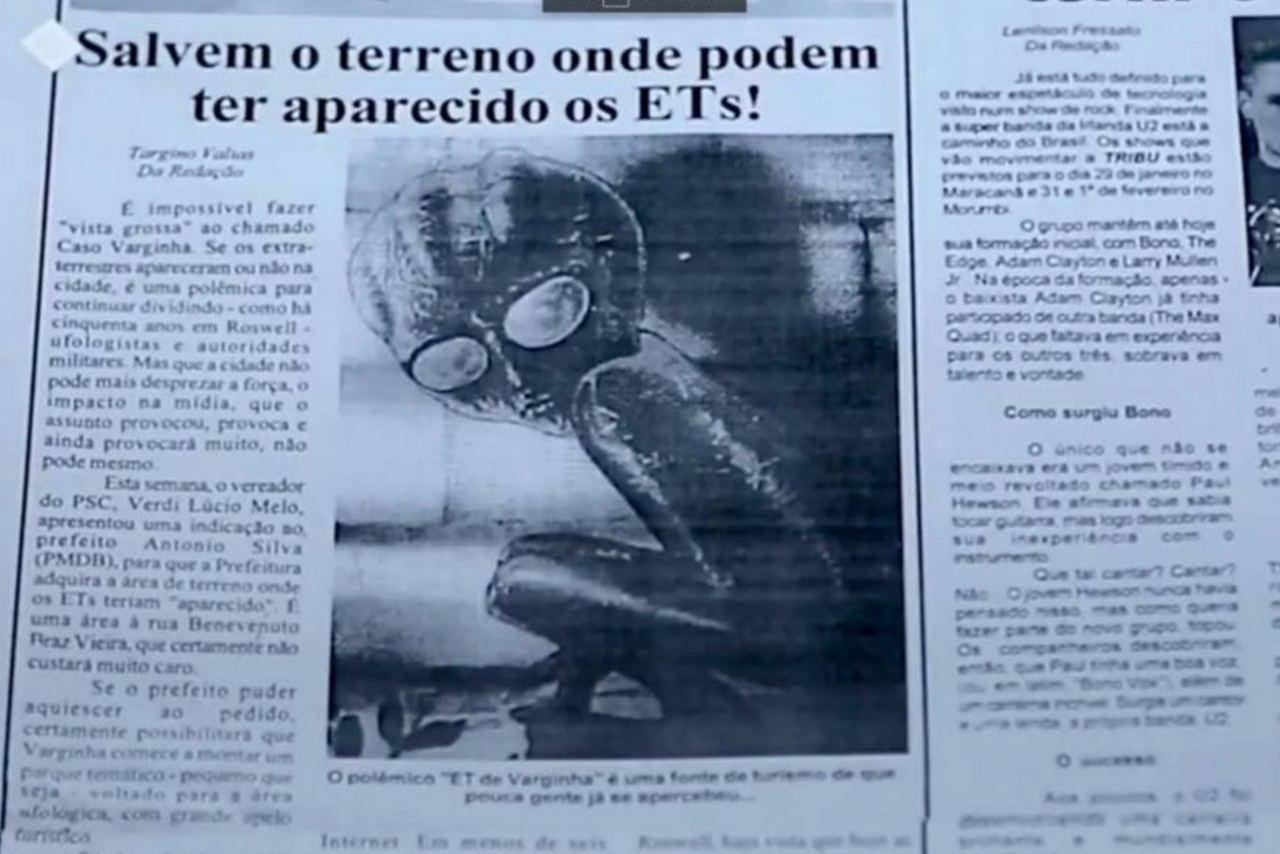
The “alien being” seen by three girls, just days after the alleged crash
This post is an attempt to lay out every well known detail of the Varginha incident, chronologically and comprehensively, drawing from the original Brazilian investigations, international research, documentary work, and the most recent testimony that emerged in January 2026 at the National Press Club in Washington, D.C. Where accounts conflict, both versions are presented. Where evidence is lacking, that is noted plainly. The goal is not to convince anyone of anything. The goal is to put every piece of this puzzle in one place and let the reader decide what to make of it.
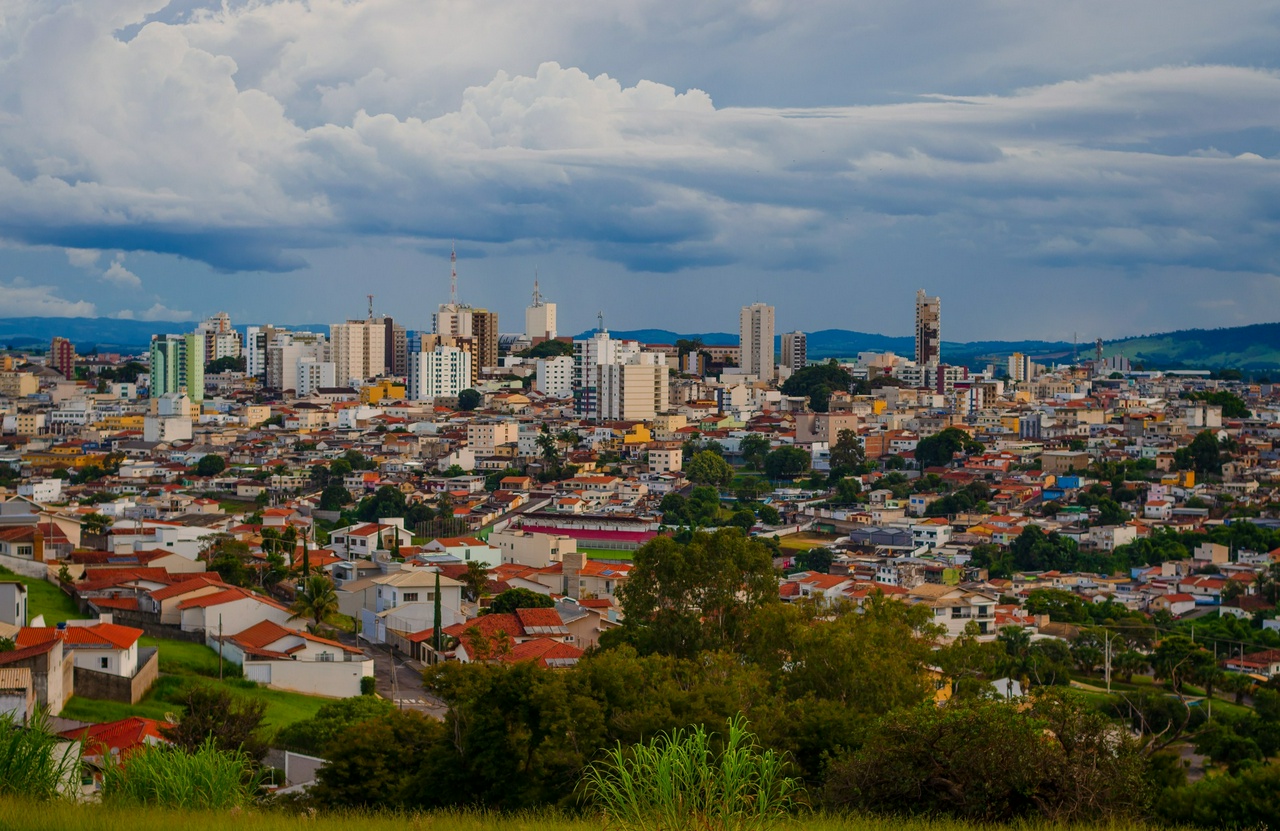
Varginha is a city of roughly 100,000 people in the landlocked state of Minas Gerais, in southeastern Brazil. Known primarily for its coffee production, the city sits in a region of rolling hills and cattle country about 300 kilometers north of São Paulo. Minas Gerais has long had a reputation as a hotspot for UFO-related reports in Brazil, though Varginha itself had no particular connection to the phenomenon before January 1996.
In the days and weeks leading up to the central events, residents of the broader region reported an increase in unusual aerial activity. Lights in the sky, objects moving in ways that conventional aircraft do not, the kinds of reports that fill UFO databases around the world. On their own, these sightings would have been unremarkable. In retrospect, they form the opening act of something much stranger.
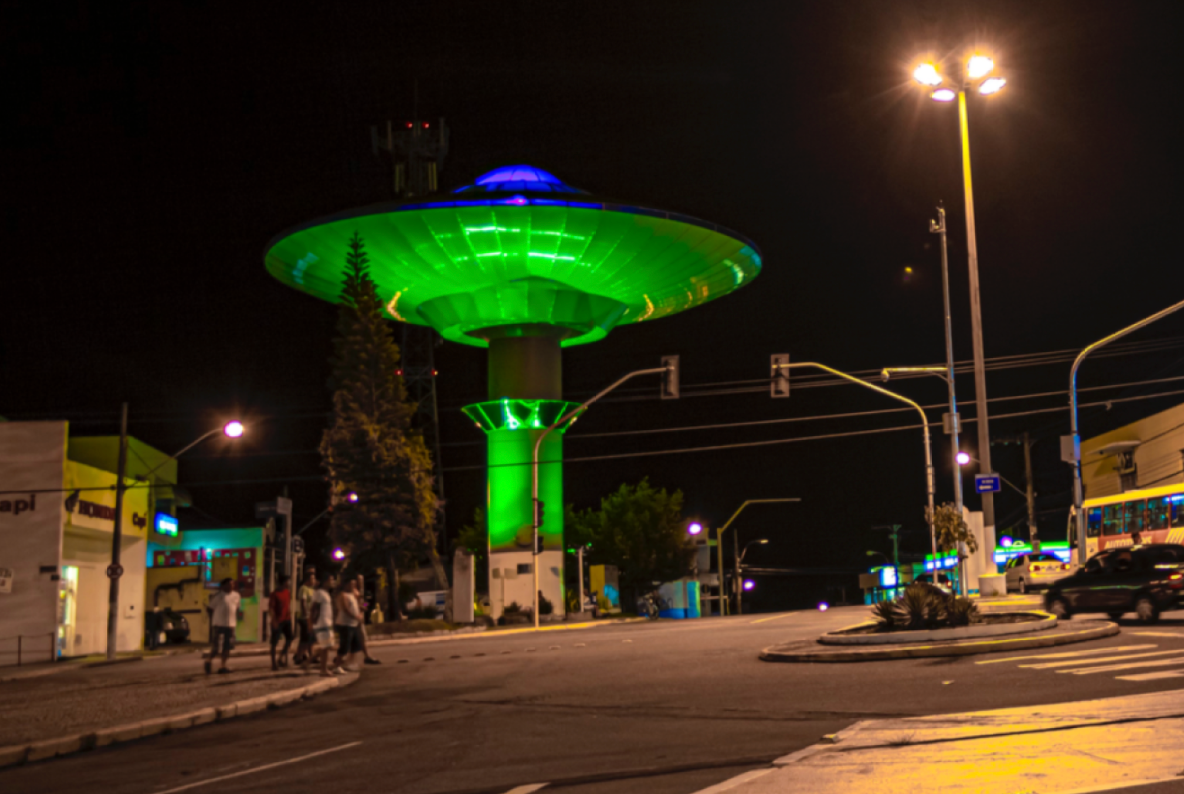
The UFO shaped monument was created in Varginha after the incident.
NORAD, CINDACTA, and the Alleged Tracking of an Unknown Object
According to claims that surfaced through Brazilian UFO researchers, particularly Vitório Pacaccini, the North American Aerospace Defense Command (NORAD) detected an uncorrelated object entering the western hemisphere in mid-January 1996. NORAD allegedly contacted its Brazilian counterpart, CINDACTA (Centro Integrado de Defesa Aérea e Controle de Tráfego Aéreo, or the Integrated Center for Air Defense and Air Traffic Control), to alert them that an unidentified flying object was descending over the southern portion of Minas Gerais state.
This information was reportedly leaked by both a Brazilian Air Force soldier and an employee at the radar facility of Air Force Base VI Comar. According to these sources, CINDACTA in turn alerted the Brazilian Army command at Três Corações, the military town about 25 kilometers from Varginha that houses the Escola de Sargentos das Armas (ESA), the Army's Sergeants School and a major military installation with over 5,000 personnel. All branches of the Brazilian military in the region were allegedly placed on heightened alert.
It should be noted that this claim has never been officially confirmed by NORAD, CINDACTA, or any Brazilian military authority. Some versions of the story go further, claiming that the United States Air Force had intercepted and damaged the object before it entered Brazilian airspace. This particular detail is even more difficult to verify and remains firmly in the category of rumor, though it has been repeated by multiple researchers over the years.
The Farming Community Sightings
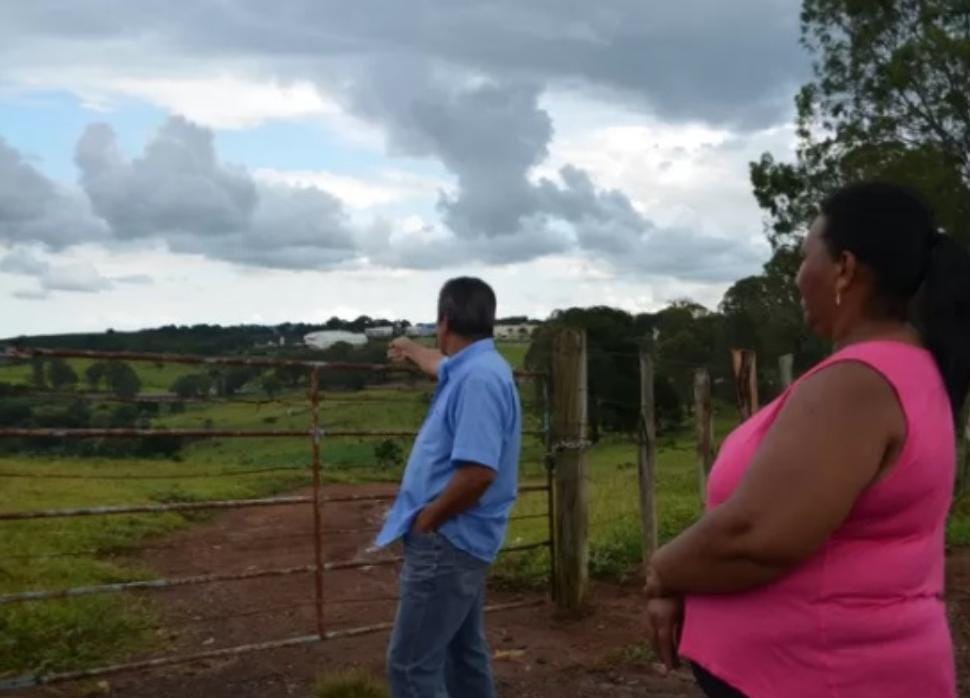
Local residents Eurico de Freitas and his wife Oralin pointing out where they sighted the flying object
Before the events in Varginha proper, rural residents in the surrounding area reported their own encounters. Among them were Eurico de Freitas and his wife Oralina, who lived on a farm outside the city. In the early morning hours of January 20, 1996, sometime around 1:00 AM, the couple was awakened by the panicked sounds of their farm animals. Cattle, chickens, and dogs were in a state of agitation, running back and forth across the fields.
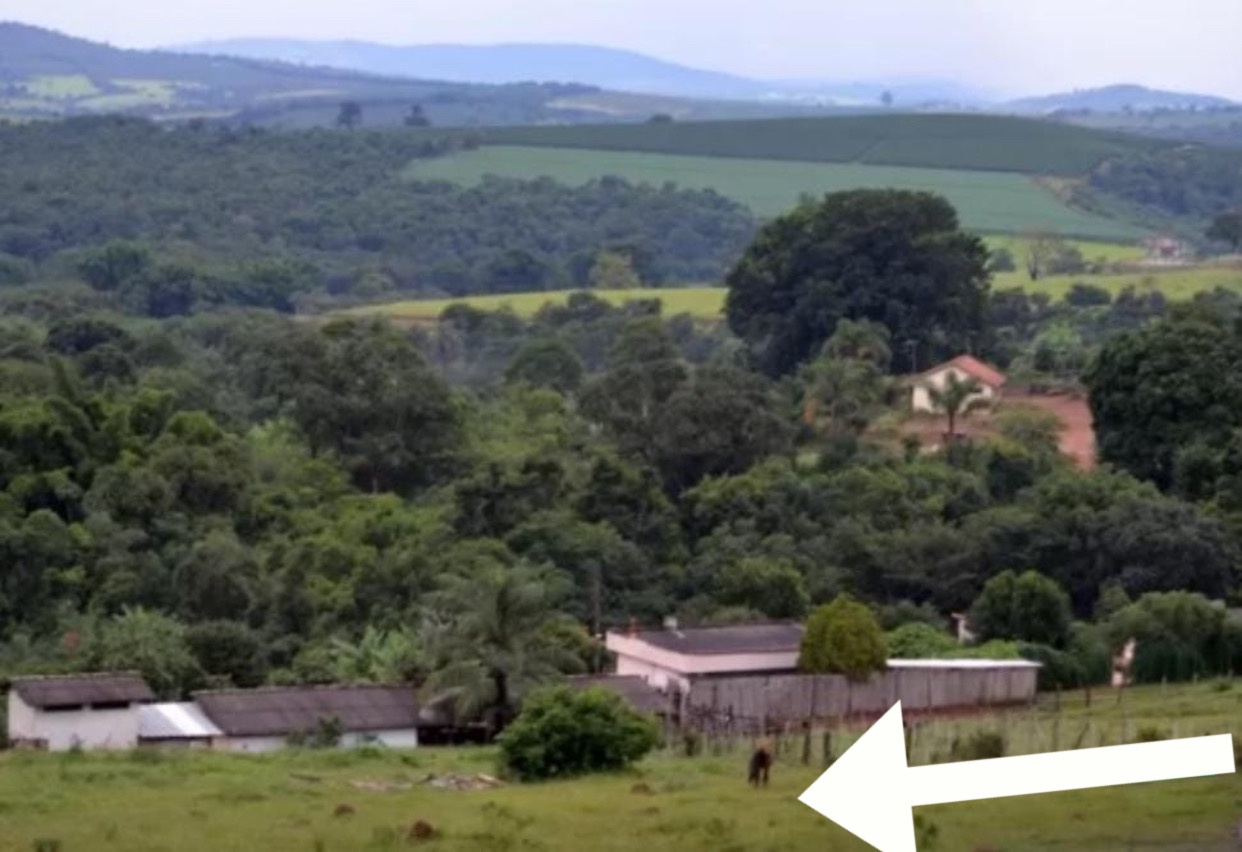
Exact location where Mr. Eurico and Mrs. Oralina saw the “Flying Object”
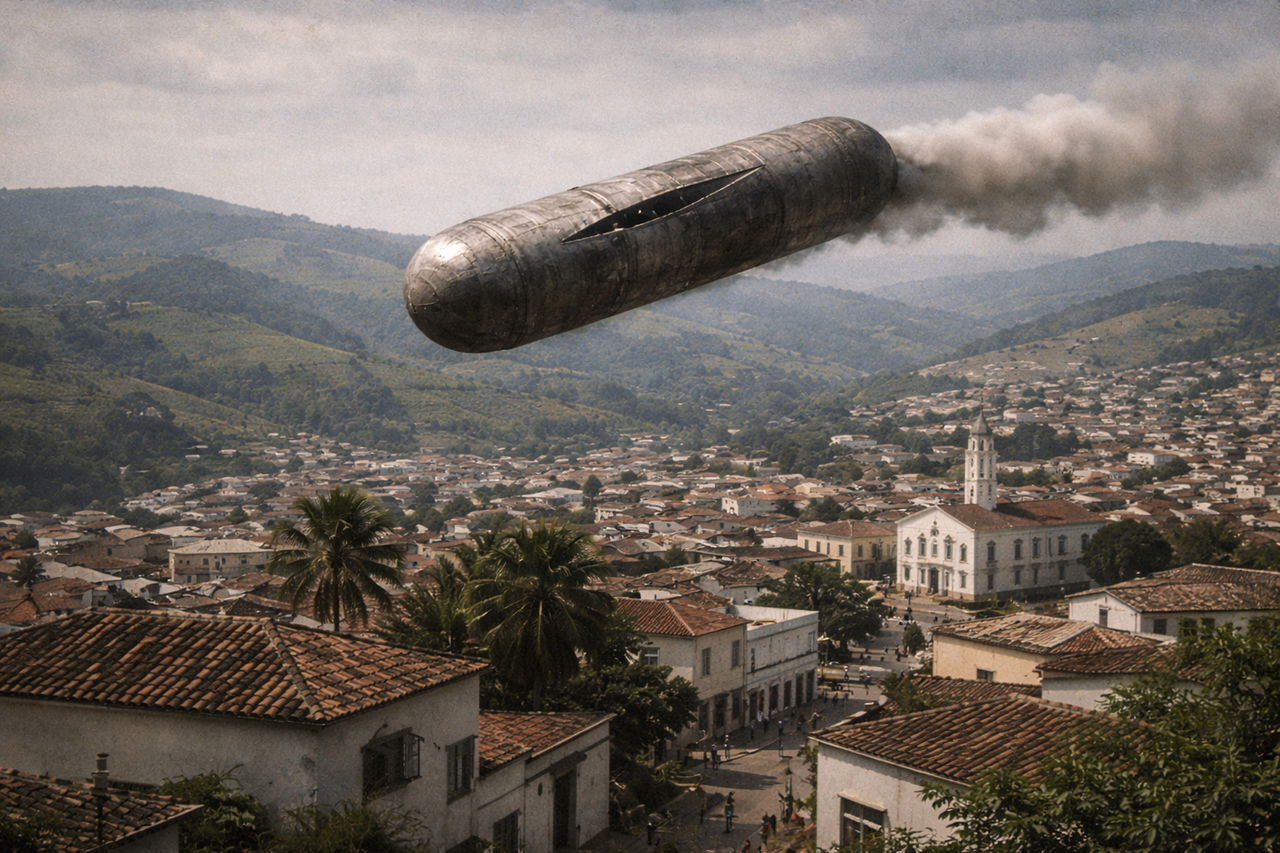
Looking out their window, the couple reported seeing a silent craft hovering approximately five to six meters above the ground. They described it as submarine-shaped or cigar-shaped, roughly the size of a minibus, with a dim light illuminating its hull. A small cloud of smoke or grayish vapor was emerging from the rear of the object. It moved slowly, swaying gently from side to side, and took roughly 45 minutes to drift out of view, heading in the general direction of Varginha.
Also on January 13, the same day as the crash described in the next section, resident Afrânio da Costa Brasil and his nine-year-old daughter Emeline reportedly watched a strange craft hovering near their home. Emeline's drawing of the object, depicting a cigar or submarine-shaped form, would later match descriptions provided by other witnesses who had no contact with the family.
These sightings established a pattern: something was in the skies over southern Minas Gerais in the days before everything changed. But the farming community reports were just atmosphere. What happened on January 13 was the main event.
January 13, 1996: The Crash Witness
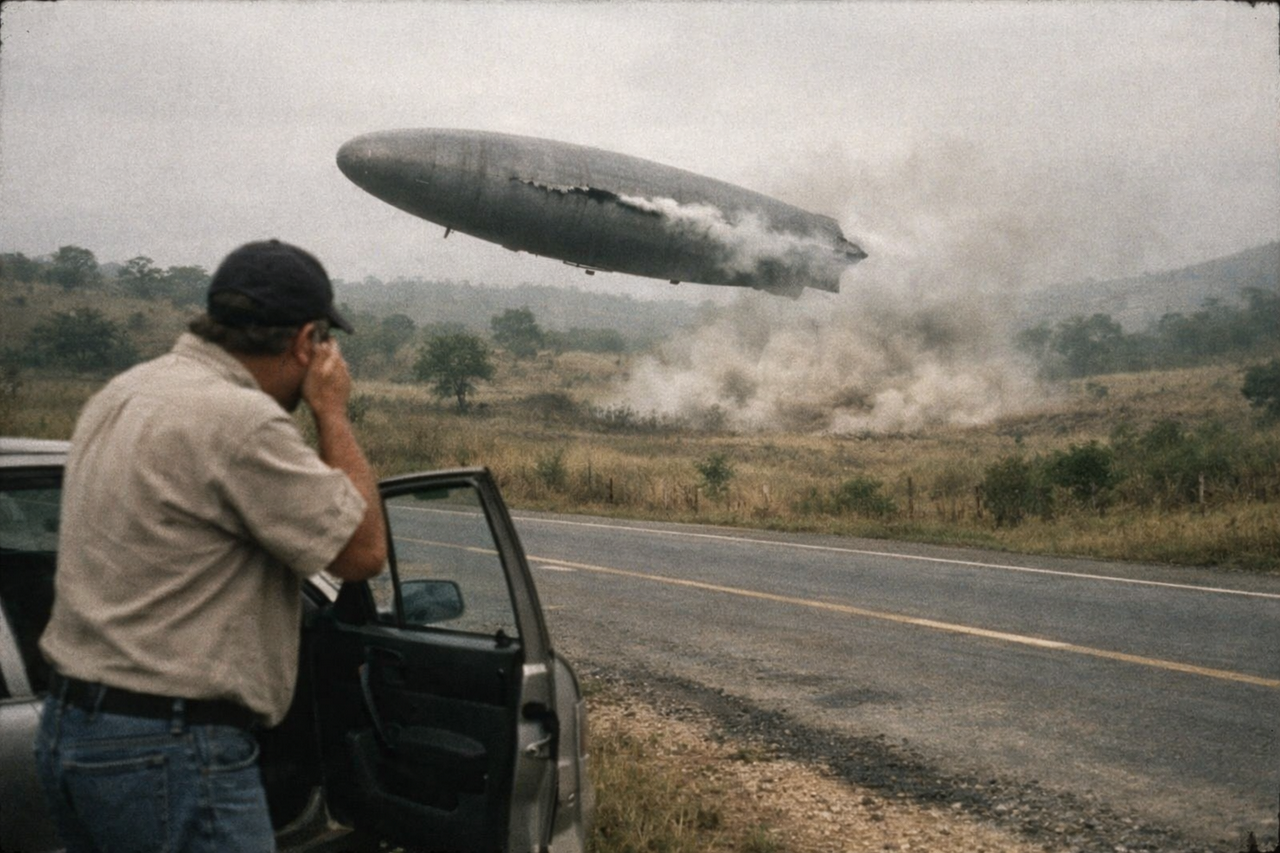
If the Varginha case has a Roswell, this is it. Not the creature sightings a week later, not the hospital encounters, not the military convoys through city streets. The story begins with a craft falling out of the sky and a man who stopped to help.
Carlos de Sousa was a local resident, a geography teacher at a nearby university, and an amateur ultralight pilot with enough flight hours to know what a conventional aircraft looks like in distress. On January 13, 1996, he was driving from São Paulo toward Minas Gerais to visit friends when he noticed something in the sky ahead of him.
It was cylindrical, roughly the size of a school bus, moving at an altitude of 300 to 400 meters. At first, de Sousa thought it might be a blimp or a small aircraft in trouble. It was not behaving like any aircraft he had ever seen. He would later compare its movement to a “broken washing machine,” lurching and struggling to maintain altitude, fighting against whatever force was pulling it down. There was a visible lateral tear along the side of the craft, and white smoke was trailing behind it. Not the black smoke of a fuel fire or engine failure. White smoke, as though something other than combustion was leaking from the hull.
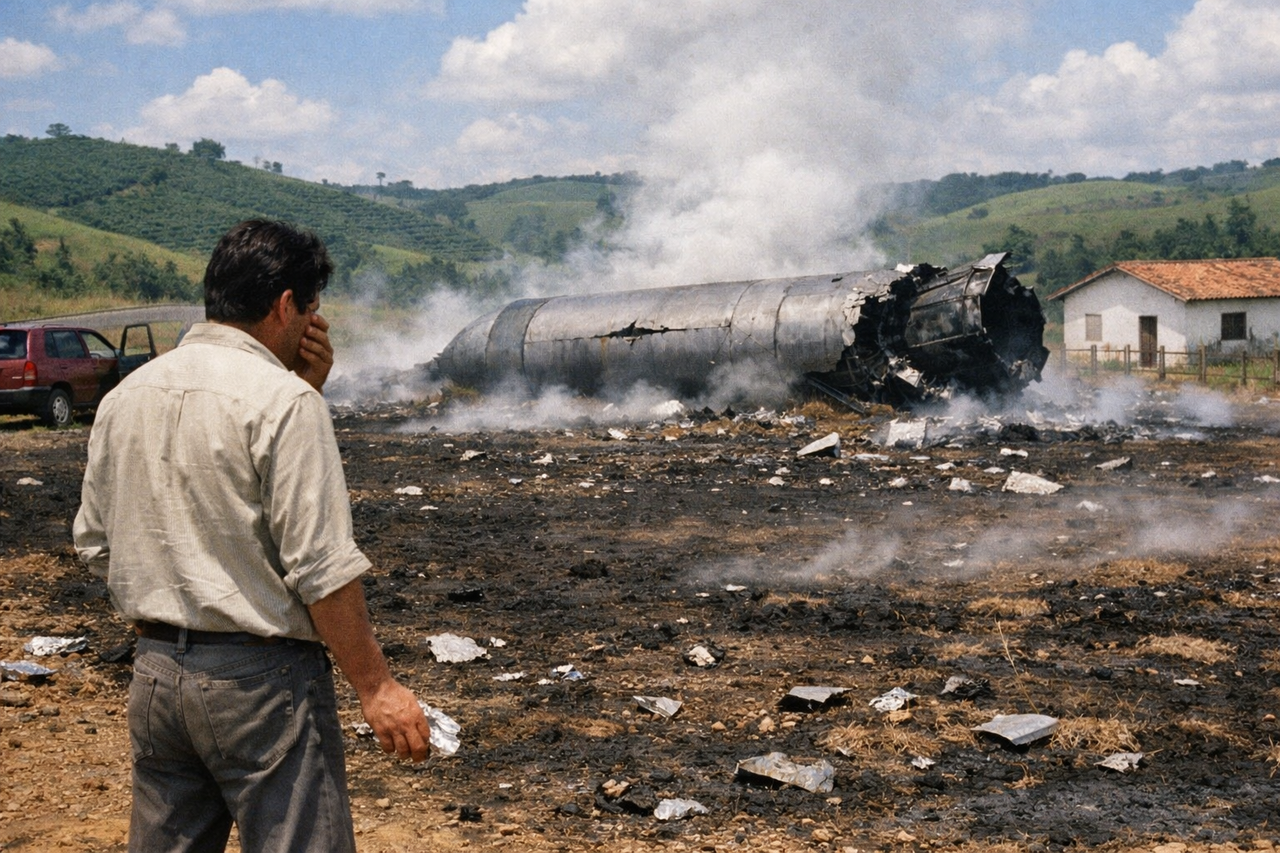
De Sousa watched the object lose altitude steadily. Just before it reached the highway, it made a sudden, sharp 360-degree turn, as if making one last attempt to correct its trajectory, and then flew in the opposite direction. It managed to glide for a few more moments before its propulsion appeared to die completely. It dropped out of the sky like a stone and crashed to the earth near a small white house alongside the road.
De Sousa is not the kind of person who drives past an accident. He was a teacher, a pilot, someone trained to assess situations. His immediate thought was that people might be hurt. He turned his car toward the crash site.
What he found was not what he expected.
The object had come down hard. The area around the crash was scorched. Burned grass extended in a roughly 40-meter diameter from the point of impact. Debris was scattered across the ground. And the smell hit him immediately: a thick, nauseating wave of ammonia and rotten eggs, so powerful that he had to cover his face. This was not the smell of jet fuel or burning rubber. It was chemical, acrid, and unlike anything he had encountered before
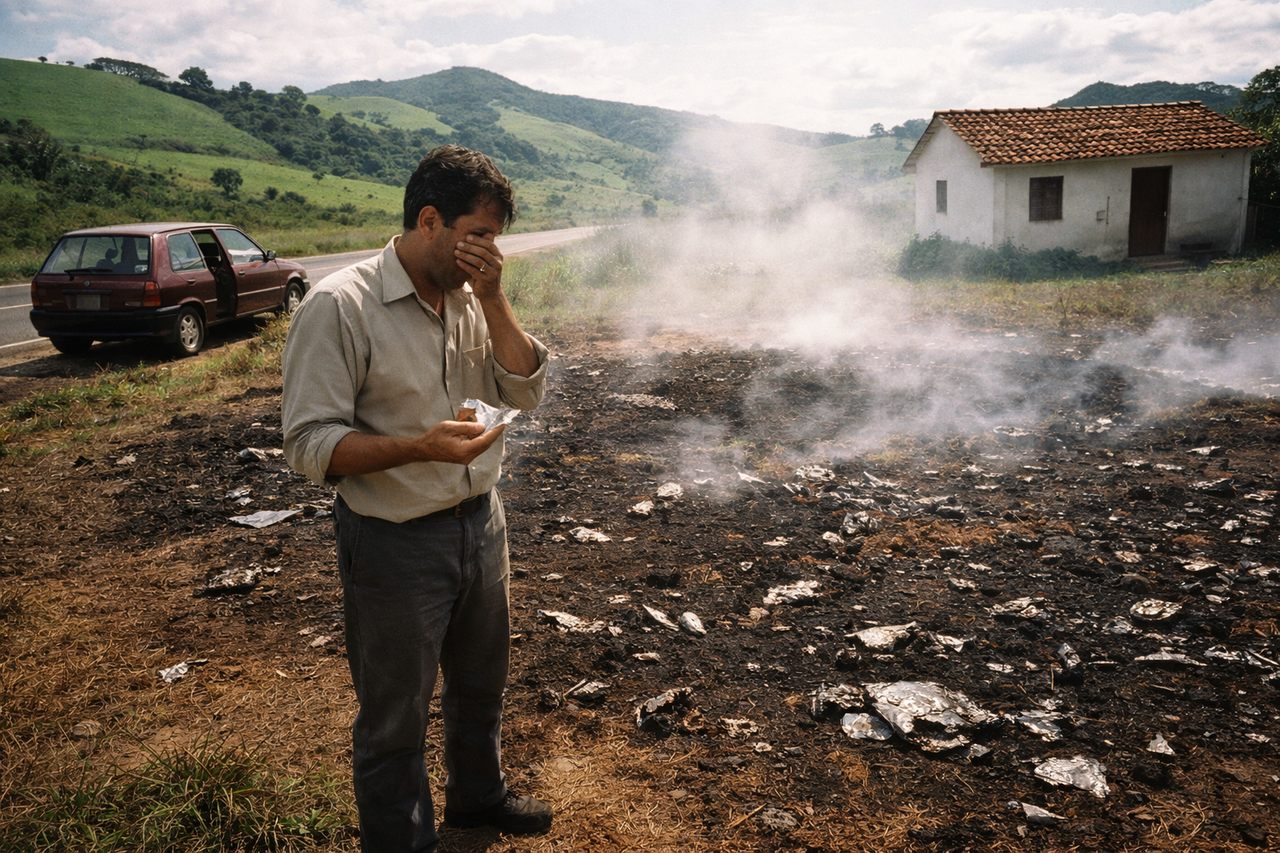
De Sousa approached the wreckage. Among the scattered debris, he picked up a fragment of material that looked like aluminum foil. It was light. He crumpled it in his fist, the way you would crush a ball of tinfoil. And then he watched it unfold itself. The moment he released pressure, the material sprang back to its original shape, smooth and unbent, as though it had never been touched. He crumpled it again. It sprang back again. This detail, so specific and so strange, echoes one of the most persistent claims from Roswell witnesses in 1947, who described “memory metal” debris that behaved in exactly the same way.
De Sousa did not have long to investigate. Within minutes, military trucks arrived at the scene. This response time is itself remarkable. The crash had just occurred, in a rural area along a highway, and yet the military was already there. It suggests either extraordinary coincidence or that the Brazilian armed forces were already tracking the object and had units positioned to respond.
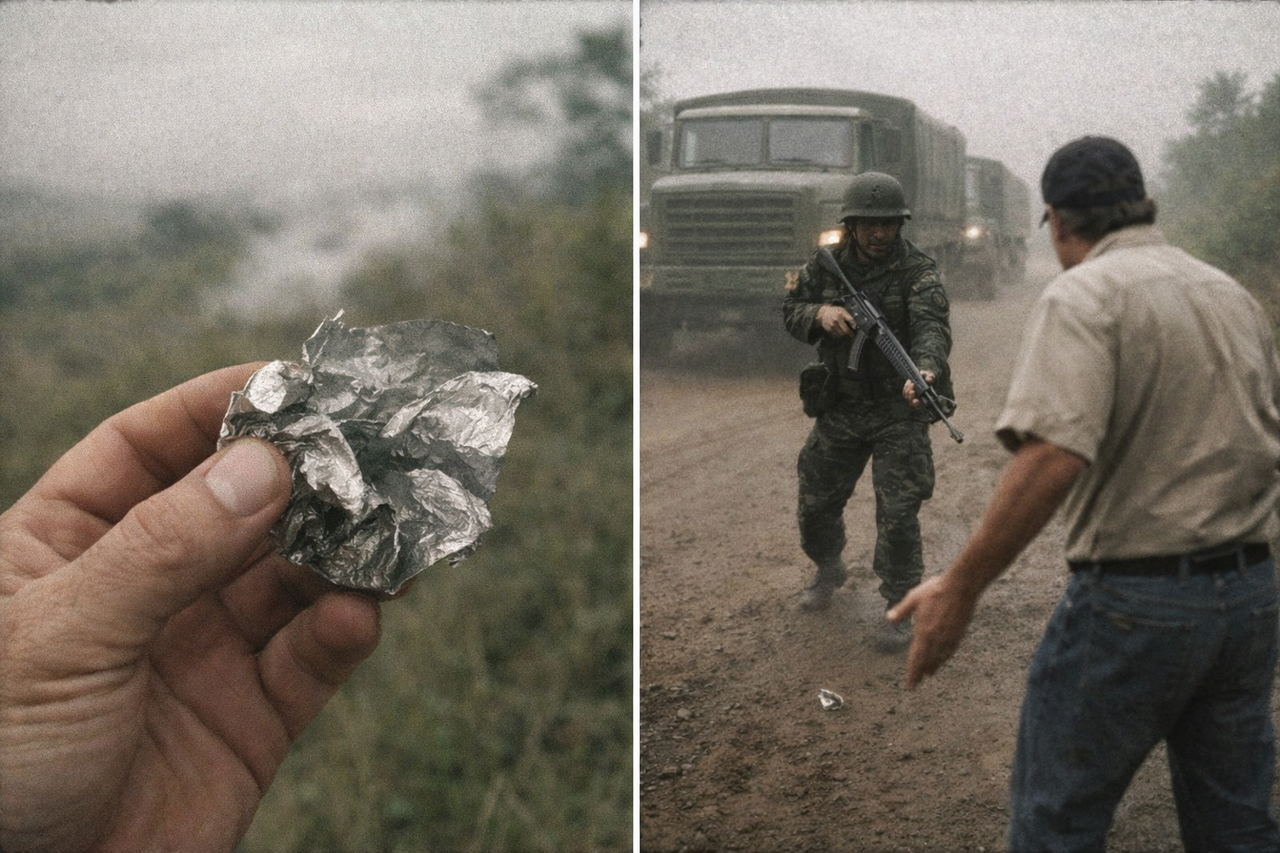
A soldier approached de Sousa. There was no conversation. No request for identification. No attempt to assess whether he was injured or in need of assistance. The soldier aimed his weapon directly at de Sousa's head and delivered a message that left no room for interpretation: “Leave now, or I'll split your skull.”
De Sousa dropped the fragment of debris. He got back in his car. He left.
But the encounter was not over. Shortly after fleeing the crash site, de Sousa was intercepted by two men in an unmarked dark vehicle. They were not in military uniform. They did not identify themselves. What they did was recite his personal information back to him: his name, his wife's name, his occupation, details about his life that a stranger should not have known. The message was clear: we know who you are, we know where to find you, and we know how to reach the people you love. They demanded his silence. They threatened his family if he spoke about what he had seen.
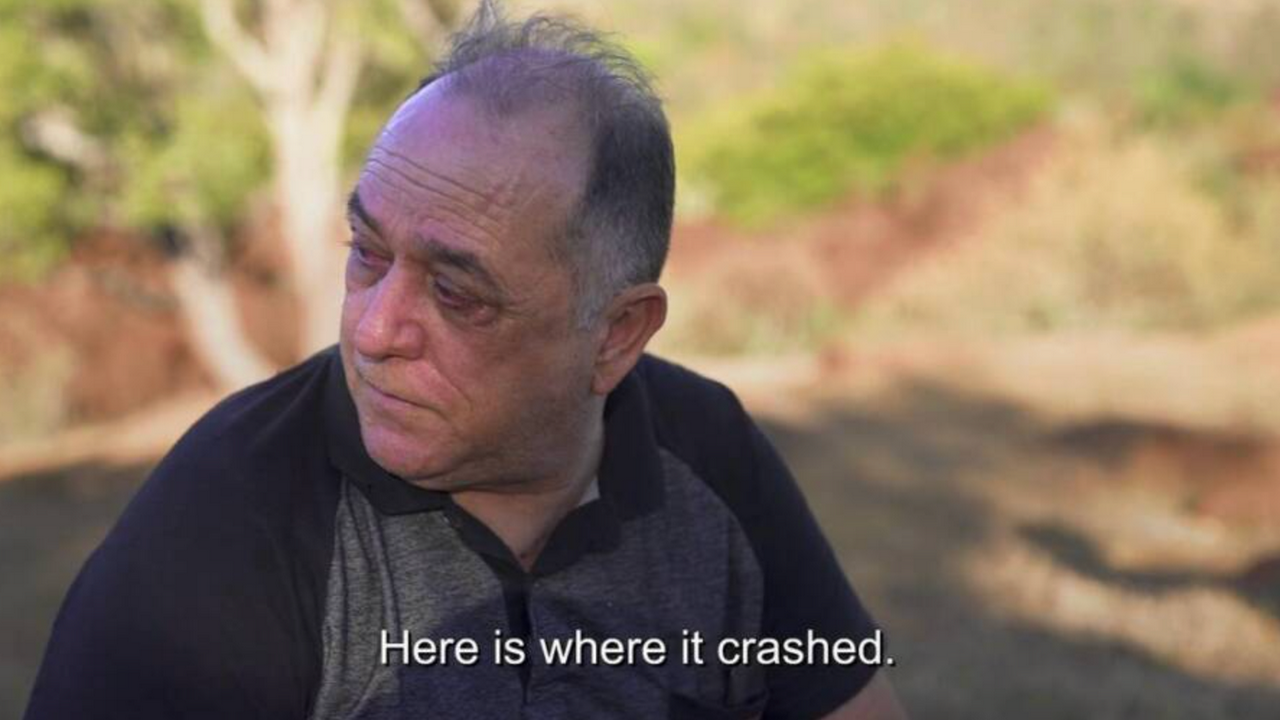
Carlos de Sousa went quiet. He gave one interview, in 1996, to Brazilian researcher Claudeir Covo. He spoke briefly on camera about what he had witnessed, describing the craft's movement and appearance. And then he disappeared from the public record for twenty-six years.
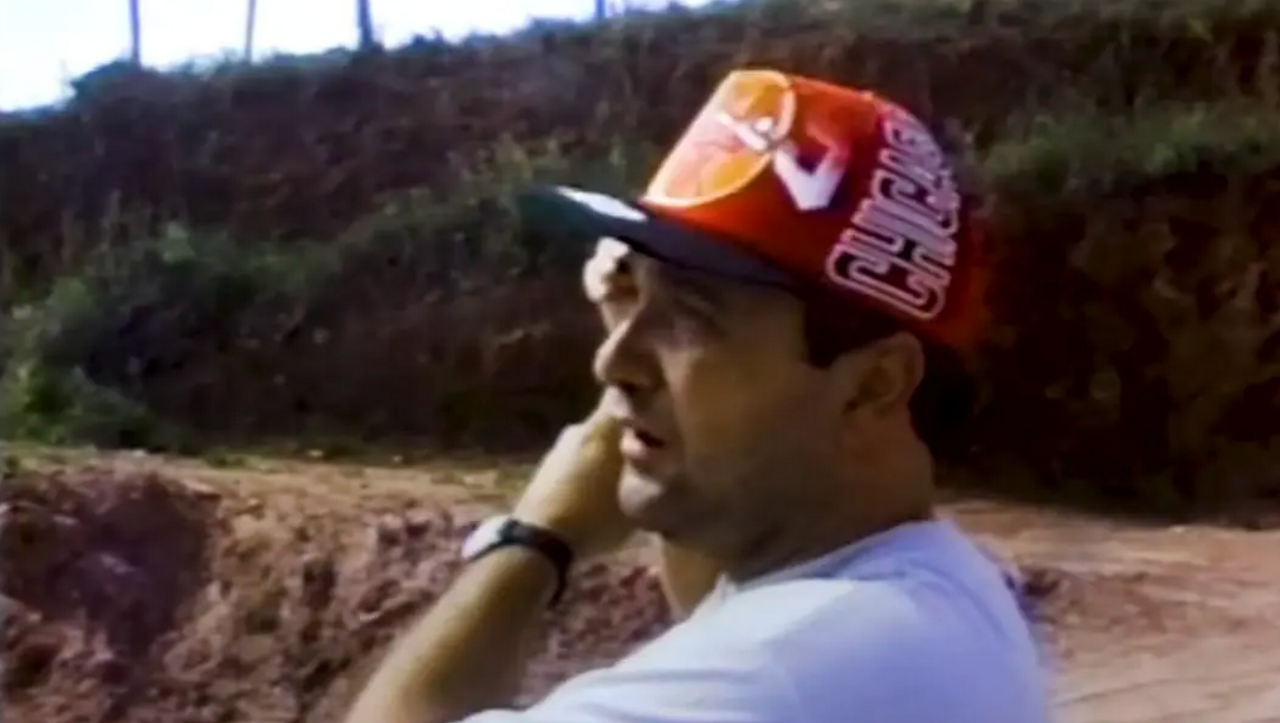
Still from the original interview Carlos gave in 1996
Think about what that means. For over a quarter of a century, a man who watched something fall out of the sky, who walked through the debris field, who held a piece of material that defied the known properties of any substance he had ever encountered, who had a gun pointed at his head by his own country's military, said nothing. He did not seek fame. He did not write a book. He did not sell his story to a tabloid. He raised his family, taught his classes, and carried the weight of what he had seen in silence.
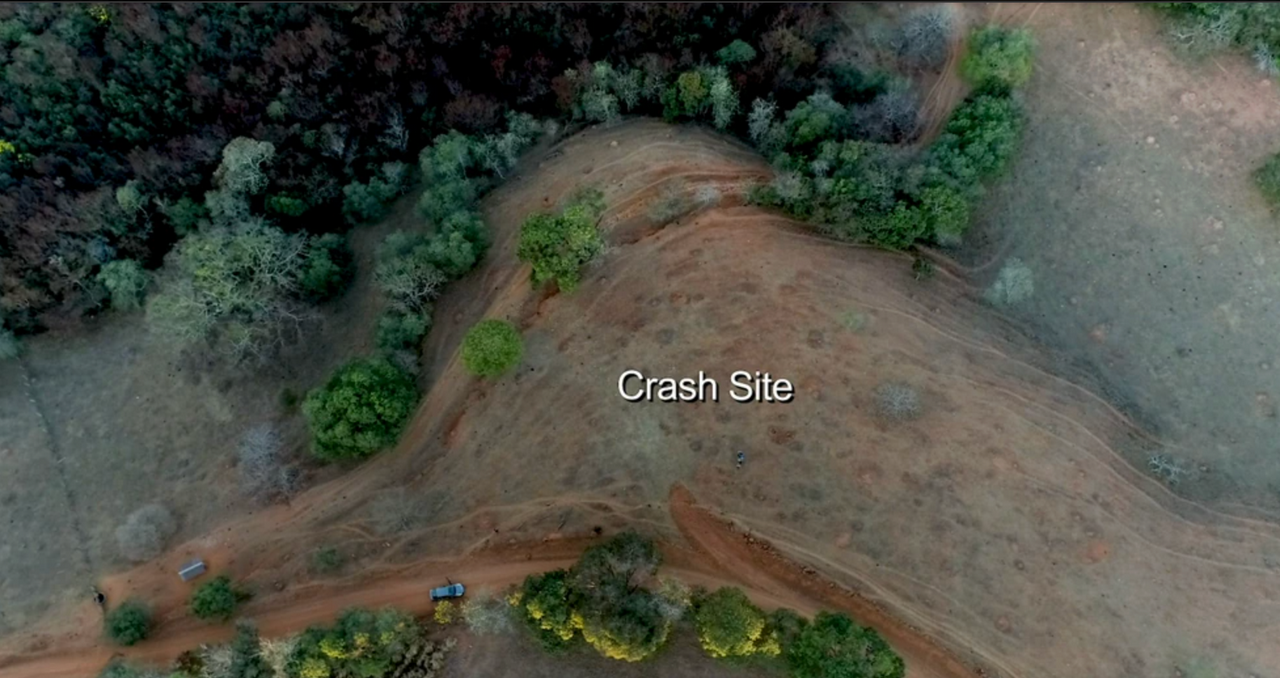
Drone image of the crash sight from above
It was not until James Fox tracked him down for the documentary Moment of Contact, released in 2022, that de Sousa agreed to speak again. And even then, it was reluctant. He had spent 26 years being ridiculed by the few people who knew his story. He had no financial incentive. He had nothing to gain and everything to lose.
Fast forward to the present, On January 2026, James Fox held press conference at the National Press Club in Washington, D.C., de Sousa stood before an audience that included a United States Congressman and described the object he had seen crash thirty years earlier. He used his hands to demonstrate the cylindrical shape of the craft. He described the smoke, the smell, the debris, the material that rebuilt itself in his palm. And he described the soldier, the gun, and the men in the dark car who knew his wife's name.
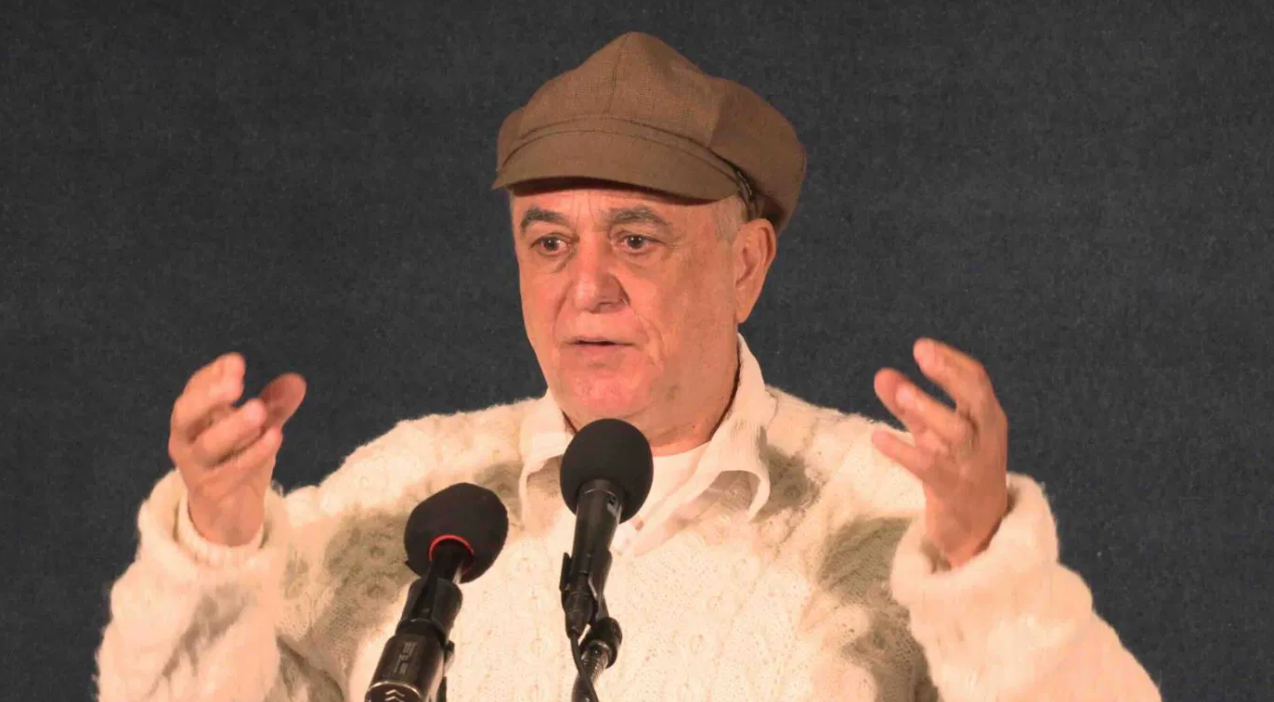
Carlos de Sousa speaking at the National Press Club in Washington (Jan 2026)
He concluded his testimony by acknowledging the toll. Thirty years of ridicule. Thirty years of people doubting his account or mocking him for telling it. He emphasized that there was no advantage to be gained from his story, no financial profit, no fame he was seeking. He simply wanted, after all this time, for people to take his experience seriously.
The crash Carlos de Sousa witnessed on January 13 is the event that sets the entire Varginha timeline in motion. If a craft came down outside the city that day, and if the military was already on alert because NORAD had tracked the object into Brazilian airspace, then everything that followed, the creatures loose in the streets a week later, the firefighters and soldiers swarming Jardim Andere, the captures, the hospitals, the convoys, the death of a young policeman, all of it flows from this single point: something fell from the sky, and whatever was inside it survived the impact.
January 20, 1996: The Day Everything Changed
Saturday, January 20, 1996, is the date that anchors the entire Varginha case. What began in the predawn hours with the Freitas family's sighting unfolded throughout the day into a series of events involving firefighters, soldiers, police officers, civilians, and hospital staff that would transform a quiet coffee city into one of the most famous UFO locations in the world.
Early Morning: The Fire Department Call and the First Capture of a unknown “being”
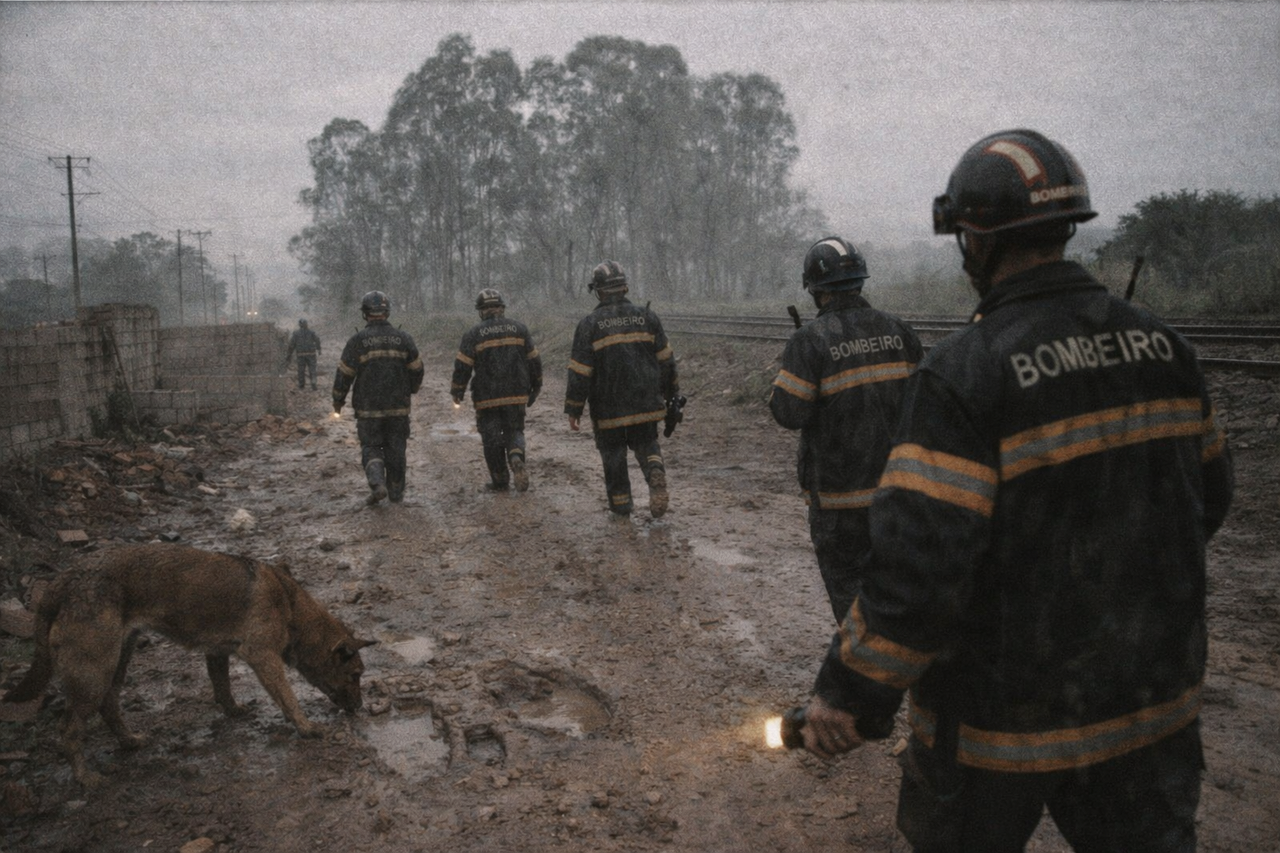
Sometime between 7:00 and 8:00 AM, the Varginha Fire Department received phone calls from residents of the Jardim Andere neighborhood reporting a “strange animal” in the wooded area between Jardim Andere and the Santana district. In Brazil, fire departments operate under the authority of the Military Police and routinely respond to reports of wild animals straying into urban areas. At first, the call was treated as nothing particularly unusual.
Around the same time, college student Hildo Lúcio Galdino, 20, who lived in Jardim Andere, reportedly opened his bathroom window and saw a creature with “oily dark brown skin crouched in the alleyway.” He described it as having very small hands with three extremely long fingers, “kind of like a starfish.” The creature ran away when Galdino cried out. He described it as hairless, unclothed, and roughly four to five feet tall.
By approximately 10:00 AM, firefighters in regulation uniforms, wearing thick gloves and carrying nets, arrived at the wooded area in Jardim Andere and began searching the vegetation. According to witness accounts compiled by researchers Ubirajara Franco Rodrigues and Vitório Pacaccini, the search lasted several hours. The firefighters reportedly spotted the creature and chased it through the brush before finally capturing it with the help of their nets.
Soon after the fire department arrived, a truck from the ESA military base in Três Corações pulled up to the site. Soldiers entered the woods as though on a special mission. Two civilian witnesses, including a man named Henrique José da Silva, reported hearing what sounded like four rifle shots from the wooded area.
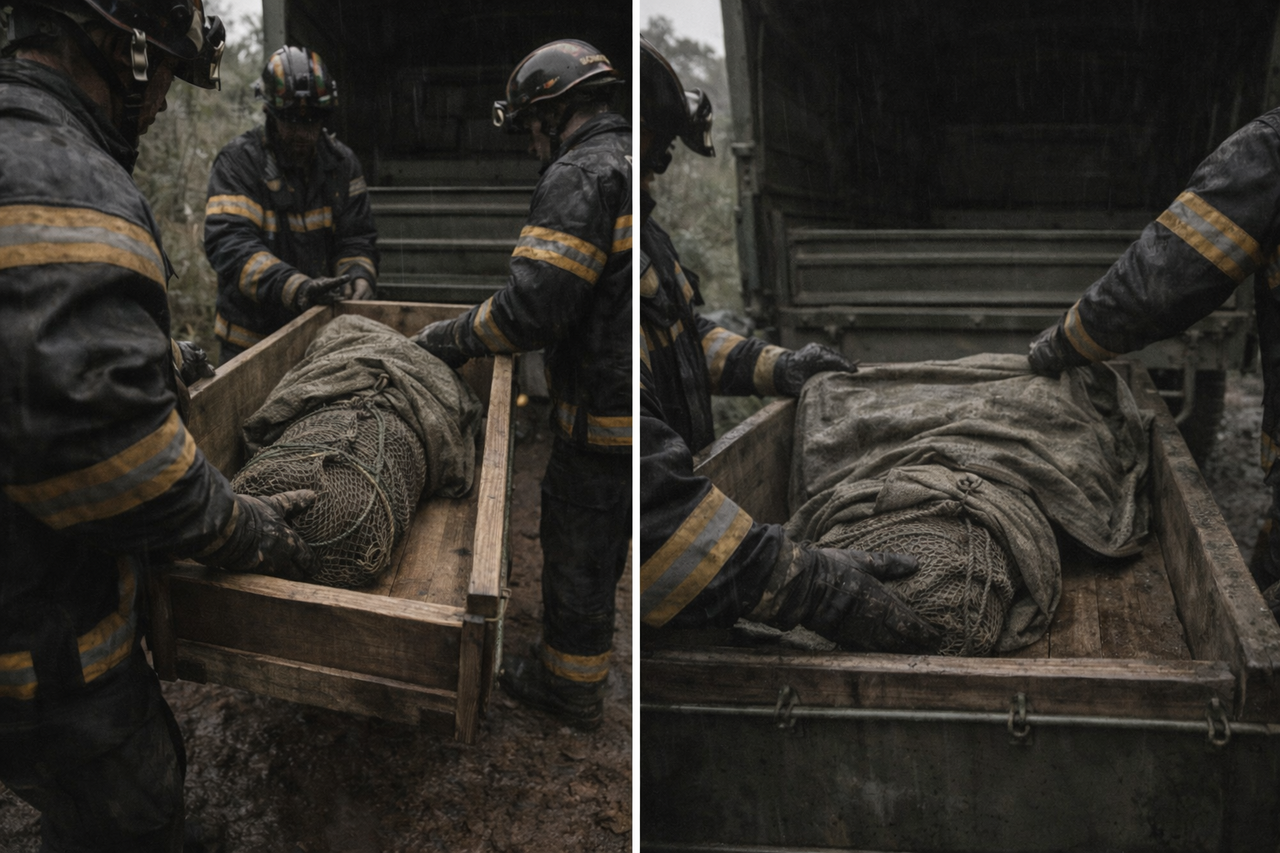
Multiple witnesses reported seeing military personnel with camcorders documenting the scene. The creature was allegedly placed into a wooden box covered with a white plastic canvas, stretched taut so that the contents could not be seen, and transported away by an army truck.
Researcher Graham W. Birdsall, the British UFO journalist who was among the first Western investigators to compile a comprehensive timeline of the events, described the captured being as roughly 3.5 feet tall with oily brown skin, disproportionately large blood-red eyes, and three raised ridges on its head. It appeared injured, emitted a faint buzzing sound “like bees,” and had only a tiny mouth opening.
The involvement of specific military officers has been alleged by investigators. Lieutenant Colonel Olímpio Wanderley Santos was identified as the chief of operations at the site. Major Maciel was named as the chief of the first capture operation. These names were compiled from both the fire department insider source and civilian witnesses.
It is worth noting that in later years, newly released fire department documents obtained under Brazil's Access to Information Law revealed serious gaps in the official record for January 20, 1996. Researcher Rony Vernet found that only nine incidents were logged for the entire day, a remarkably low number compared to other days in January 1996. The morning period was particularly suspicious, with only one incident recorded, a medical emergency, whose logged duration seemed far too brief to reflect the true nature of the event. Logs appeared to have been renumbered and, in some cases, erased.
3:30 PM: The Three Girls' Encounter
The most famous moment of the Varginha case occurred that afternoon.
Liliane Fátima Silva (age 16), her sister Valquíria Fátima Silva (age 14), and their friend Kátia Andrade Xavier (age 22) were walking home from a domestic work assignment. They decided to take a shortcut through a vacant lot on Rua Dr. Benevenuto Braz Vieira in the Jardim Andere neighborhood, roughly two kilometers from the town center.
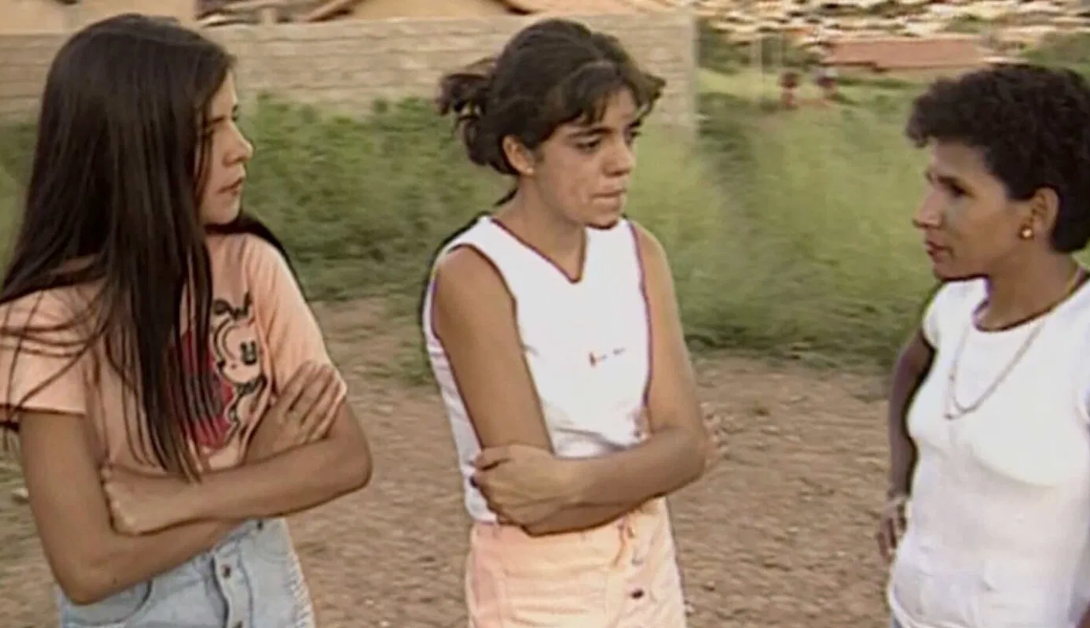
Some houses in the area were under construction. The lot was overgrown with tall grass. It was there, at approximately 3:30 PM, that Liliane noticed something crouched against a wall, partially hidden beneath some graffiti.
What she saw stopped her in her tracks.
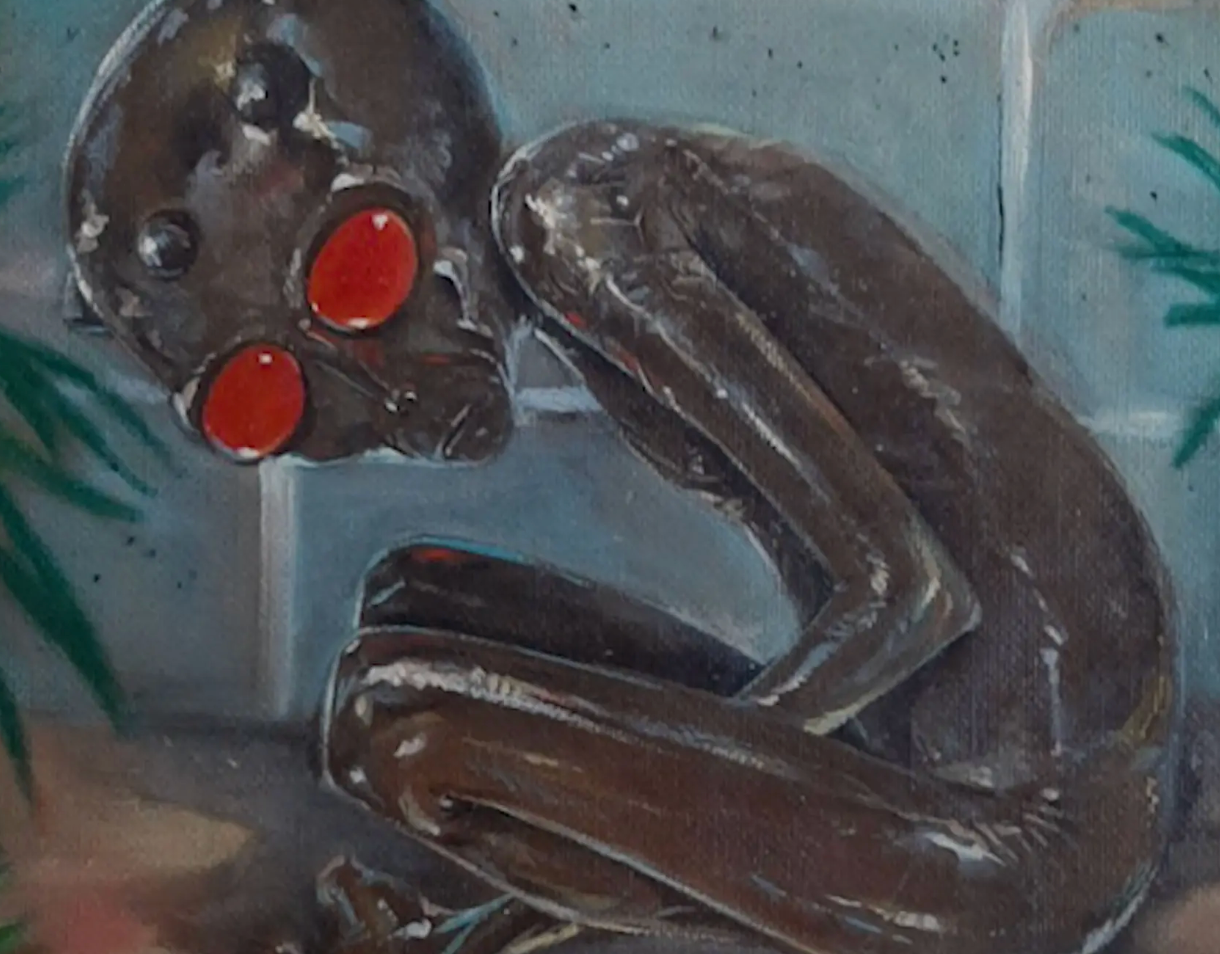
The creature was small, perhaps 80 centimeters to one and a half meters tall (accounts vary between roughly 2.5 and 5 feet). It was crouching, appeared naked, and had no visible sexual organs. Its head was disproportionately large, roughly triangular in shape. Three large ridges or protuberances ran from its forehead to the back of its skull. Its eyes were enormous, red, oval-shaped, and appeared to bulge outward. They lacked visible pupils. Its skin was dark brown, oily-looking, with prominent veins visible on the surface. It had a very small mouth, barely a slit. The nose was almost nonexistent. No ears were visible. Its arms were thin, its hands small, with three extremely long fingers. Its feet were large with a V-shaped structure.
The creature was not aggressive. According to all three witnesses, it appeared scared, vulnerable, as if it were suffering.
And the smell. Every witness mentioned the smell. A powerful, acrid odor, compared to ammonia or sulfur, that was almost unbearable.
Liliane screamed. The creature looked at her. In her words, given nearly thirty years later for the January 2026 press conference: “When I saw it, I had a terrible feeling as if the world had stopped. The creature looked at me. I looked into its eyes. It gave me a sensation that it was suffering, that it was asking for help, hiding from someone.”
All three ran. They fled to the home of Liliane and Valquíria's mother, Luiza Helena da Silva, and told her they had seen the “devil.”
Valquíria confirmed the details: “It was brown, it had red eyes, the skin was bright, like an oil, and had three horns.”
Kátia added: “It had three fingers on its hand, a big foot. It seemed he was suffering, asking me for help.”
Luiza, their mother, went back to the scene with Kátia approximately twenty to thirty minutes later. The creature was gone. But she found a V-shaped footprint on the ground with three large toes, and the acrid ammonia smell remained so strong that it lingered in her nose for several weeks afterward.
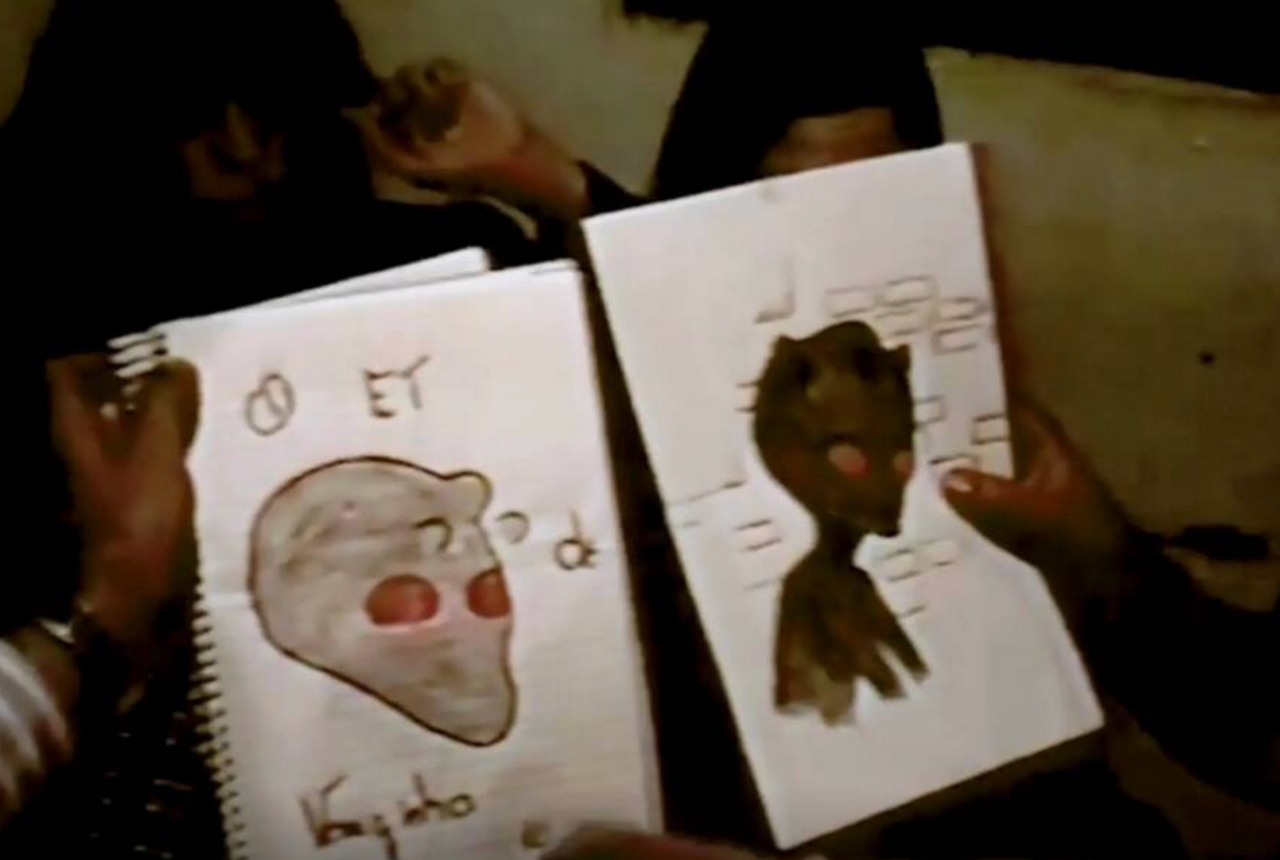
Sketches drawn by the girls
The consistency of the three girls' testimony over the ensuing decades is one of the most frequently cited aspects of the case. They were interviewed extensively in 1996 by Ubirajara Franco Rodrigues and Vitório Pacaccini, and their accounts did not waver. They gave repeated interviews from 1996 through 1999, reportedly without seeking or receiving payment. In the 2000s, they declined to speak further without compensation, understandably fatigued by the constant requests. As Liliane put it: “Everything that we did and saw has already been spoken.”
For the January 2026 press conference organized by James Fox at the National Press Club in Washington, all three women provided fresh video statements. Their descriptions remained unchanged after thirty years. The same creature. The same details. The same feeling of encountering something in distress.
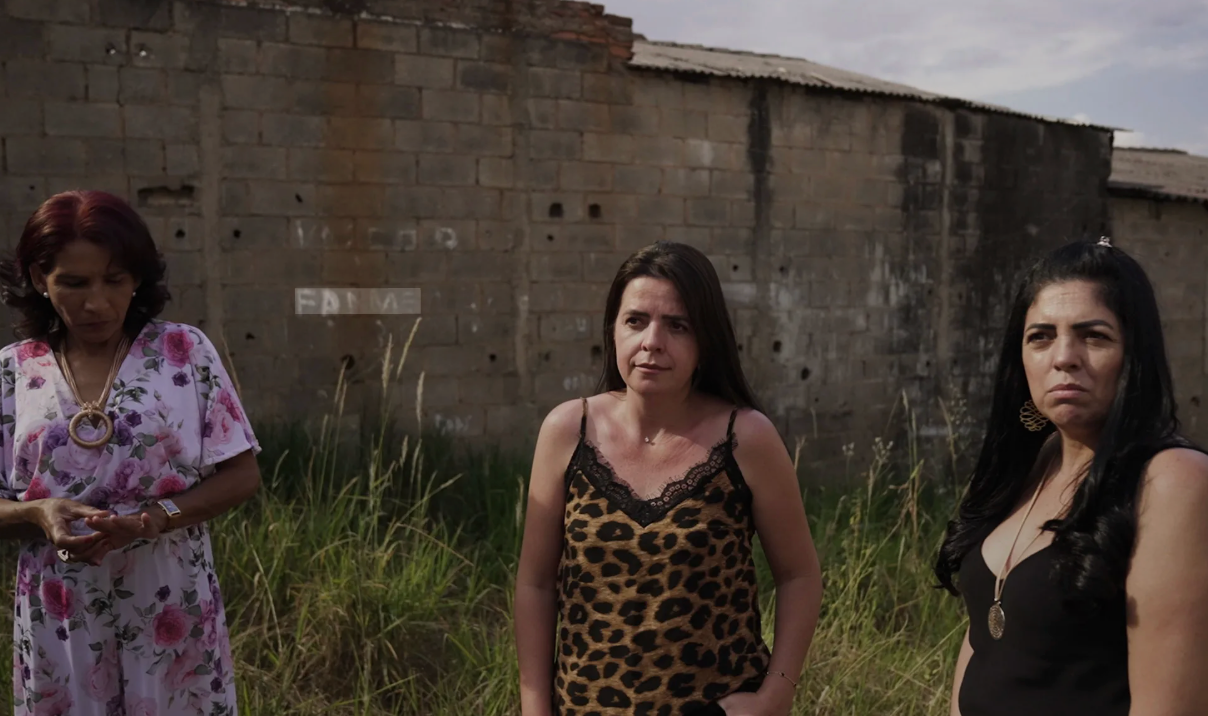
The girls go back to the location of the sighting in the James Fox Documentary “Moment of Contact” – 2022
The official Brazilian military investigation, concluded in 2010, offered a different explanation. The inquiry determined that the three young women had mistakenly identified a local homeless man nicknamed “Mudinho” (a Portuguese term meaning “little mute”). Mudinho was described as a mentally and physically disabled individual known in the community who would often crouch in corners and was frequently dirty. The investigators concluded that Mudinho, probably soiled from the heavy rains, was seen crouching by a wall and was mistaken for a creature.
However, the three women have always rejected this explanation. They knew Mudinho. They had seen him in the neighborhood on other occasions. What they encountered in the vacant lot, they insist, was not a human being.
Early Evening: Other Civilian Sightings
The three girls were not the only civilians to report seeing something strange that day.
Beyond Hildo Galdino's morning sighting, other witnesses came forward in the days and weeks that followed. A man jogging through the woods of Jardim Andere and a lawyer living nearby reported hearing gunshots and then seeing soldiers and police officers climbing up a slope carrying bags, some of which appeared to be moving.
At least one other sighting involved a couple who reported seeing a creature at a different location in the Varginha area, matching the same general description: small, dark-skinned, large-headed, with prominent red eyes.
A local taxi driver claimed to have seen a “shaking creature, like a child in pain,” being loaded into a truck by men in what appeared to be hazmat gear. His account was dismissed by officials
Around 8:00 PM: The Military Police Encounter and the Second Capture
Later that evening, as a sudden and violent rainstorm moved through Varginha with hailstones heavy enough to damage rooftops, the most consequential encounter of the day allegedly took place.
Two plainclothes military police intelligence officers (P-2, the Military Police's secret service division) were on a surveillance mission in the Jardim Andere area, tasked with observing any unusual activity. They were driving down Rua Benevenuto Braz Vieira, the same street where the girls had seen the creature hours earlier, when something darted across the road in front of their vehicle.
The driver braked sharply. Corporal Marco Eli Chereze, 23 years old, jumped out of the car.
What happened next depends on the source. The most commonly cited account, supported by Chereze's own family, is that he attempted to capture whatever had crossed the road. He grabbed the creature with his bare hands, without gloves or any protective equipment. During the struggle, the creature scratched his left arm. Chereze managed to wrestle it into the back seat of the vehicle
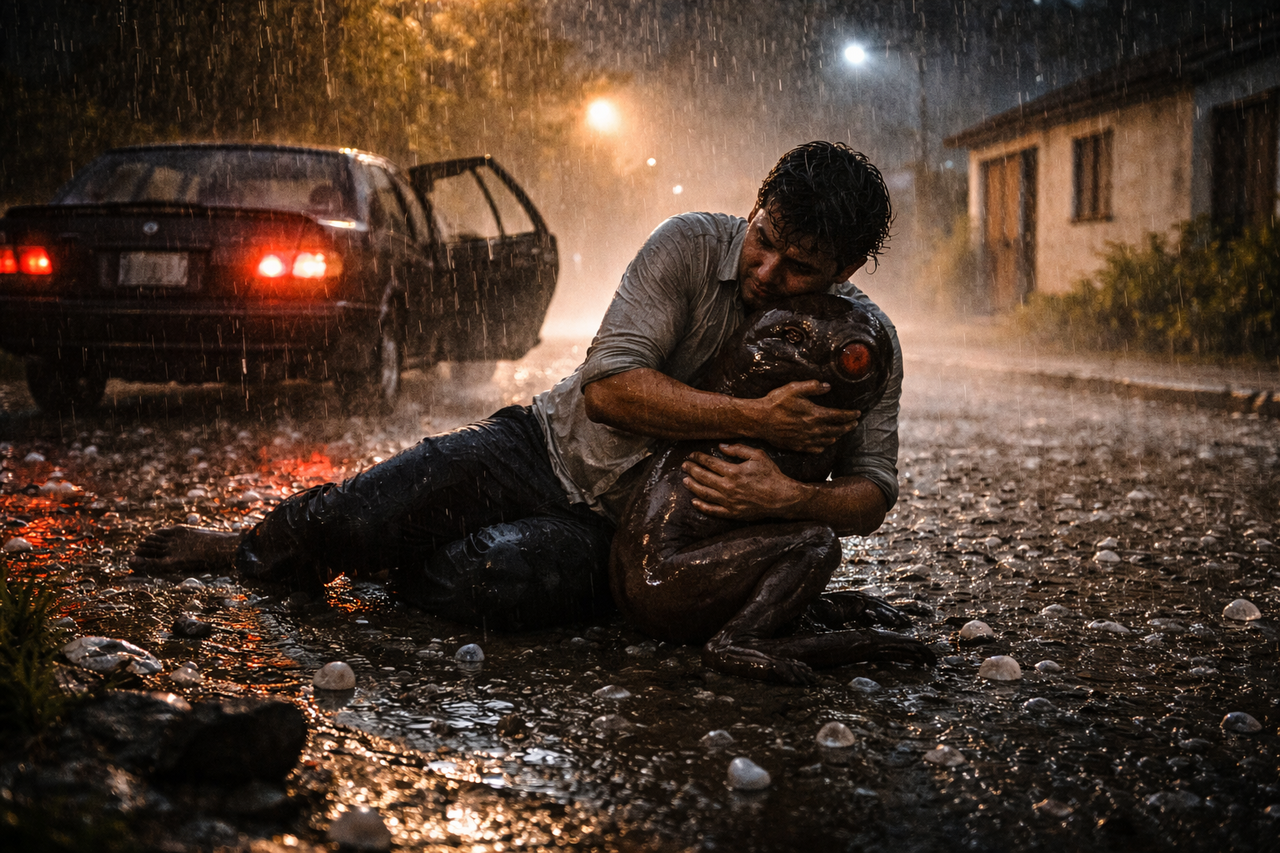
His partner at the time was Corporal Eric Lopes. Lopes has never publicly confirmed or denied the incident. When approached by investigators in later years, he allegedly pulled a gun on them and declared he knew nothing.
The creature was driven first to a health center in the city, which reportedly refused to accept it. Then the officers took it to the Hospital Regional de Varginha (Regional Hospital of Southern Minas Gerais), where one room was isolated as soon as the creature arrived.
Chereze's mother, Lourdes, later recalled that her son came home around 6:00 PM that evening with his shirt soaked from the rain. He changed clothes and told her to let his wife know he would not be home for dinner because he was “on a mission.”
The military police's own records, according to the official investigation, do not show Chereze on the work schedule for January 20. His family disputes this, maintaining that he worked in plainclothes and that his assignments were not always formally logged
Being is taken to: Hospital Regional de Varginha
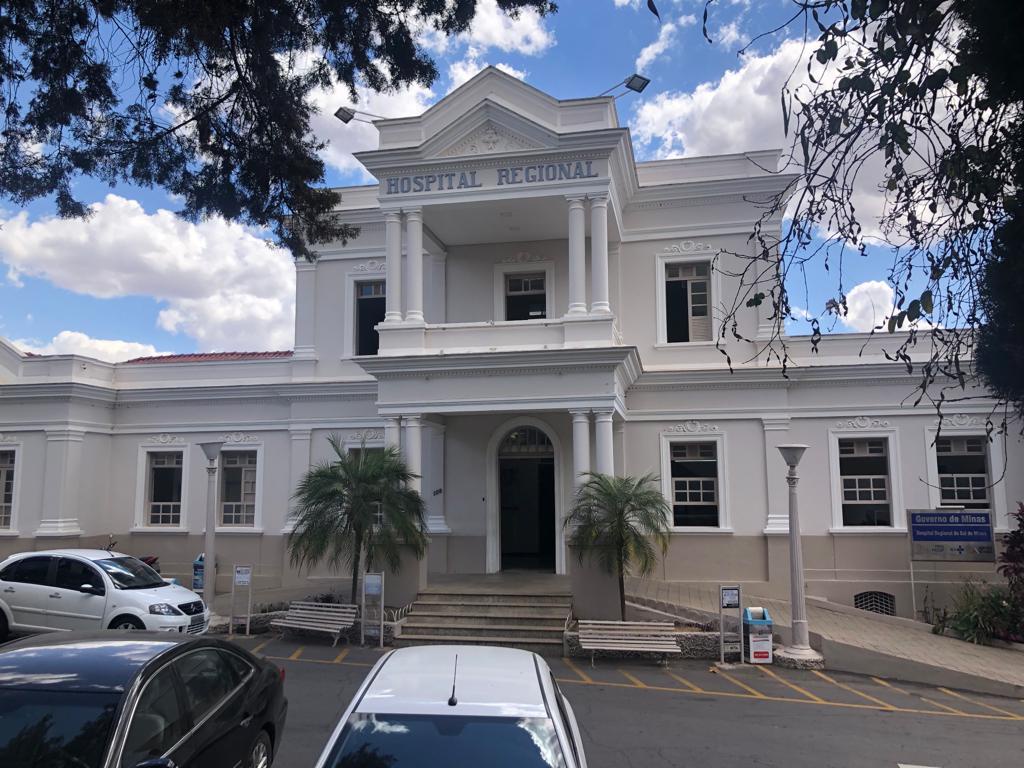
The accounts of what happened at Hospital Regional form one of the most medically detailed and, for many observers, most compelling aspects of the Varginha case. Multiple medical professionals have come forward over the years, though most have done so reluctantly and some only recently.
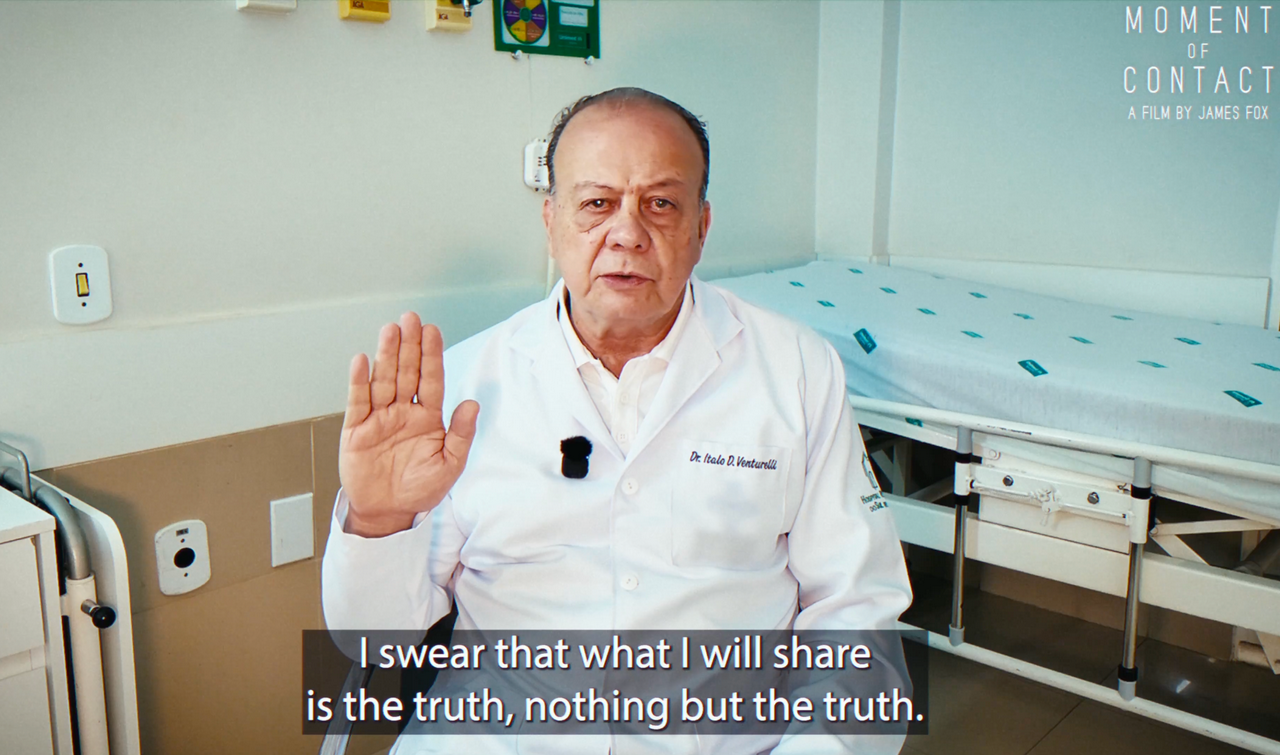
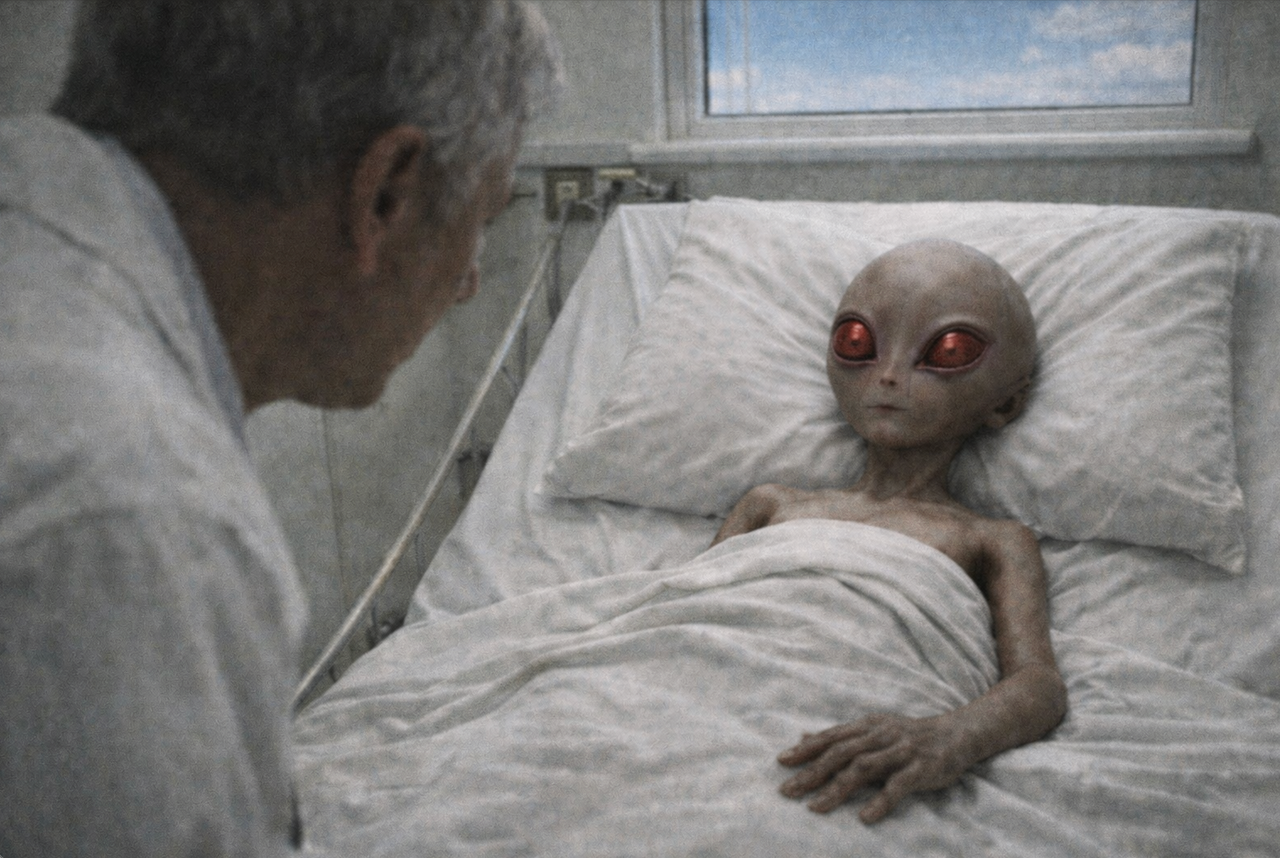
According to the testimony of Dr. Italo Venturelli, a neurosurgeon who has worked at Hospital Regional for decades, he was on duty at the hospital on January 20, 1996. A colleague pulled him aside and first showed him a brief black-and-white video, roughly 15 to 20 seconds long, depicting what appeared to be an unusual patient. He was then directed to a room where the “patient” was lying in a bed.
Dr. Italo, who did not speak publicly about his experience for nearly three decades, provided his full account to filmmaker James Fox for the first time in 2025, after a near-fatal heart attack persuaded him that the truth should be told while he was still alive to tell it. He subsequently traveled to Washington, D.C. in January 2026 to testify both in a private closed-door session with three members of the U.S. Congress and at a public press conference at the National Press Club.
His description of the being is extraordinarily specific. He said it looked roughly like a seven-year-old child. Its eyes were lilac-colored and teardrop-shaped. The cranium was also teardrop-shaped and disproportionately large. Its skin was white (notably lighter than the brown, oily skin described by the girls who saw a creature in the street). It had a slim torso with no nipples. A small mouth. A sliver of ears. Three fingers and a thumb on each hand. It was bare above the bed sheet.
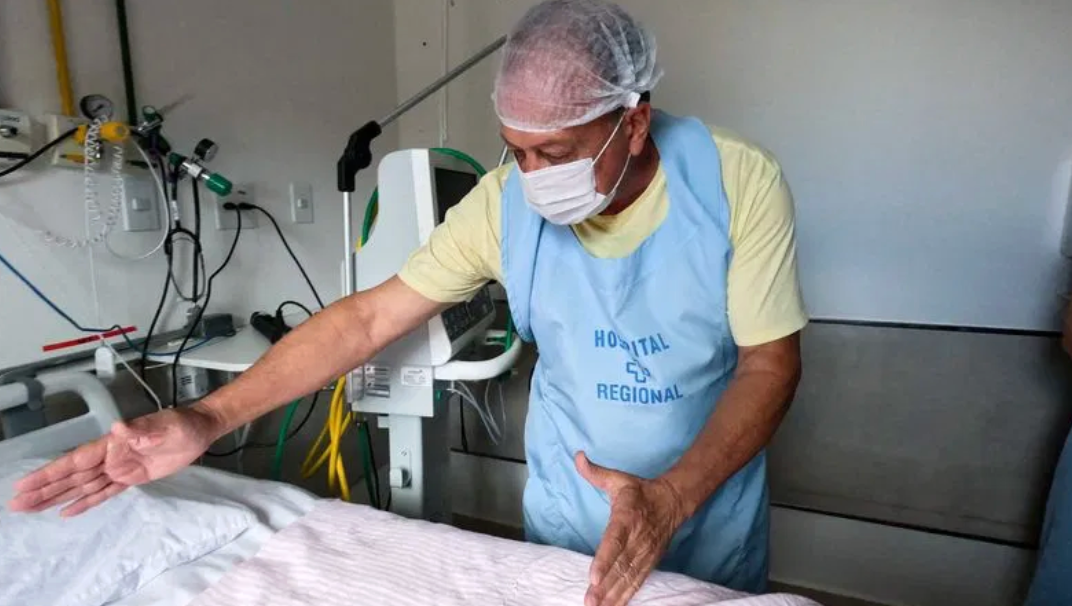
Dr. Italo Venturelli in the same room at the Hospital where he treated the “being”
“I've been a doctor for forty-six years and have performed thousands of surgeries,” Dr. Italo stated. “To me, it was obvious that this was not a human being.”
According to Dr. Italo, his colleague Dr. Marcos Vinico Neves had already treated the being, suturing a wound on its cranium. Neves died in 2018, and no medical records of this procedure are known to survive.
Dr. Italo spent three to four minutes at the bedside, having been asked to perform a visual examination. What struck him most were the eyes.
“It transmitted calm and tranquility,” he told the congressional representatives. He described a sense that the being was at peace with what was happening, and that he perceived it as possessing intelligence greater than his own. He compared the feeling to looking at an angel.
“I wouldn't say it communicated telepathically; it communicated empathetically,” he said, “through its eyes.”
At one point, the being looked at him, then looked out the window at the blue sky, and then looked back at the doctor, as if to communicate its wish to be released.
When asked by Representative Anna Paulina Luna whether other medical staff could corroborate his story, Dr. Italo said yes, but noted that most doctors are afraid to speak out because they have been threatened or fear damage to their careers.
The official version from the hospital has always been a denial. Staff members publicly stated that no unusual patient was treated at the facility. No medical records have surfaced. Dr. Adilson Usier, another physician whose name has been connected to the case, has consistently denied examining any extraterrestrial being.
However, a hospital orderly named Carlos de Souza told investigators that Dr. Usier spent over an hour in isolation room 15 on the night of January 20 and emerged looking shocked, immediately making phone calls. A nurse, who spoke to investigators in 1996 but later requested anonymity, described something being brought through the back entrance around 11:00 PM. She was told it was “a deformed animal for research purposes.” A military doctor who came out of the room reportedly told her, “This isn't from Earth.”
Hospital Humanitas
There are also accounts indicating that at least one creature was taken to the better-equipped Hospital Humanitas in Varginha, either directly or after an initial stop at Hospital Regional.
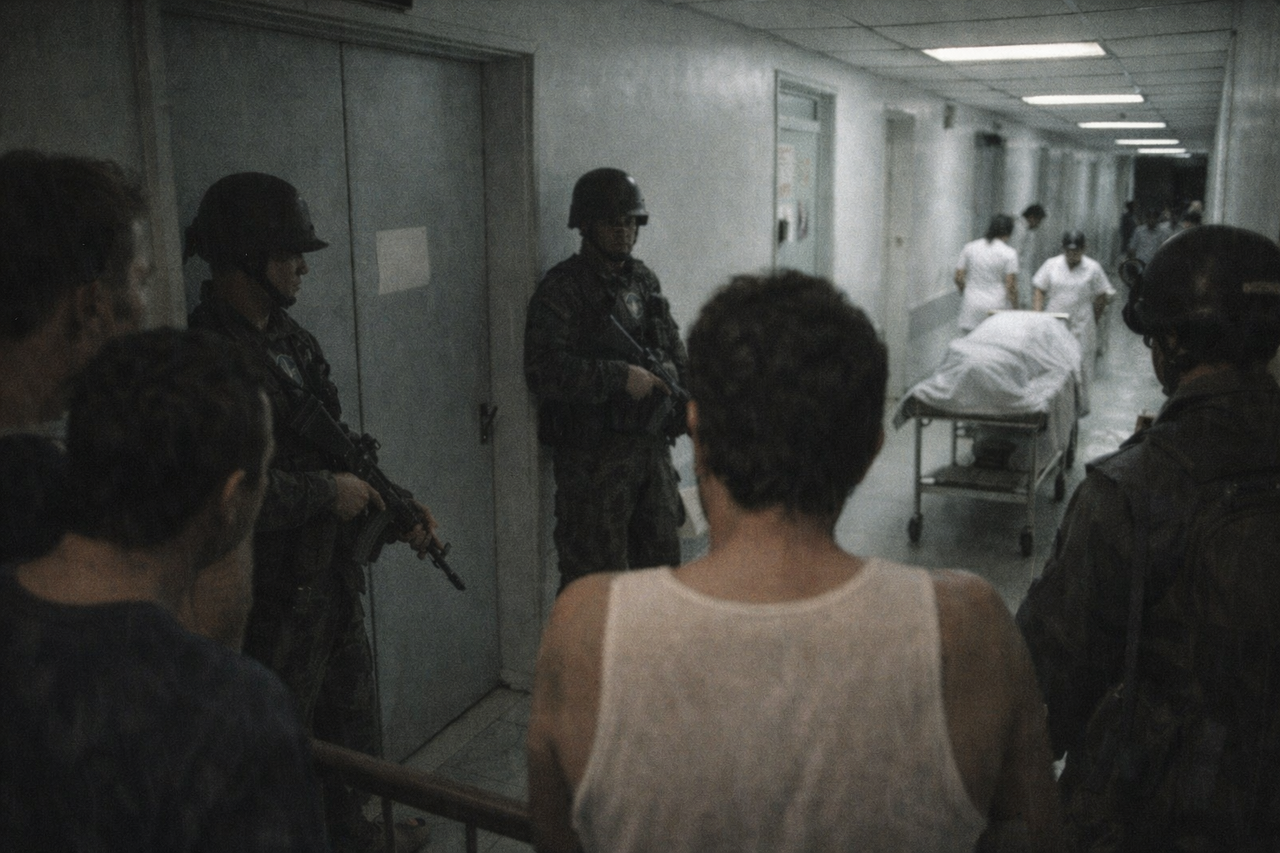
On the evening of January 22, 1996, three military trucks were reportedly seen outside Humanitas between 3:00 and 6:00 PM. Witnesses described a hospital room thick with the ammonia-like odor that had become the signature of the Varginha encounters. At least 15 doctors were allegedly present, along with firefighters and soldiers, surrounding a small wooden casket. By nightfall, the being inside was said to be dead.
American ufologist Dr. Roger Leir, who visited Varginha and published the first major English-language account of the case (UFO Crash in Brazil, 2005), reported that he interviewed a surgeon at Humanitas who said he had been instructed by armed officers to perform corrective surgery on what was described simply as “a leg.” The operating theater was sealed except for one entrance manned by armed guards. Members of the Brazilian Army's S-2 military intelligence division were present inside the room during the procedure.
The surgeon Leir interviewed, identified only as “Doctor” and granted anonymity, described a being with injuries of different kinds and severity. He was urgently called by military staff and described his astonishment at encountering something “never seen or reported before.” One of the most extraordinary claims from this unnamed surgeon is that he experienced intense telepathic communication with the being at the end of the surgery. He provided a precise physical description that aligned with those given by other witnesses.
The Question of Dr. Fortunato Badan Palhares
No discussion of the hospital angle is complete without addressing the controversial figure of Dr. Fortunato Badan Palhares, a prominent forensic pathologist associated with the University of Campinas (Unicamp).
For years, UFO researchers claimed that Palhares was the physician who performed an autopsy on one of the Varginha creatures after they were transferred to Unicamp. Palhares was a high-profile figure in Brazilian forensic medicine, known for his work on notorious criminal cases. His alleged involvement lent the Varginha case an aura of scientific credibility.
In 2012, when directly contacted by European researcher Aurimas Svitojus, Palhares categorically denied any involvement. His reply (translated from Portuguese) was unambiguous: “Unfortunately, all information about the Varginha ET involving my name are fruits of fantasy authors and do not deserve any respect from me because they are liars.” He further stated: “I did not and never was called to do absolutely anything with this matter. I am a scientist and I do not need to hide such facts if they exist. I am not connected to any intelligence or defense agencies. I am a free citizen and unhindered to speak what I want.”
This denial was seized upon by skeptics as a definitive debunking of a key pillar of the case. Believers countered that any physician involved in a classified operation would be expected to deny involvement, particularly if still under threat or oath.
Early accounts from researchers had noted that Palhares, while denying involvement, once stated he “may have more to say at a later time.” Whether this hinted at eventual disclosure or was simply a throwaway comment remains a matter of interpretation.
It is important to distinguish Dr. Fortunato Badan Palhares, whose involvement in autopsying the Varginha creatures has been denied, from Dr. Armando Fortunato, the forensic pathologist who performed the autopsy on Marco Eli Chereze. These are different individuals, despite the similar names, and their roles in the case are distinct.
The Death of Marco Eli Chereze
Of all the threads that make up the Varginha case, none is more disturbing or more resistant to easy dismissal than the fate of the 23-year-old military police corporal who allegedly captured one of the creatures with his bare hands.
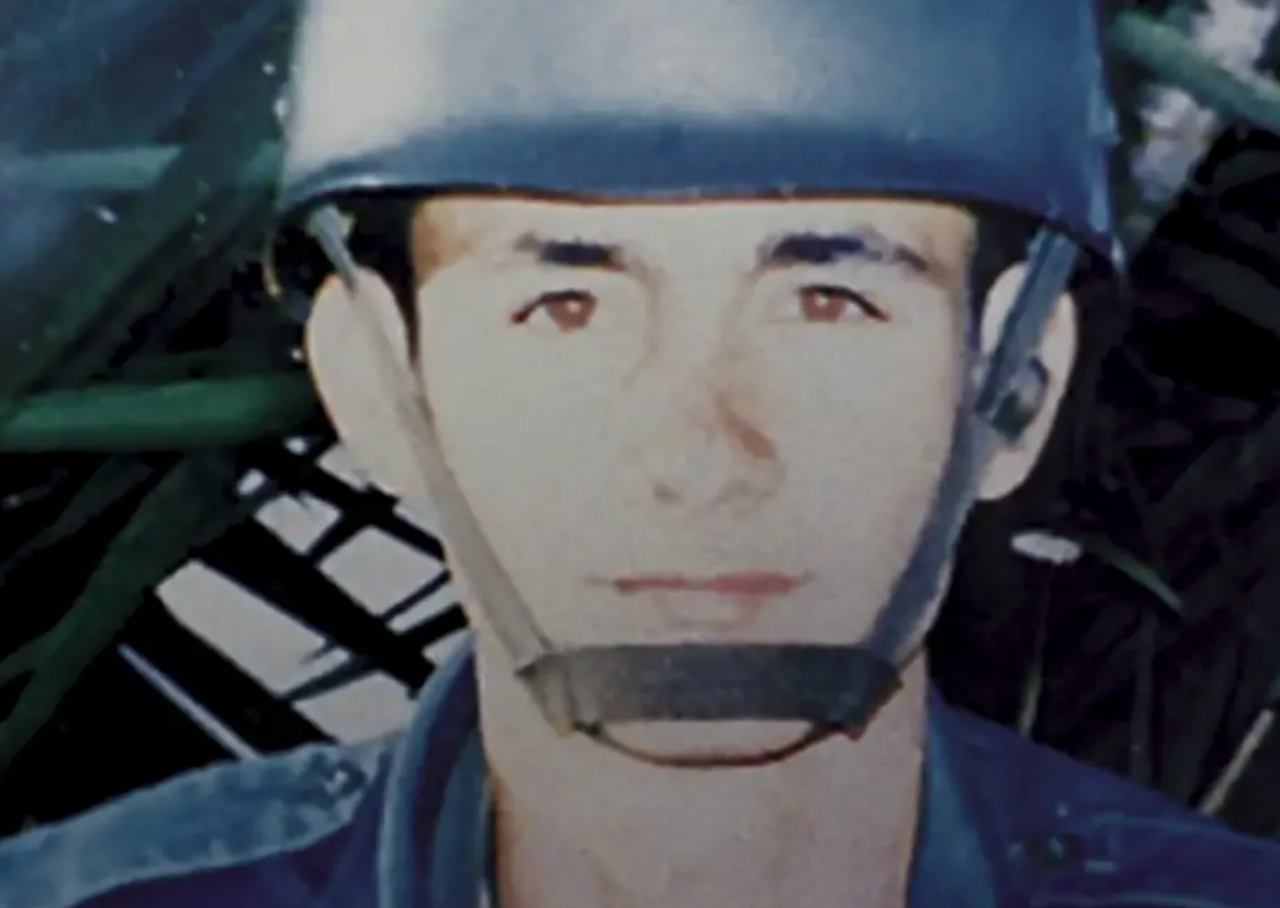
Timeline of His Illness
After the events of January 20, Chereze reportedly complained of a strange, greasy residue on his skin that would not wash off. His clothes retained a persistent ammonia-like odor. Family members and colleagues noticed that his body had become “greasy and sticky” in a way that was difficult to explain.
Within days, a small abscess or tumor, similar to a furuncle, appeared under his left armpit, near where the creature had allegedly scratched him. The official military account would later claim that this cyst was pre-existing and that surgery to remove it had been scheduled before the January 20 events. His family contests this.
On February 12, 1996, Chereze was hospitalized at Hospital Bom Pastor in Varginha, complaining of severe abdominal pain and high fever. His condition deteriorated rapidly.
On February 15, 1996, less than three days after admission, he was transferred to the Intensive Care Unit. One of his attending physicians was Dr. Cesário Lincoln Furtado. Less than five hours after the ICU transfer, Marco Eli Chereze was declared dead.
He was 23 years old. He was buried the following day, February 16, as is customary in tropical Brazil.
Cause of Death
The official cause of death was listed as sepsis, pneumonia, and a generalized infection caused by what doctors described as a “benign bacteria” whose source was never determined. The former commander of the 24th Military Police Battalion of Varginha, Maurício Antonio Santos, stated: “The death occurred due to a strong hospital infection after the operation. Former soldier Chereze was not involved in any incident with extraterrestrials.”
But the details do not sit comfortably with the official explanation.
Dr. Cesário Lincoln Furtado, who treated Chereze in his final days, gave a long interview to researcher Ubirajara Franco Rodrigues in August 2004, published in Brazilian UFO Magazine (No. 102). Furtado described an infection that was aggressive in ways he could not explain, in a patient whose age and physical condition should not have led to such a rapid death from what appeared to be a routine abscess.
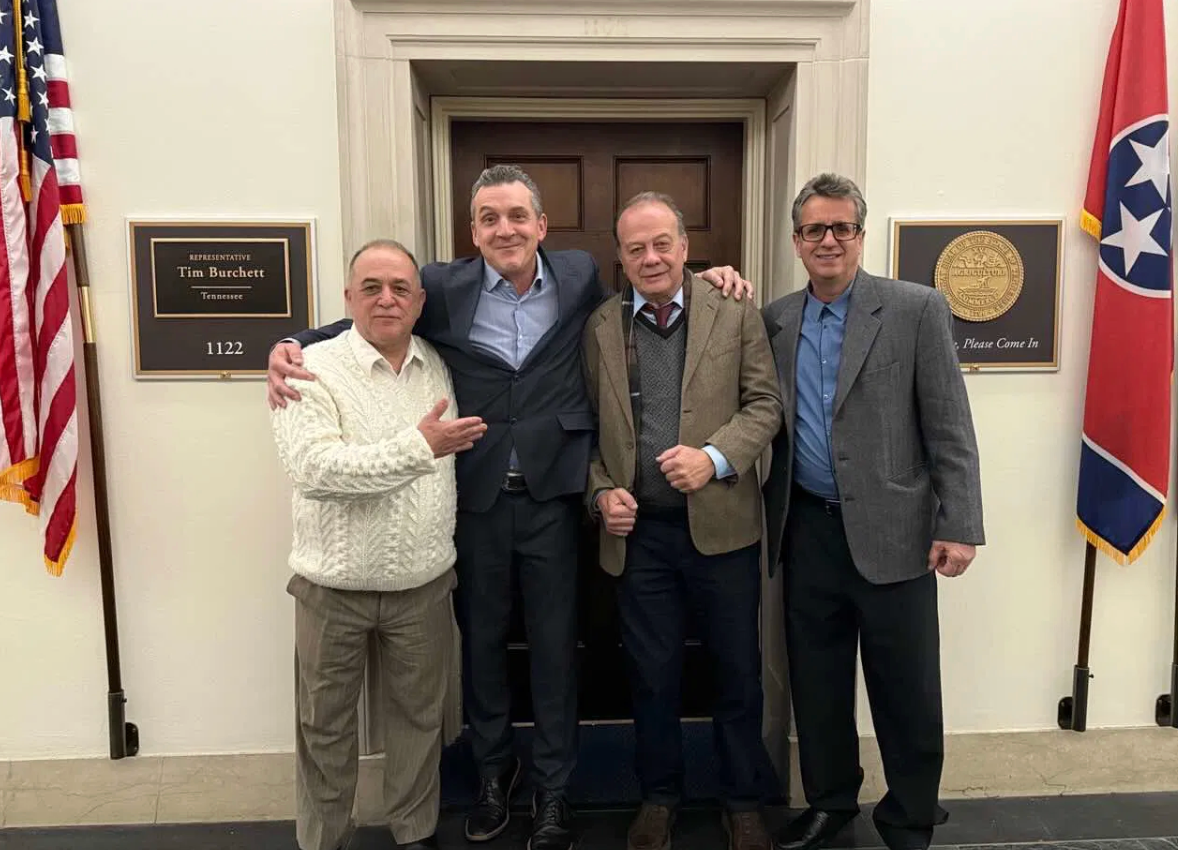
In a separate development that surfaced at the January 2026 press conference, Dr. Armando Fortunato, a forensic pathologist and criminal medical examiner for the Civil Police with over thirty years of experience, confirmed that he had performed the autopsy on Chereze. Dr. Armando presented testimony to three U.S. Congressional representatives in a closed-door meeting in Representative Tim Burchett's office on January 15, 2026.
Dr. Armando also submitted to the representatives a signed statement from Dr. João Janini, 89, a specialist in pathological anatomy who claims to have performed over 50,000 autopsies and conducted more than a million microscopic analyses during his career. Janini attested that he found a rare form of bacterium “of extremely high aggressiveness and lethality” in tissue samples from Chereze's body. The characteristics of the infection, Janini stated, went “so far beyond the limits of what is conventional” that, in his professional opinion, “it raises the hypothesis of its alien origin.”
A legal request has been filed to exhume Chereze's body with hopes of collecting bacteria or DNA samples that could undergo further analysis.
The Family's Account
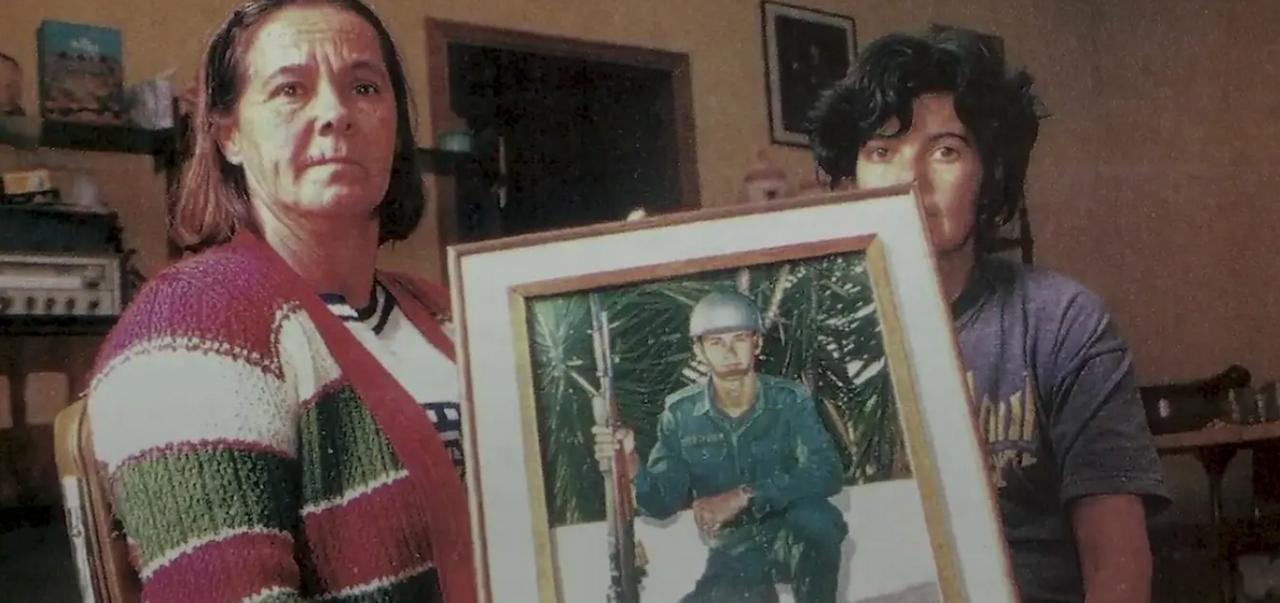
Chereze's family has never accepted the official explanation. His sister, Marta Tavares Chereze, claims that shortly after his death she went to the office of Dr. Cesário Lincoln Furtado and stated that Marco had revealed on his deathbed that he took part in a secret mission to recover an alien creature. Marta is the only person known to have heard this deathbed statement, and some family members dispute her specific claim about a confession, though the broader family unanimously insists Marco was involved in something that night and that his death was connected to it.
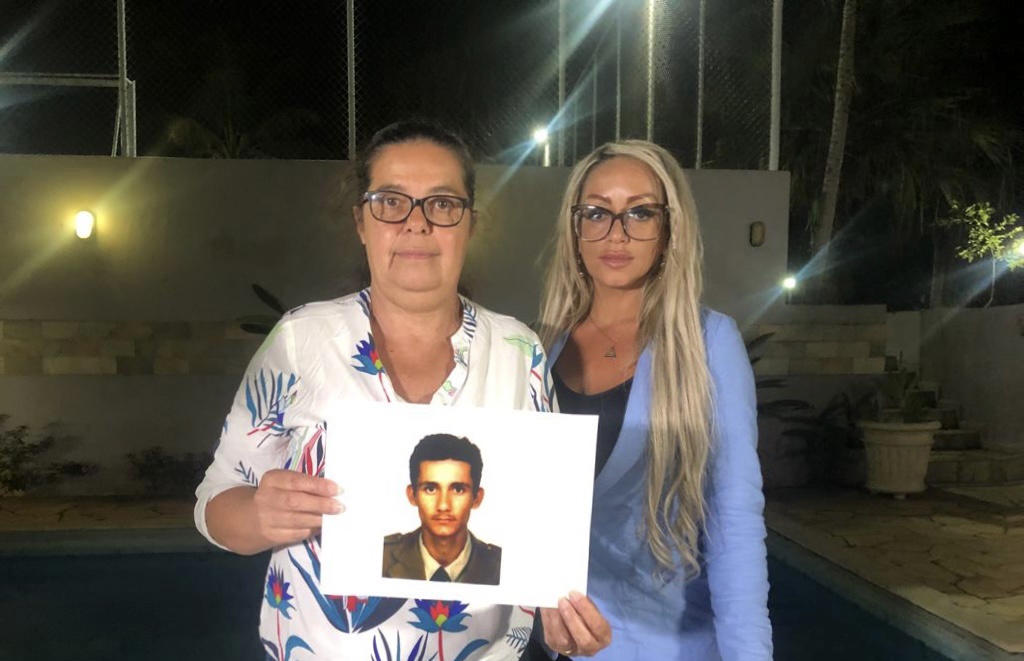
Marco's wife, Valéria, attempted to obtain her husband's complete medical records. When she finally received documents from the hospital, she discovered that pages were missing. The police superintendent who led the inquiry into the death was unable to attend the autopsy despite his insistence. The necropsy report was withheld from the family for eleven months after the burial.
Marta attempted to file a lawsuit without legal representation, claiming the hospital was responsible for Marco's death due to medical error. The case stalled.
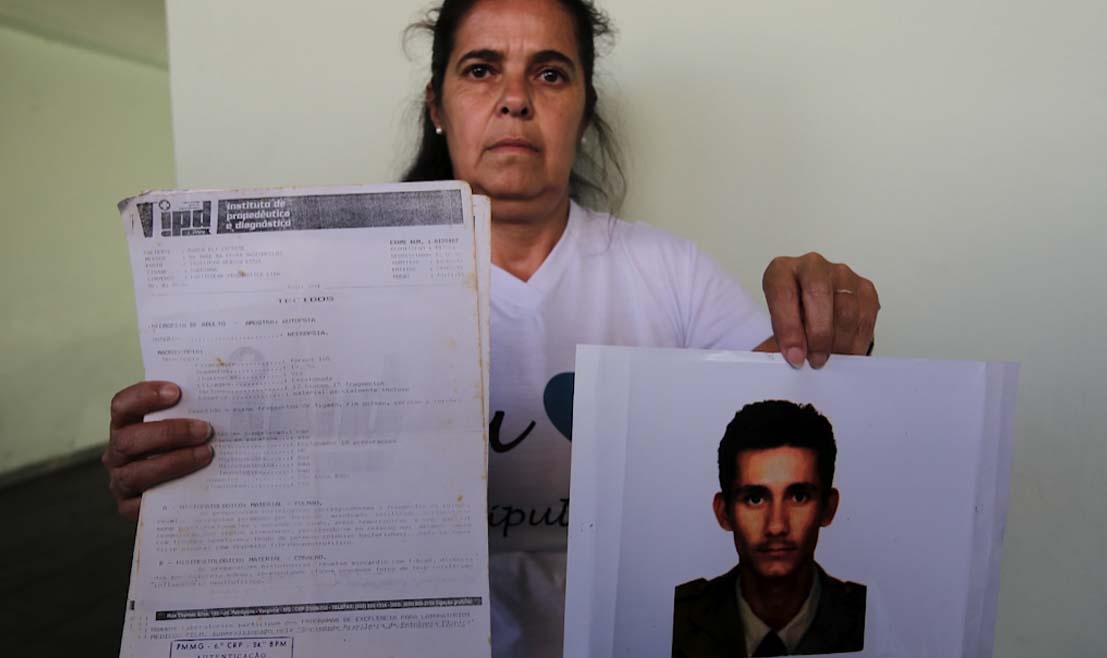
It was not until January 20, 1997, one year after the incident, that investigators publicly denounced the withholding of the autopsy report. At a press conference marking the first anniversary, the family, the police superintendent, and the press finally gained access to the file. But the questions it raised were as troubling as the silence that preceded it.
The Significance
The death of Marco Eli Chereze is the element of the Varginha case that most resists debunking. It is a verifiable death. It happened on a specific date at a specific hospital. The timeline aligns with the alleged exposure. The official explanation, a hospital infection from a routine cyst removal, is contradicted by the rapidity of the decline, the unusual nature of the bacterium, and the pattern of information suppression that followed.
James Fox, the documentary filmmaker who has spent over two decades investigating the case, has pointed to a possible theory: that the creatures were ammonia-based rather than carbon-based beings, and that derivatives of the ammonia molecule, which are extremely toxic and easily absorbed through the skin, gut, and respiratory tract, could have been responsible for Chereze's infection and death. This remains speculative, but it would explain both the omnipresent ammonia smell reported by virtually every witness and the otherwise inexplicable nature of the bacterium that killed a young, healthy man in 26 days.
Military and Government Response
The Official Position
The Brazilian military's official position on the Varginha incident has remained consistent: nothing happened. No creatures were captured. No UFOs crashed. No unusual operations were conducted.
The head of the official inquiry (an Inquérito Policial Militar, or IPM) stated that “the presence of the Firefighters in Jardim Andere, the parking of Army trucks in the vicinity of the concessionaire where their periodic maintenance would be carried out... and the departure of ESA vehicles... were real facts... incorrectly interpreted as Firefighters and the Military participating in the capture and later the transport of the alleged creature to Campinas.”
In other words: the military vehicles that residents saw throughout Varginha in January 1996 were simply delivering trucks to a garage for maintenance. There was nothing clandestine about it.
The 2010 Brazilian Army investigation concluded that the three young women had mistaken the homeless man Mudinho for an alien creature, and that all military activity in the area was routine. The investigation produced a 357-page report that has been partially released.
Lieutenant Colonel Olímpio Vanderlei Santos, who was identified by investigators as the chief of the alleged capture operation, denied involvement from his retirement home in Franca, São Paulo. “We used to go to Varginha by car because the city was our support point in terms of fleet maintenance,” he said. “There was a climate of concern, colleagues were scared at the time. I was surprised when I saw my name involved.”
Major Eduardo Calza, a military spokesman, offered what is perhaps the most colorful official explanation: the creature seen by witnesses was “an expectant dwarf couple and a mentally handicapped dwarf.”
The Brazilian Government's Broader Posture
Brazil has, in some respects, been more transparent about UFOs than many other governments. The Brazilian Air Force began declassifying its UFO files in the mid-2000s, making thousands of pages of documentation available to researchers. In 2022, Brazilian Senator Eduardo Girão led a Senate hearing on UAP (Unidentified Anomalous Phenomena) that acknowledged the seriousness of the topic.
However, on the specific matter of Varginha, the government has maintained its denial. No official from any branch of the Brazilian government has publicly acknowledged that anything extraordinary occurred in the city in January 1996.
The Americans
One of the most persistent threads in the Varginha case is the alleged involvement of the United States military in the aftermath.
A Brazilian Air Force radar operator and traffic controller named Marco Feres reportedly told investigators that on or about January 20, 1996, a U.S. Air Force cargo plane, most likely a C-17, took off from an American base and landed at Viracopos airport in Campinas to pick up unusual cargo before departing for an unknown location in the United States. Eduardo Mondini, a Brazilian researcher, found an employee at the IML (Instituto Médico Legal, the Institute of Legal Medicine) in Campinas who reported military movement inside the facility during January 20-26, involving the Army's private storage areas.
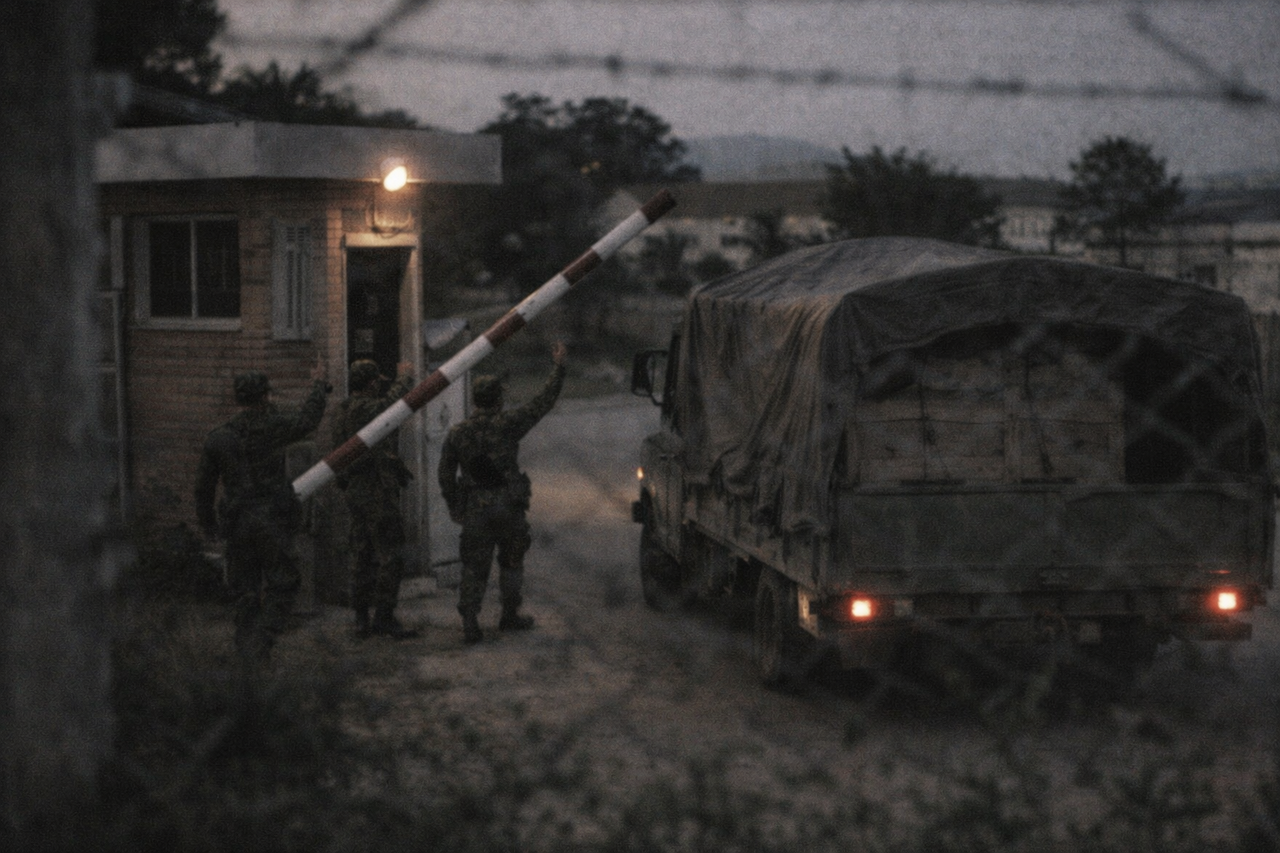
At the January 2026 press conference, retired U.S. Air Force Colonel Fred Claussen, who held a top-secret clearance, outlined ways such a mission might be documented. He noted that any cargo plane flight would require paperwork from Air Mobility Command at Scott Air Force Base in Illinois and the Air Mobility Wing at Charleston Air Force Base in South Carolina. Air refueling would generate additional records, as would an international flight plan to Brazil, even if the mission were classified. At Campinas, there would be refueling records and another international flight plan.
“Even without a paper trail,” Claussen stated, “thirty to forty Americans involved with the operation should have direct knowledge of this flight and its purpose. Here is my plea: if you were a participant and have knowledge of this mission, come forward.”
Representative Anna Paulina Luna, who attended the closed-door meeting with the Brazilian witnesses, suggested Congress should seek Air Force flight logs and landing permits to confirm or deny any American retrieval operation. Whether such a paper trail exists remains unknown.
Dr. Roger Leir reported being shown authenticated documents concerning agreements between Brazil and the United States that allow “any material coming from space that is found in Brazil to be turned over to the government of the United States.” In the weeks following the incident, a surprise visit to Brazil was paid by Warren Christopher and Daniel S. Goldin, who were at the time the U.S. Secretary of State and the Director of NASA, respectively. The timing may be coincidental. It may not.
An anonymous Brazilian military witness provided a videotaped statement for the January 2026 press conference, his face obscured, stating that he was in the army in 1996 and helped transport the being from the hospital in Varginha to Três Corações and from there to Campinas, where other soldiers took over. Upon returning to Três Corações, he said, “There was talk the Americans had the creature, having transported it to an undisclosed location.”
Other Witnesses and Ancillary Events
The Varginha Zoo
A series of events at the Varginha Zoo has been linked, at least speculatively, to the broader incident.
On the evening of April 21, 1996, roughly three months after the main events, 67-year-old Terezinha Gallo Clepf was attending a birthday party at a restaurant located within the grounds of the Varginha Zoo. She stepped out onto the restaurant's covered porch to smoke a cigarette when she felt that someone was watching her. Turning to her left, she came face to face with a creature she could not identify.
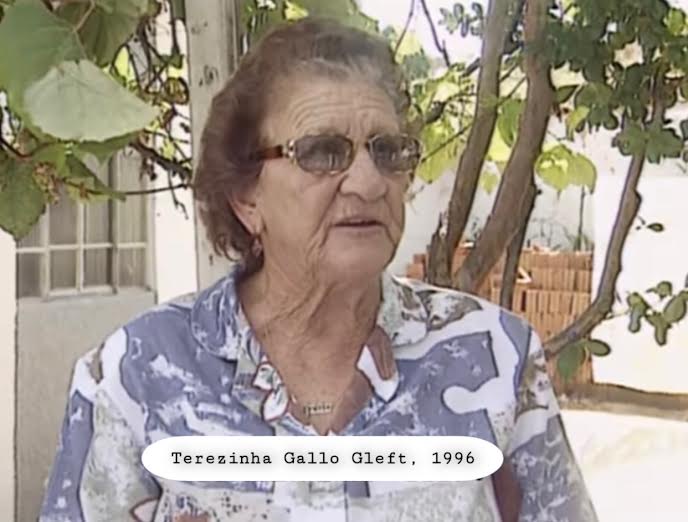
She described it as having oily skin, dark and brilliantly brown in color, with red eyes and just a slit where the lips should be. It was approximately seven meters (about 23 feet) away, staring directly at her. She observed it for roughly five minutes before retreating inside the restaurant to collect her thoughts. When she went back out, the creature was still there. Clepf's description matched earlier accounts provided by the girls and other witnesses.
In the weeks and months following this sighting, several animals at the zoo died under unexplained circumstances. Accounts vary regarding the exact number and species, but multiple sources cite a tapir, an ocelot (or jaguar), and two deer. Some accounts add a blue macaw to the list, bringing the total to five. The zoo's veterinarian, Dr. Marcos Mina, removed the animals' viscera and sent them to a laboratory, where an unidentified toxic substance was reportedly found. The deaths were officially diagnosed as “caustic intoxication,” and zoo authorities discouraged speculation about any connection to an alien pathogen.
The connection between the zoo animal deaths and the Varginha creatures is unproven. The timing is suggestive but the months-long gap between the main events and the animal deaths makes a direct causal link difficult to establish.
Intimidation of Witnesses
Multiple witnesses reported being visited by strangers who attempted to silence them through threats or bribes.
Luiza Helena da Silva, the mother of sisters Liliane and Valquíria, stated that she was visited by four men dressed in black suits who offered her a briefcase filled with cash if her daughters would go on television and claim the creature they saw was actually a calf, a sick dog, or a sick human being. She refused and threatened to call the police. The men left. She described them as foreigners.
Carlos de Sousa, whose encounter at the crash site is described in detail earlier in this account, was threatened at gunpoint at the scene and then intercepted by men in a dark vehicle who knew his personal details and threatened his family.
Vitório Pacaccini, one of the primary investigators, claimed that after accusing the military of a cover-up, his car was driven off the road on four separate occasions. On the fourth attempt, two shots were fired at his vehicle.
Local news reporter Nyei Nadeia, who was a friend of the police commissioner handling the case, attempted to investigate the scene and found that the military had set up a blockade. When he approached, a soldier told him he could not pass. When he asked why, the response was: “It's a matter of national security.”
The Couple Who Saw a Creature at Night
Additional accounts describe a couple who reported seeing a creature of similar description crossing a road at night. The being allegedly shielded its red eyes from their headlights. Details on this particular sighting are thinner than the others, and the couple's identities have not been widely publicized, but the account is consistent with the pattern of sightings during this period.
Rosangela Ramos and the Chief of Police
In one of the most recent developments, on January 26, 2026, a woman named Rosangela Ramos appeared on camera with James Fox. She stated that her late husband, Pedro Luiz Aguiar, was the chief of police in Três Corações in 1996 and had been on duty during the incident. He claimed to have also witnessed the creature, though Ramos had no further details about the specific circumstances. Aguiar died in December 2025, taking whatever he knew to his grave.
Key Researchers and Investigators
Ubirajara Franco Rodrigues
Ubirajara Franco Rodrigues was a lawyer, law professor, and ufologist who became the primary on-the-ground investigator of the Varginha case. He applied legal methodology to witness evaluation and collected over 15 video-recorded testimonies from military and civilian sources. He was the first researcher to interview the three girls after their sighting and found them still visibly traumatized.
Rodrigues worked methodically, tracking down death records, locating Chereze's family, and compiling a detailed timeline of events. He was the one who obtained Dr. Cesário Lincoln Furtado's critical interview about Chereze's treatment and death. His 2001 book, O Caso Varginha, remains one of the foundational texts on the case.
In a notable turn, Rodrigues became more skeptical over time. In later years, he was “brought back to the scene” on what he described as the opposite front, dismissing the main military witness and rebutting claims that Marco Eli Chereze had made a deathbed confession. He stated publicly: “There is no proof that an extraterrestrial being was captured in Varginha. People said that they saw, that they touched an extraterrestrial, but this does not serve as scientific proof. At that time, our tendency was to believe that it was a being from another planet.”
Rodrigues's shift from believer to skeptic has been interpreted both as intellectual honesty and as evidence of pressure to recant. The truth likely lies somewhere in between.
Vitório Pacaccini
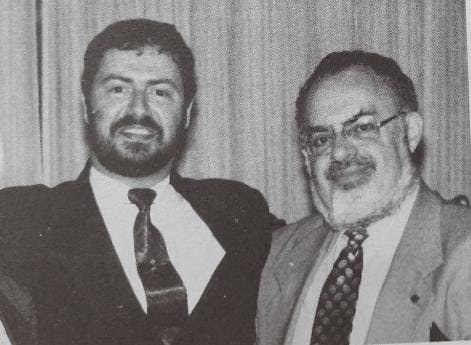
Vitório Pacaccini and Stanton Terry Friedman , 1996.
Vitório Pacaccini was an Italian-Brazilian engineer with over 30 years of UFO research experience who became the case's most vocal public advocate. He reportedly lived in Varginha for approximately two years conducting full-time investigation. He claimed to have videotaped interviews with at least seven military officers, which he kept in secure locations.
Pacaccini was the one who first publicized the NORAD/CINDACTA connection and who named Lieutenant Colonel Olímpio Wanderley Santos as the chief of the capture operation. He was a tireless promoter of the case but also a polarizing figure whose aggressive style alienated some fellow researchers.
After years of relative silence, Pacaccini resurfaced shortly after the announcement of the Moment of Contact documentary. He served as a consultant for the Varginha ET Museum, which was inaugurated in November 2022.
He has also claimed to have watched a “very definitive and detailed” video of the Varginha creature, reportedly 35 seconds in length, back in 2012.
A.J. Gevaerd and Brazilian UFO Magazine
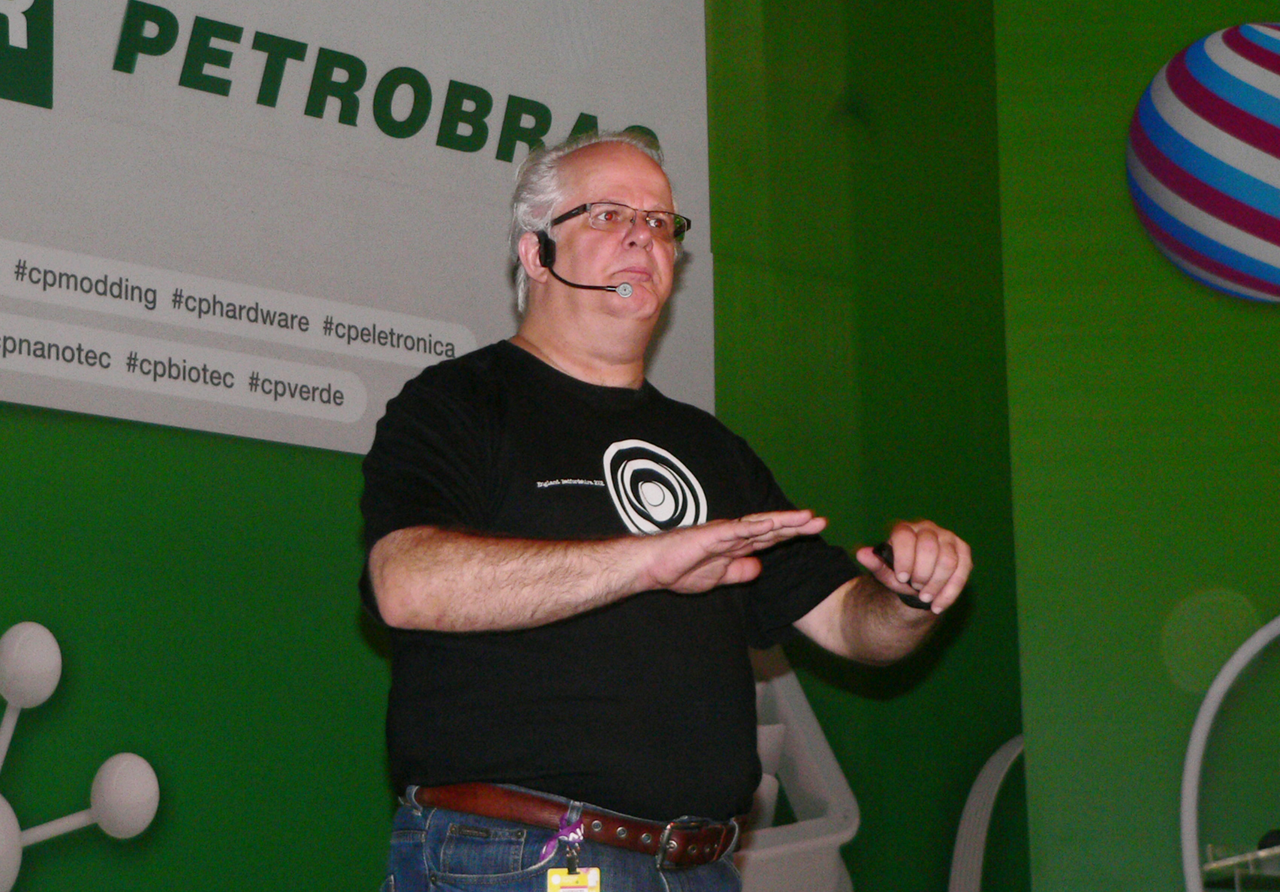
Ademar José Gevaerd, editor of the Brazilian UFO Magazine and the Brazilian UFO Network, played a central role in bringing the case to national and international attention. He published extensive investigative pieces, facilitated the release of key testimonies including the Dr. Furtado interview, and served as a bridge between Brazilian researchers and the international UFO community.
International Investigators
The case attracted serious investigators from outside Brazil. Bob Pratt, the former National Enquirer UFO desk chief, made multiple trips to Brazil. Dr. John Mack, the Harvard Medical School professor, Pulitzer Prize winner, and alien abduction researcher, took a personal interest. Stanton Friedman, the nuclear physicist who helped bring the Roswell case to public attention, investigated alongside Birdsall and contributed to early international coverage. John Carpenter, a U.S. abduction researcher, judged the case after interviewing witnesses as “a darn good one” that might stand “equal to Roswell” in its weight of converging testimony.
Dr. Roger Leir, an American surgeon and ufologist, made the first substantial English-language contribution with his 2005 book UFO Crash in Brazil, based on extensive interviews with military officials, hospital surgeons, and civilian witnesses.
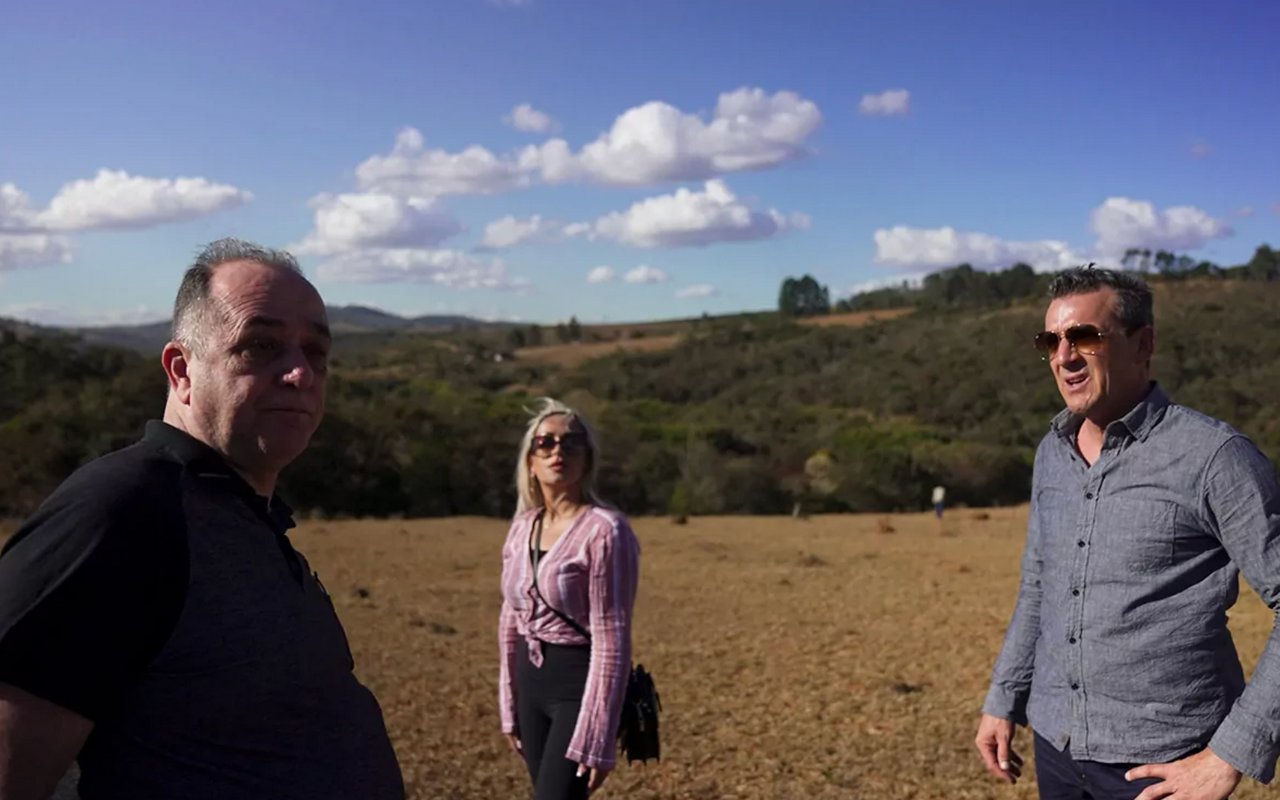
James Fox and Marco Aurelio Leal
Developments Over the Decades
The Late 1990s
The Varginha case exploded into Brazilian media almost immediately. Fantástico, Brazil's biggest television show at the time (with 52-60% viewership share), ran segments on the “ET de Varginha.” The story made national headlines and drew both fascination and ridicule. International UFO researchers began arriving in Varginha within months.
The Brazilian military conducted its IPM investigation. The family of Marco Eli Chereze fought for access to his autopsy report. Researchers scrambled to document witness testimony before memories faded or people were silenced.
By the late 1990s, the core narrative had been established: a possible UFO crash, multiple creature sightings, military captures, hospital involvement, and a suspicious death. But hard evidence, photographs, video, medical records, physical samples, remained elusive.
The 2000s
The case entered a quieter phase. The three girls declined to give further unpaid interviews. Some researchers moved on. Varginha began to lean into its UFO identity, investing in themed tourism infrastructure. A 20-meter tall spaceship-shaped water tower was erected in the town center. Bus stops were designed to look like flying saucers. A UFO museum was planned and partially funded but construction stalled, leaving what locals described as a “rusty skeleton of a spaceship surrounded by weeds.”
Roger Leir published his book in 2005, providing the most comprehensive English-language account to date. New witnesses trickled forward but no breakthrough evidence emerged.
The 2010s
The Brazilian Army's 357-page investigation report, concluded around 2010, offered its official explanations: Mudinho, routine military maintenance, mass misidentification. Skeptics pointed to the report as definitive. Believers argued it was a whitewash.
In 2012, Dr. Badan Palhares's emphatic denial of involvement was published, dealing a blow to the narrative that he had performed an alien autopsy. The same year, Pacaccini claimed to have seen video evidence of the creature.
2022: Moment of Contact
James Fox's documentary Moment of Contact, released in October 2022, was a watershed moment for the case. For the first time, a polished, professionally produced film brought the Varginha story to a global English-speaking audience. It featured Carlos de Sousa breaking his 26-year silence on camera, along with other new witness testimony and claims of continued cover-up.
The film concluded with testimony that the crashed UFO and recovered beings were ultimately loaded onto a USAF cargo plane at Campinas and transported to the United States. It also featured retired Brazilian Air Force General José Carlos Pereira, who told Fox: “Governments tend to cover up everything they can't explain to their population.”
The documentary received mixed reviews. Some praised its witness-driven approach and emotional impact. Others criticized it for a lack of hard evidence. But its effect on bringing the case to international attention was undeniable.
2025: New Documentaries and Continued Investigation
In 2025, two significant developments occurred. Fox produced an expanded version of his documentary, New Revelations of Alien Encounters, incorporating testimony from Dr. Italo Venturelli and other new witnesses. Separately, Brazilian directors Ricardo Calil and Paulo Gonçalves produced O Mistério de Varginha (The Mystery of Varginha) for Rede Globo, one of Brazil's largest media networks, bringing renewed domestic attention to the case.
Newly released fire department documents obtained under Brazil's Access to Information Law revealed the suspicious gaps in the official record for January 20, 1996, adding another layer to the case.
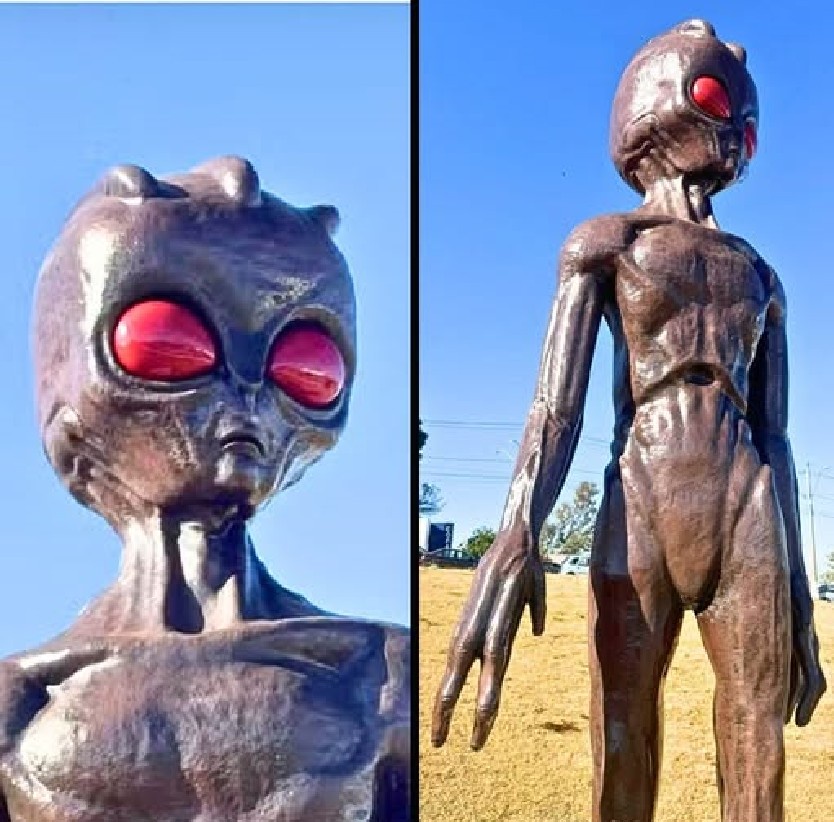
In September 2025, the city of Varginha installed a 4-meter (13-foot) tall alien statue created by artist Renato Criaturas, further cementing the city's identity as Brazil's “UFO capital.”
January 2026: The Thirtieth Anniversary and Capitol Hill
The most dramatic recent development came in January 2026, exactly thirty years after the original incident. James Fox organized a two-part event in Washington, D.C. that represented the most significant public airing of the Varginha case in its history.
The Closed-Door Congressional Meeting (January 15, 2026)
On January 15, Fox brought three Brazilian witnesses to a private meeting in the office of Representative Tim Burchett (R-TN). In attendance were Burchett, Representative Anna Paulina Luna (R-FL, chairwoman of the House Task Force on the Declassification of Federal Secrets), and Representative Eric Burlison (R-MO), along with staff members. Two Democrats with longstanding interest in UAP issues, Jared Moskowitz (D-FL) and Andre Carson (D-IN), were invited but unable to attend. Also present were journalists Leslie Kean and Ralph Blumenthal, who had exclusive media access to the event.
The three witnesses who testified were Dr. Italo Venturelli (the neurosurgeon), Dr. Armando Fortunato (the forensic pathologist who autopsied Chereze), and Carlos de Sousa (the geography teacher and crash witness).
“Can you take it from the top?” Luna asked Dr. Italo at the beginning of the meeting. “Who brought the being in? I want detail about what the interaction was, from point A to point B.”
Burchett pressed on communication: “Was the being able to communicate in any way? Was it telepathic or anything like that?”
Dr. Italo's testimony was detailed and emotional. He described the being's lilac eyes, its calm demeanor, his sense that it possessed intelligence greater than his own. He told the representatives that he had learned the being was taken from the hospital to the ESA military base, then to Campinas, and then to the United States.
Burlison asked if other medical staff could corroborate. “It's very important to get the others,” he said.
The National Press Club Conference (January 20, 2026)
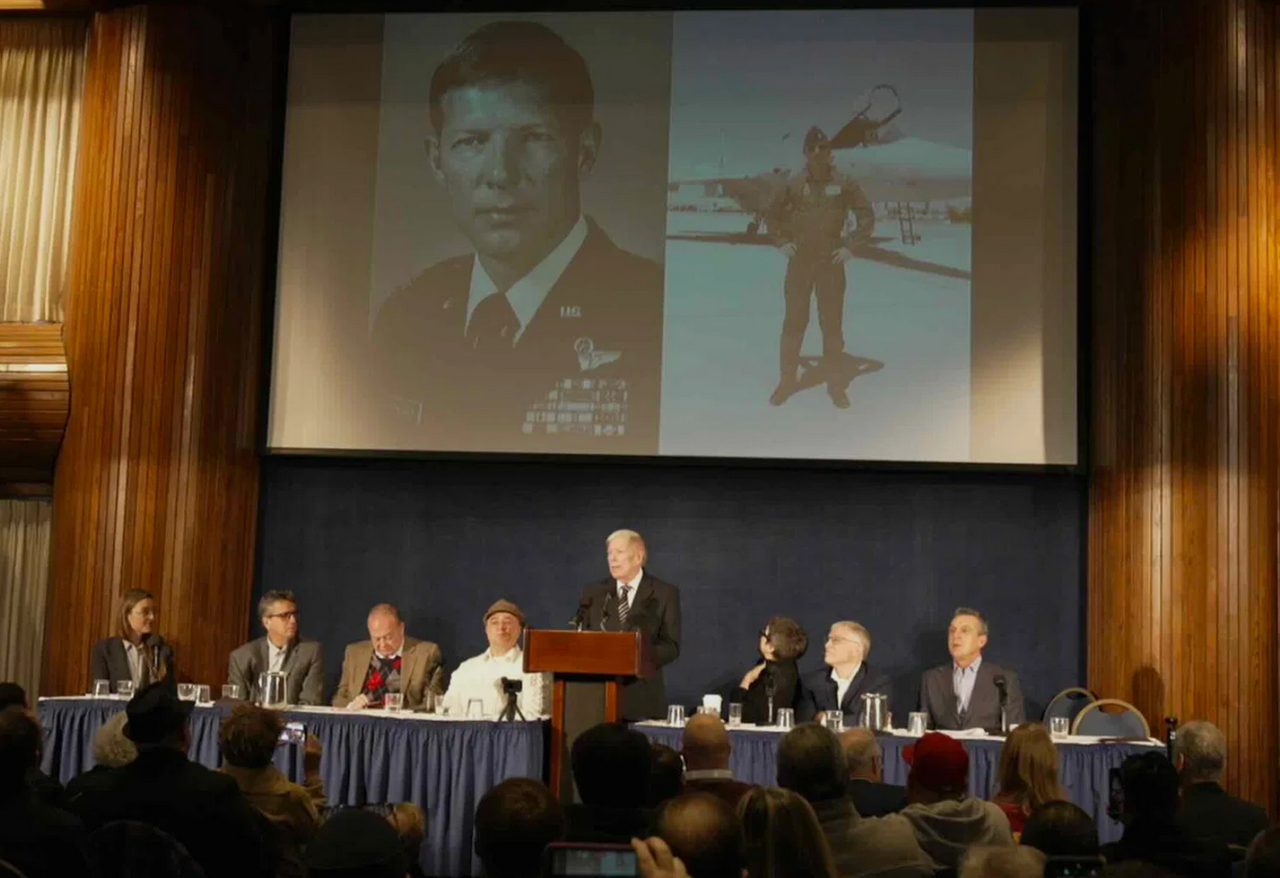
Retired U.S. Air Force Col. Fred Claussen speaks at the National Press Club in Washington, D. C. on Jan. 20, the 30th anniversary of the Varginha incident
Five days later, on the exact thirtieth anniversary of the incident, Fox held a public press conference at the National Press Club.
Six additional Brazilian witnesses had been denied entry to the United States by the State Department on the grounds that they might overstay their visas. In response, Fox and his producing partner Aline Kras traveled to Brazil in December 2025 to compile their testimonies on videotape. These were screened at the conference.
The video statements included fresh testimony from Liliane Silva, Valquíria Silva, and Kátia Xavier, whose descriptions remained unchanged after three decades. Luiza Helena da Silva, their mother, described the V-shaped footprint, the lingering ammonia smell, and the visit from the four men in black who offered cash for the family's silence.
Kirk McConnell, a 37-year veteran of the Senate Armed Services Committee, the Senate Intelligence Committee, and the House Intelligence Committee who retired in early 2024, opened the event. He revealed that reports similar to those from the Varginha case had reached senators and staff during their UAP investigations. The interested senators, who included now-Secretary of State Marco Rubio, had held meetings in sensitive compartmented intelligence facilities “with very credible sources reporting both direct and secondhand knowledge of the reality of highly intelligent nonhuman beings, government retrievals and reverse engineering of craft not made by human beings, and the recovery of bodies of non-human beings.”
“So what these folks are going to tell you today are astounding,” McConnell said, “but they're not the only credible testimony about such events.”
Jacques Vallée, the French-American computer scientist who has worked on projects at NASA and DARPA, provided a video statement citing a “data warehouse system” compiled for the Defense Intelligence Agency containing over 200,000 reports of anomalous objects in flight, plus “hundreds of reports of creatures, live or dead, associated with crashed or landed vehicles of unknown provenance, including some similar to those in Varginha.”
Brazilian Senator Eduardo Girão came to Washington to meet with members of Congress and attended the event. He and Burlison discussed the need for a joint Brazilian-American effort to acquire tangible evidence.
Representative Burlison, who had flown in from Missouri at 4:00 AM to attend, delivered the press conference's most quoted line: “If there's any government that's holding information about the knowledge of whether or not we are alone or not alone in the universe, that is not for any government, no matter how powerful it is, to withhold from the rest of humanity.”
Where the Case Stands Now
As of early 2026, the Varginha case remains exactly what it has been for thirty years: extraordinarily compelling testimony from dozens of independent witnesses, unsupported by the kind of physical evidence that would settle the matter beyond dispute.
What Exists
Over two dozen witnesses to various aspects of the case have come forward independently, providing pieces of a puzzle that seem to fit together. These include three young women who saw a creature in a vacant lot, a geography teacher who witnessed a crash, a neurosurgeon who examined a being in a hospital bed, a forensic pathologist who autopsied a young policeman who died of an inexplicable infection, military personnel who transported something from Varginha to Campinas, and civilians who saw convoys, blockades, and creatures in places they should not have been.
The descriptions are specific and consistent across witnesses who had no contact with each other. The smell of ammonia. The oily brown skin. The large red or lilac eyes. The three protuberances on the head. The three-fingered hands. The sense that the being was intelligent, suffering, and afraid.
The death of Marco Eli Chereze is documented and real. His rapid decline from a seemingly healthy 23-year-old to dead in 26 days remains medically suspicious. The bacterium that killed him has been described by a pathologist with 50,000 autopsies to his name as unlike anything he has seen.
The gaps in fire department records for January 20, 1996, are documented and real. The intimidation of witnesses, while harder to prove, is reported by multiple unrelated sources.
What Does Not Exist (Yet)
No photograph of a Varginha creature has been publicly released. No video has surfaced, though Fox claims to know the identities of people who possess such footage. No medical records from the hospitals have been produced. No physical evidence, no material from the alleged crash, no biological sample from the creatures, has been presented to the public or the scientific community.
Fox has stated that he “never gives up” on obtaining the alleged video evidence. A legal effort to exhume Marco Eli Chereze's body for further analysis has been filed.
The Skeptical View
Skeptics point to the complete lack of physical evidence as fatal to the case. Brian Dunning has called it “the most compelling example of a case where literally nothing at all happened that was remotely unusual” that was “magnified into a case considered unassailable proof of alien visitation.” The official investigation's explanation of Mudinho as the misidentified creature, combined with routine military maintenance as the explanation for the vehicle activity, provides a prosaic account that does not require invoking extraterrestrial visitors.
One of the original girl witnesses reportedly converted to an evangelical religion and dismissed the incident as “youthful folly,” though the other two have maintained their accounts consistently.
Spanish investigator J.J. Benítez's claim of discovering landing marks from a spacecraft near Varginha was debunked by engineer Claudeir Covo, who determined the marks were holes made by a vertical digger and remnants of removed termite mounds.
The Believer's View
Proponents argue that the sheer number and consistency of witnesses over three decades is itself a form of evidence. They point to the professional credentials of those who have come forward, particularly Dr. Italo Venturelli, a practicing neurosurgeon who still works at the hospital where the events occurred and who has no obvious motive to fabricate a story that could destroy his career.
They note that the official investigation's Mudinho explanation was rejected by the very witnesses it was supposed to explain, all of whom knew the man personally. They highlight the death of Marco Eli Chereze as something that simply cannot be hand-waved away. And they point to the pattern of intimidation, record-tampering, and official denial as consistent with a cover-up, not with nothing having happened.
Jacques Vallée's database for the Defense Intelligence Agency, containing hundreds of reports of creatures associated with crashed vehicles, provides a broader context in which Varginha is not an isolated anomaly but one of many similar cases, most of which remain classified.
Looking Forward
The January 2026 events in Washington represented a new phase for the case. For the first time, Varginha witnesses testified directly to U.S. Congressional representatives. The involvement of Kirk McConnell, a senior Congressional staffer who confirmed that similar reports had reached senators during classified briefings, placed the case within the broader UAP disclosure conversation that has been building since David Grusch's 2023 testimony about U.S. crash retrieval programs.
The prospect of a joint Brazilian-American evidence-seeking operation, discussed by Senator Girão and Representative Burlison at the press conference, could represent a path toward the kind of documentation the case has always lacked.
Colonel Claussen's identification of specific paper trails, Air Mobility Command records, international flight plans, refueling logs, that would confirm or deny a U.S. military retrieval operation provides a concrete investigative roadmap for anyone with the authority to follow it.
Whether the evidence will surface before the witnesses, now aging into their fifties, sixties, and beyond, are no longer able to tell their stories is an open question. Dr. Marcos Vinico Neves, the physician who reportedly treated the creature at Hospital Regional, died in 2018. Pedro Luiz Aguiar, the chief of police in Três Corações who allegedly witnessed the creature, died in December 2025. Roger Leir, who wrote the first major English-language account, passed away in 2014. Graham Birdsall, who compiled the earliest Western timeline, died in 2003.
The clock is ticking.
Conclusion
Thirty years after the events of January 1996, Varginha remains one of the most thoroughly investigated and hotly debated UFO cases in history. It has everything: multiple independent witnesses, specific physical descriptions that remain consistent across decades, credible medical professionals willing to stake their reputations on their testimony, a documented death under suspicious circumstances, evidence of record tampering, reports of witness intimidation, and an alleged American retrieval operation that might still be traceable through military records.
What it does not have is proof. Not the kind of proof that would survive peer review, not the kind that would settle a court case, not the kind that would force the Brazilian or American governments to acknowledge what happened.
But the witnesses are still talking. New ones are still coming forward. And for the first time in three decades, the people who say they saw something in Varginha are being heard not just by UFO researchers and documentary filmmakers, but by the legislative bodies of two nations.
Something happened in Varginha in January 1996. What exactly that something was remains, for now, an open question. But after thirty years of silence, threats, ridicule, and denial, the question is being asked louder than ever.
Read Part 2 Here
Check my other posts
Was Flight MH370 Teleported?
My detailed analysis of the plane and orb teleportation videos that some people have linked to the disappearance of MH370.
Why Is Skinny Bob Still Blinking at Us?
A look at the “Skinny Bob” alien footage, where I break down why it’s so strangely convincing, what’s likely fabricated, and why the videos still spark debates years later.
Did a 2024 Forgotten Languages Post Foreshadow The Nordic Drone Crisis?
A breakdown of a cryptic Forgotten Languages post about a supposed drone strike simulation off New Jersey, and how its details later echoed the real drone shutdowns across Denmark, Norway, and Germany. I compare the timeline, the political backdrop, and the odd overlap between fiction, leaks, and NATO airspace incidents.
The “Flyby” UFO Footage: And Why It Refuses to Fade Away
A deep dive into the 2008 “Flyby” UFO video, where a disc-shaped object appears to following an airliner (or jet?), and why this short, grainy clip still sits in that uncomfortable space between what is could be a clever hoax, or genuinely a real UFO.
Best UFO Photos of All Time
A collection of some of the best and most famous UFO photos ever taken. Looking at who took them, how they’ve been debunked or defended, and why a handful of images still sit in that annoying space between “obvious hoax” and “if this is real, everything changes.”
Follow me on X for more updates.